
Western dwarf mistletoe
Arceuthobium occidentale
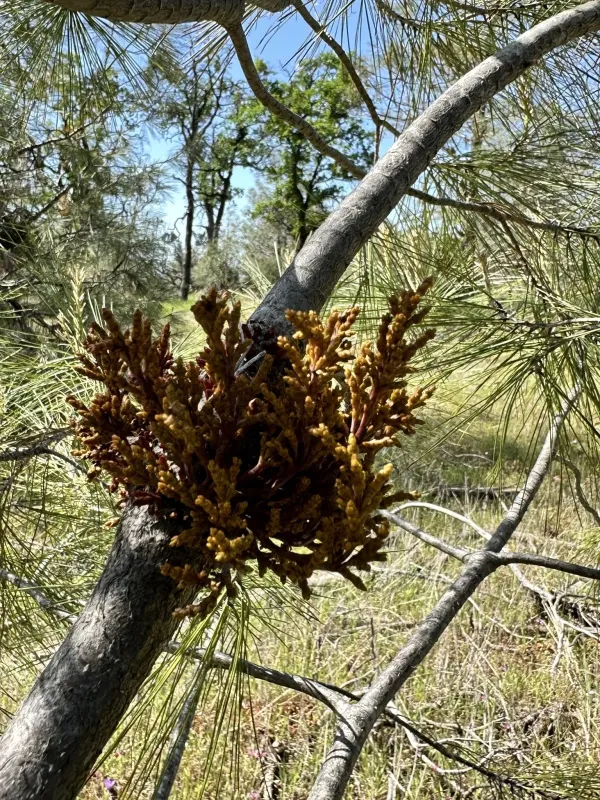
Description
Sowing dates
The western dwarf mistletoe is not a cultivated crop but an obligate parasitic plant belonging to the Santalaceae family. Reproduction occurs naturally when mature fruits explosively discharge seeds, which can travel several meters to attach to nearby host trees.
Seeds are coated in a viscin layer that acts as a natural glue, ensuring adhesion to the needles or bark of conifers. Successful germination depends on the seed landing on a site suitable for the haustoria to penetrate the host's vascular tissues.
The life cycle involves an extensive period of endophytic growth within the host tree branches before the visible aerial shoots emerge. This internal development phase can last for several years, making early detection difficult.
There are no sowing practices for this species, as it is classified as a significant forest pathogen. Agricultural and forestry efforts are entirely focused on limiting its spread rather than cultivating it.
Natural dispersal is facilitated by the explosive mechanism of the fruits, which is highly efficient in dense forest stands. The lack of active management can lead to localized epidemics within susceptible pine populations.
Growing requirements
This species has absolute requirements for a living host, specifically trees within the Pinaceae family. It cannot survive independently in the soil, as it lacks functional roots for nutrient uptake.
Climate preferences are aligned with the temperate coniferous forests of North America. It thrives in environments where host trees can maintain a stable vascular flow throughout the growing season.
Soil quality is indirectly important because it affects the vigor and nutritional status of the host tree. A well-nourished host provides a superior supply of photosynthates for the parasite's development.
Light exposure is a critical factor for the maturation of the aerial shoots. Consequently, the parasite is most frequently observed on the outer and upper branches of the canopy where photosynthetic activity is high.
Humidity is essential for maintaining the integrity of the sticky seed coat during the dispersal phase. Dry conditions might limit the attachment success, while moderate moisture supports the germination process.
Main diseases and pests
The primary threat posed by the western dwarf mistletoe is the physiological decline of the host tree. Infestation leads to reduced growth, branch distortion, and the formation of large, dense clusters of twigs known as witch's brooms.
These infestations create entry points for secondary pathogens, such as wood-decay fungi and bark beetles. The combined effect of these factors often results in the premature mortality of the infected trees.
Economic impacts include a significant reduction in timber quality and volume. The structural integrity of the wood is compromised at the sites where the haustoria have penetrated the sapwood.
Forest management strategies primarily involve the removal of infected trees to create buffers. In some cases, clear-cutting is necessary to prevent the further spread of the parasite into healthy stands.
Preventative measures include promoting forest diversity and thinning stands to reduce the probability of seed transfer between susceptible individuals. Constant monitoring by forest health professionals is vital.