
Hemlock dwarf mistletoe
Arceuthobium tsugense
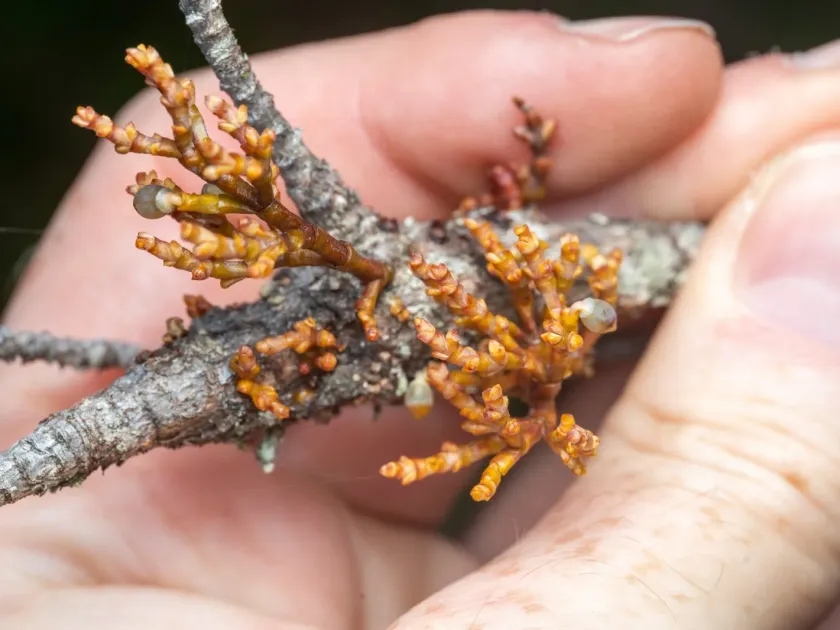
Description
Growing requirements
Hemlock dwarf mistletoe (Arceuthobium tsugense) is an obligate parasitic plant within the Santalaceae family. It is not an agricultural crop but rather a significant pathogen that affects coniferous forest ecosystems in North America.
The native distribution range is primarily along the Pacific coast, where it parasitizes various conifer species, most notably the western hemlock. The parasite relies entirely on its host for water and nutrients.
Morphologically, the plant consists of small, leafless aerial shoots that emerge from the host's bark. Its root system, or haustoria, penetrates deep into the host's xylem and phloem to extract essential resources for its survival.
Optimal environmental conditions include high atmospheric humidity and mild temperatures. The plant utilizes an explosive seed dispersal mechanism, launching seeds up to several meters to attach to new, susceptible host branches.
In forest management, the presence of this parasite is a major concern, as it causes severe growth reduction, wood deformity, and eventual mortality of the host tree if left unchecked.
Main diseases and pests
Despite being a destructive parasite, Arceuthobium tsugense itself is subject to natural control agents, including various hyperparasitic fungi such as Wallrothiella arceuthobii.
These fungi infect the mistletoe's female flowers, effectively sterilizing the parasite and preventing it from producing seeds. This biotic interaction is crucial in regulating the mistletoe population dynamics in natural forests.
Several insect species also feed on the aerial shoots and reproductive organs of the dwarf mistletoe. Certain weevils and flies contribute to reducing the overall density of the parasite within the forest canopy.
The survival of the dwarf mistletoe is strictly limited by the viability of the host tree. Management strategies often involve pruning infected branches or harvesting heavily infested trees to reduce the parasite's seed source.
Effective control requires consistent monitoring and silvicultural practices, such as thinning infested stands and promoting the growth of non-host tree species to create natural barriers against infection.