
Arceuthobium vaginatum
Arceuthobium vaginatum
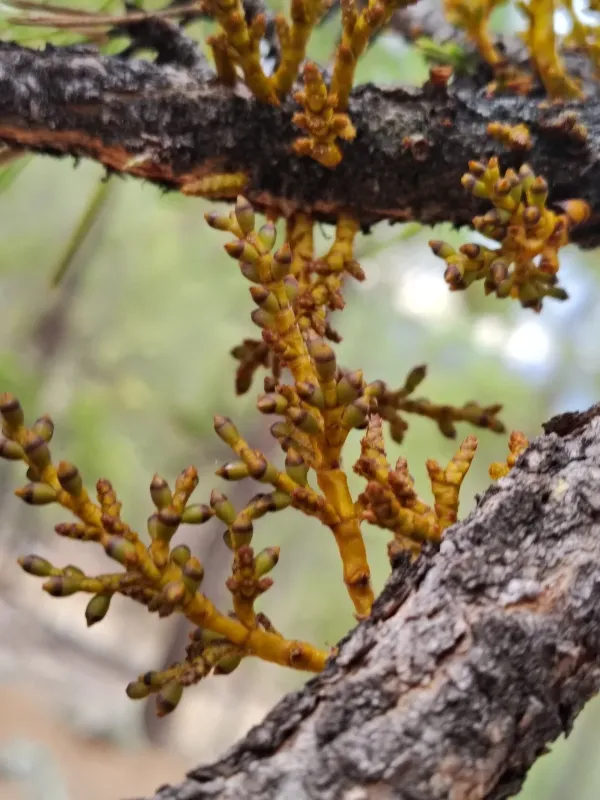
Description
Growing requirements
Arceuthobium vaginatum is an obligate parasitic plant belonging to the Santalaceae family, specialized in infecting various species of pine trees.
Originating from the mountainous regions of North America, this species thrives in high-altitude conifer forests where its host trees are abundant.
The plant lacks a functional root system of its own, relying entirely on the haustoria that penetrate the phloem and xylem of the host plant to siphon water and nutrients.
It exhibits specific environmental preferences, favoring sunny exposures on tree branches that allow for the maturation of its seeds and aerial shoots.
Botanically, it is classified as a dwarf mistletoe, characterized by its minute size, inconspicuous yellow-green stems, and high level of evolutionary specialization.
Main diseases and pests
The primary damage caused by this parasite is the physical and physiological stress inflicted upon the host tree, leading to stunted growth and reduced vigor.
Severe infestations often result in the development of dense clusters of abnormal branches commonly known as witch's brooms.
These infestations significantly decrease the timber yield and overall health of commercial forest stands, leading to premature tree mortality.
Propagation occurs via ballistic seed dispersal, where pressurized fruit capsules launch seeds long distances, making control extremely difficult.
Current management strategies are strictly limited to silvicultural practices, such as pruning infected branches or harvesting heavily infested trees to reduce inoculum.