
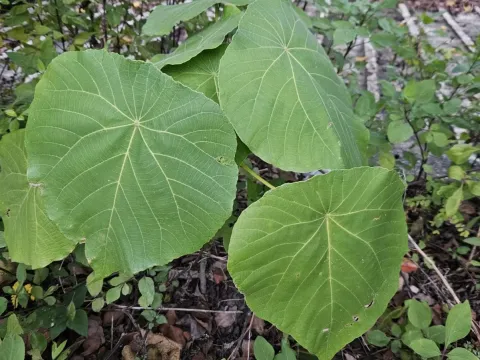
Macaranga
Macaranga
Macaranga is a genus of fast-growing trees and shrubs belonging to the Euphorbiaceae family. These plants are known as pioneer species, which dominate disturbed habitats in tropical regions across Africa, Asia, and the Pacific.
What the section contains
 Macaranga aleuritoides
Macaranga amissa
Macaranga amissa
Macaranga aleuritoides
Macaranga aleuritoides
Macaranga amissa
Macaranga amissa
 Macaranga angolensis
Macaranga angolensis
Macaranga angolensis
 Macaranga bancana
Macaranga bancana
Macaranga bancana
 Macaranga barteri
Macaranga celebica
Macaranga celebica
Macaranga barteri
Macaranga barteri
Macaranga celebica
Macaranga celebica
 Macaranga conifera
Macaranga conifera
Macaranga conifera
 Macaranga denticulata
Macaranga denticulata
Macaranga denticulata
 Macaranga diepenhorstii
Macaranga diepenhorstii
Macaranga diepenhorstii
 Macaranga gigantea
Macaranga glaberrima
Macaranga glaberrima
Macaranga gigantea
Macaranga gigantea
Macaranga glaberrima
Macaranga glaberrima
 Macaranga grandifolia
Macaranga grandifolia
Macaranga grandifolia
 Macaranga griffithiana
Macaranga griffithiana
Macaranga griffithiana
 Macaranga harveyana
Macaranga harveyana
Macaranga harveyana
 Macaranga hosei
Macaranga hosei
Macaranga hosei
 Macaranga hypoleuca
Macaranga hypoleuca
Macaranga hypoleuca
 Macaranga indica
Macaranga indica
Macaranga indica
 Macaranga involucrata
Macaranga involucrata
Macaranga involucrata
 Macaranga javanica
Macaranga kilimandsharica
Macaranga kilimandsharica
Macaranga kingii
Macaranga kingii
Macaranga javanica
Macaranga javanica
Macaranga kilimandsharica
Macaranga kilimandsharica
Macaranga kingii
Macaranga kingii
 Macaranga mappa
Macaranga mappa
Macaranga mappa
 Macaranga monandra
Macaranga motleyana
Macaranga motleyana
Macaranga monandra
Macaranga monandra
Macaranga motleyana
Macaranga motleyana
 Macaranga peltata
Macaranga peltata
Macaranga peltata
 Macaranga pruinosa
Macaranga pruinosa
Macaranga pruinosa
 Macaranga recurvata
Macaranga recurvata
Macaranga recurvata
 Macaranga rhizinoides
Macaranga rhizinoides
Macaranga rhizinoides
 Macaranga schweinfurthii
Macaranga schweinfurthii
Macaranga schweinfurthii
 Macaranga spinosa
Macaranga spinosa
Macaranga spinosa
 Macaranga tanarius
Macaranga tanarius
Macaranga tanarius
 Macaranga triloba
Macaranga triloba
Macaranga triloba
 Macaranga velutina
Macaranga velutina
Macaranga velutina
Macaranga
The plant requires a strictly tropical climate with consistently high temperatures and significant annual rainfall. It cannot survive in cold temperatures and is highly susceptible to frost damage.
Regarding soil, Macaranga prefers well-drained, fertile soils with a slightly acidic to neutral pH. Proper soil structure is critical as the root system is highly sensitive to waterlogging, which often leads to root rot.
A unique biological feature of many Macaranga species is their mutualistic relationship with ants. The plants provide hollow stems and nectar to the ants, which in turn protect the tree from herbivores and encroaching vines.
Light availability is a primary factor for growth. Being a heliophyte, Macaranga thrives in open, sunny locations where it can rapidly outcompete surrounding vegetation during its initial growth phase.
The primary economic output of Macaranga is its light-density timber. It is widely utilized for construction, the manufacturing of crates, and as a raw material for the pulp and paper industry.
Due to its rapid growth, the genus is highly valuable for large-scale reforestation and land rehabilitation programs. It effectively prevents soil erosion on exposed slopes in tropical territories.
Secondary uses of the plant include traditional medicine applications, where various parts of the tree are used to treat skin infections and inflammatory conditions due to the presence of specific flavonoids.
The species also contributes to the restoration of soil health, as its leaf litter decomposes rapidly, adding essential organic matter to tropical soils that are often nutrient-depleted.
Yield estimation is focused on biomass production per hectare per year. Given its life cycle, it provides a faster harvest cycle than many traditional tropical hardwoods used in sustainable forestry.
Fungal pathogens represent the most significant threat to Macaranga plantations, especially during seasons with extremely high humidity or poor canopy ventilation, leading to severe leaf spot diseases.
Herbivorous insects, such as caterpillars, can cause defoliation, but their impact is typically neutralized by the symbiotic ants associated with the tree. Disruption of this symbiosis can increase the frequency of pest outbreaks.
Invasive plant species, particularly woody vines, can overgrow young Macaranga stands. Without initial manual weeding, the survival rate and growth velocity of the trees can be significantly hindered.
Root rot, driven by pathogen accumulation in waterlogged soils, is a common issue that necessitates proper drainage infrastructure before planting large-scale stands of the crop.
Overcrowding in intensive monoculture plantations can lower the individual health of trees, making the stand more vulnerable to rapid spread of infections and reducing the overall wood quality.