
Macaranga triloba
Macaranga triloba
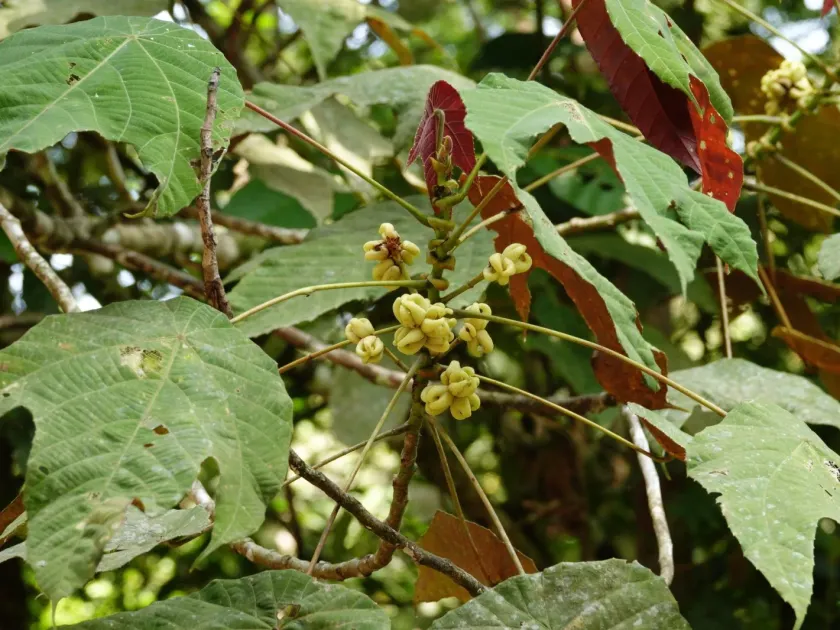
Description
Sowing dates
Propagation of Macaranga triloba is primarily achieved through seeds, which must be sown shortly after harvesting due to their relatively short viability period. Fresh seeds exhibit higher germination rates.
In nursery conditions, seeds are sown in trays filled with a light, well-draining substrate. The onset of the rainy season provides the ideal environment for the seeds to germinate within 2–4 weeks.
Before sowing, it is advisable to remove the fleshy fruit pulp and soak the seeds in warm water for 24 hours. This practice effectively breaks dormancy and ensures a more uniform germination across the bed.
Seedlings are ready for field transplantation when they reach a height of 40–50 cm. At this stage, the root system is sufficiently robust to establish itself quickly in the plantation soil.
For large-scale forestry projects, a planting density of 3x3 meters is generally recommended. This spacing encourages rapid canopy closure, which suppresses weeds and promotes straight, vertical growth.
Growing requirements
Belonging to the Euphorbiaceae family, Macaranga triloba is a classic pioneer species. It thrives in high-light environments and is extremely sensitive to shading, making it unsuitable for understory planting.
The tree prefers fertile, well-drained soils but is remarkably adaptable to degraded land, which is a major advantage for reforestation efforts. It thrives in areas with adequate aeration and moisture.
The climate must be strictly tropical, characterized by high humidity and consistent rainfall. It does not tolerate prolonged dry spells, as this inhibits its rapid growth cycle and metabolic activity.
Ideal temperatures range from +22 to +32 degrees Celsius. Constant warmth allows for continuous vegetative growth, ensuring the species maintains its status as a high-yielding biomass producer.
Annual rainfall requirements are significant, ideally exceeding 2000 mm per year. Sufficient water availability is critical for the tree to reach its maximum timber production potential within a short timeframe.
Yield
The main yield of Macaranga triloba is its lightweight, versatile timber. The species is highly regarded for its exceptional growth rate, allowing for short-rotation forestry cycles of 10–15 years.
Yield capacity depends heavily on site management and spacing. When managed intensively, plantations can produce a high volume of biomass compared to slower-growing hardwood species in the same region.
The wood is primarily utilized in the plywood, pulp, and paper industries. Its low density makes it easy to process, which reduces energy costs during the primary milling and production stages.
Beyond timber, the plant offers secondary resources including resins and medicinal compounds. These materials are often harvested by local communities, adding value to the plantation economy.
Ongoing research into genetic selection for faster growth and higher wood density promises to further increase the yield potential of this species in commercial forestry applications.
Main diseases and pests
Fungal diseases are the most significant threat to Macaranga triloba, particularly in stagnant, poorly drained soils. Root rots can cause rapid collapse of young tree stands if not properly managed.
Leaf-eating insects, such as beetles and caterpillars, can cause localized damage to the foliage. While usually not fatal to mature trees, heavy infestations can significantly retard growth rates.
Competition from aggressive invasive weeds can suppress the development of young saplings. Implementing effective weed control strategies during the first two years is essential for plantation success.
Stem-boring insects present a risk to timber quality, as they can create galleries inside the wood. Monitoring these pests is crucial to ensure the final product meets market standards.
Environmental factors like extreme storms can cause mechanical damage. Although the wood is somewhat flexible, strong winds can break branches or uproot trees in plantations with low root stability.
Harvesting
Harvesting usually takes place when trees reach technical maturity, typically between 12 and 18 years of age. Decisions are based on desired log diameter and specific industrial requirements.
Selective harvesting or clear-cutting methods are employed depending on the management strategy. Proper planning ensures that heavy machinery does not compact the soil or damage remaining trees.
Immediately after harvest, timber should be transported to processing facilities to prevent fungal colonization and discoloration, to which the light-colored wood is highly susceptible.
Post-harvest management involves clearing debris and preparing the site for the next planting cycle. Macaranga species are naturally adapted to regenerate, making them sustainable for repeated forestry usage.
Standard log scaling and grading are performed at the landing site to sort timber for various commercial applications, such as veneer production or fiber processing for the paper industry.