
Macaranga gigantea
Macaranga gigantea
Description
Growing requirements
Macaranga gigantea belongs to the Euphorbiaceae family and is recognized as one of the fastest-growing tropical pioneer trees in Southeast Asia. It plays a vital role in natural forest succession.
The plant thrives in humid tropical climates with high annual precipitation levels. It is an obligate heliophyte, meaning it requires full, direct sunlight to achieve its maximum growth potential.
For optimal growth, it prefers deep, well-drained, and nutrient-rich soils. While it appreciates high soil moisture, stagnant water and waterlogged conditions should be strictly avoided to prevent root decay.
The species is strictly limited to tropical regions, as it lacks any cold tolerance. Consistent, high temperatures are essential for maintaining the metabolic rates required for its rapid biomass accumulation.
In silvicultural practices, Macaranga gigantea requires minimal intervention after establishment. However, weed control during the early stages of development is crucial to allow the canopy to close and suppress competitive growth.
Yield
The primary economic use of Macaranga gigantea is the production of low-density timber, which is highly valued for manufacturing paper pulp, plywood, and various packaging materials.
Its primary ecological role is in reforestation and land rehabilitation projects. The tree can rapidly cover degraded or cleared forest land, effectively protecting the soil from erosion.
Due to its high yield of biomass, it is considered a candidate for short-rotation forestry, where the goal is to produce rapid supplies of wood fiber for local industries.
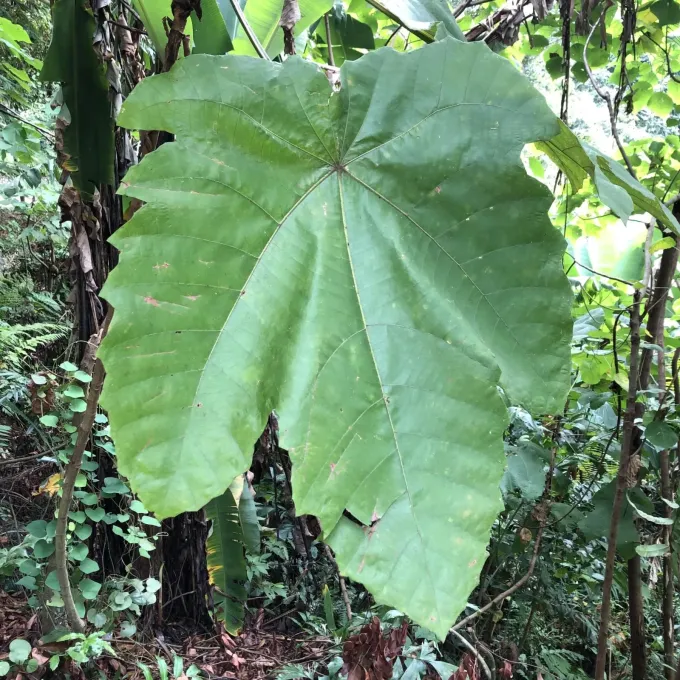
The broad leaves of the tree are highly effective at recycling nutrients. When they shed, they create a thick layer of organic mulch, significantly improving soil fertility in managed plots.
Community forestry programs utilize this species for charcoal production, providing a sustainable alternative to harvesting slow-growing hardwood species from primary forests.
Main diseases and pests
Macaranga gigantea is generally robust, but like any forest crop, it can be susceptible to specific pests and pathogens when planted in large-scale homogeneous blocks.
Defoliating insects are the most common threat. These pests can cause significant damage to young leaves, thereby reducing the tree's photosynthetic capacity and slowing its growth cycle.
Fungal infections can occur in environments with poor air circulation. Proper spacing between trees is essential to promote airflow and mitigate the risk of pathogen outbreaks.
Rodents represent a secondary threat, particularly in the seedling phase, as they can girdle the stems and damage the root systems of young trees.
Integrated pest management (IPM) strategies, including maintaining plant diversity and regular site sanitation, are recommended to maintain the health and vigor of the plantation.