
Macaranga angolensis
Macaranga angolensis
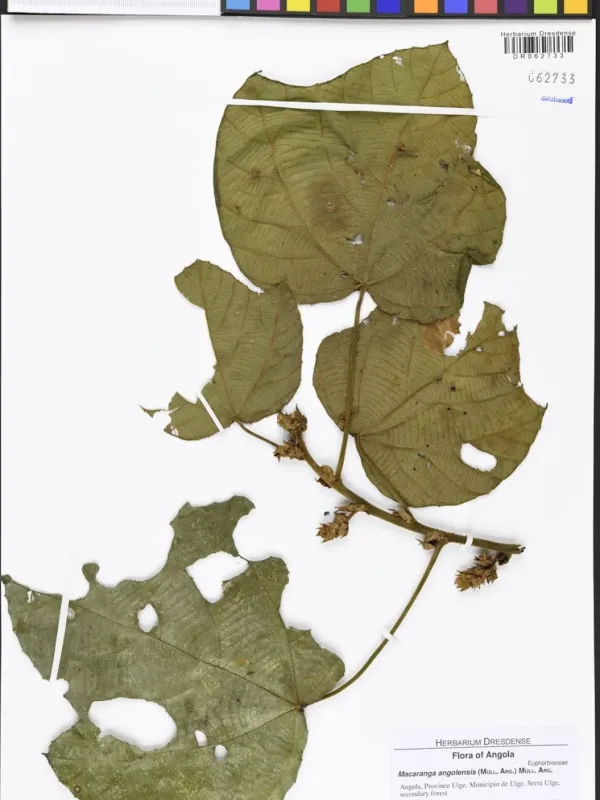
Description
Growing requirements
Macaranga angolensis is a member of the Euphorbiaceae family, widely distributed across tropical Africa. It is recognized as a pioneer species that excels in colonizing degraded lands and forest gaps, providing essential ecological services.
The tree thrives in humid tropical climates where annual rainfall is high and temperatures remain consistently warm. It is highly sensitive to frost and extreme drought, which strictly restricts its cultivation to equatorial and tropical regions.
Regarding soil, it prefers deep, well-drained profiles. While it shows remarkable tolerance for nutrient-poor substrates, consistent growth rates are best achieved in soils with moderate organic matter content and good moisture retention capacity.
Cultivation requires careful site selection to ensure adequate sunlight exposure. As a photophilic species, Macaranga does not perform well in the deep shade of closed canopies, necessitating strategic thinning if grown in mixed-species plantations.
Agronomic management involves standard nursery practices including propagation from seeds. Seedlings should be planted at optimal spacing to ensure that each individual has enough space to develop a strong canopy without excessive inter-tree competition.
Harvesting
The primary economic application of Macaranga angolensis is its timber. The wood is lightweight, relatively soft, and easy to work with, making it a staple material for local construction, plywood manufacturing, and pulp production.
In agroforestry systems, the species is frequently utilized for soil stabilization and as a shade tree for cash crops that require protection from direct solar radiation during their early developmental stages.
Harvesting is typically managed on a rotation basis. Given the species' rapid growth, cycles of 10 to 15 years are common for commercial timber production, allowing for a sustainable supply of raw material.
Beyond timber, the bark of the tree contains secondary metabolites that have been historically utilized in traditional medicine. Sustainable bark harvesting methods are necessary to maintain tree health and ensure long-term vitality.
The role of the tree in restoring soil fertility through its significant leaf litter production is another critical harvestable benefit, as it naturally cycles nutrients back into the soil, supporting the health of the broader ecosystem.