

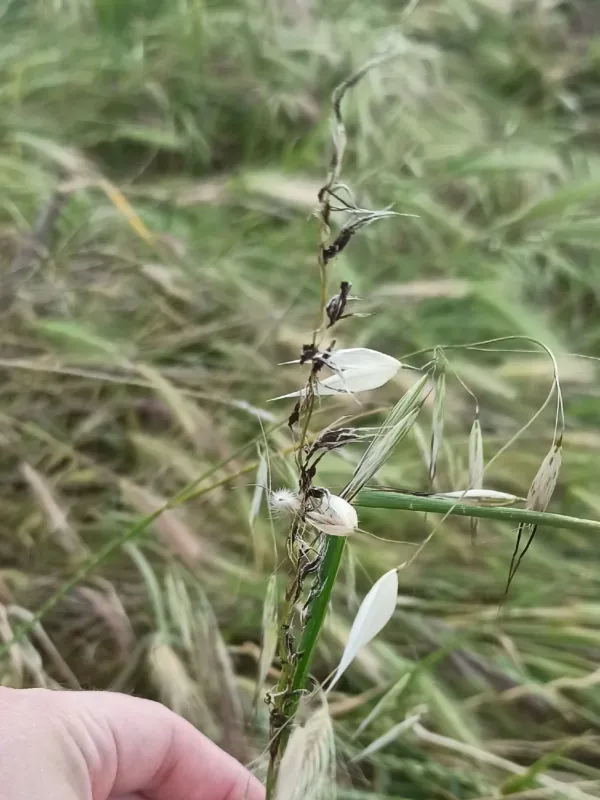
Description
Symptoms
The symptoms of loose smut become clearly visible during the heading stage of oats. Instead of a normal grain-bearing panicle, a deformed structure covered in dark spores appears.
The fungal mass replaces the entire grain, leaving only the central axis of the panicle. These spores are easily detached and scattered by wind, leaving a bare stalk by the time of harvest.
The infection is systemic, meaning that typically all panicles on an infected tiller or plant exhibit the symptoms of the disease. This uniformity is a key diagnostic feature.
The black, dusty spore mass is highly characteristic and distinguishes loose smut from other panicle disorders. The destruction of the floral parts is usually total.
Field inspections during the early heading stage are crucial to identifying the presence of the disease, as the spore mass is most visible before it gets fully dispersed by wind and rain.
Pathogen
The causal agent of loose smut is the basidiomycete fungus Ustilago avenae. It is a specialized pathogen that specifically targets oat plants, leading to significant physiological disruption.
The infection cycle begins during the flowering stage, when teliospores are dispersed by wind and land on the healthy florets of oats. The spores germinate and infect the developing ovary, establishing a dormant mycelium within the embryo.
The pathogen remains latent inside the seed until planting. There are no external symptoms on the seed, making it a "hidden" source of infection that is difficult to detect through visual inspection.
Once the seed germinates in the soil, the dormant mycelium resumes growth. It follows the growing point of the plant upward, systematically colonizing the stem and developing tissues.
As the plant prepares to head, the fungus completely replaces the tissues of the panicles with its reproductive spores, effectively sterilizing the plant's reproductive structures.
Conditions for development
The primary driver of loose smut outbreaks is the use of infected seeds. Since the fungus is seed-borne, the level of infestation in the seed lot directly dictates the field infection rate.
Environmental conditions during germination play a secondary role. Cool, moist soil conditions that slow down seedling emergence can sometimes increase the success rate of the fungus in colonizing the host.
The dispersal of spores during flowering requires specific environmental conditions. Mild temperatures and adequate humidity assist the germination of spores on the floral parts.
Agronomic practices, such as late planting or poor soil fertility, can exacerbate the impact of the disease by weakening the plant's natural resistance and prolonging the vulnerability window.
Unlike some other fungal diseases, loose smut does not depend on soil moisture for secondary infections; its primary mode of transmission is strictly through the seed embryo.
Why it matters
The most direct impact of loose smut is the complete loss of grain yield in affected plants. The replacement of grain with fungal spores results in zero economic value for the infected panicles.
Large-scale infections lead to a significant reduction in overall yield per hectare. This reduction is often proportional to the percentage of infected plants in the field.
Beyond quantity, the presence of spores can contaminate healthy grain during the harvesting process. This reduces the quality of the marketable product and can trigger penalties or rejection by buyers.
Loose smut can also affect the vegetative vigor of the plant, potentially leading to smaller stalks and reduced biomass, which can be an issue if the crop is intended for forage.
The accumulation of the pathogen in subsequent generations of seeds creates a feedback loop that can make the disease increasingly difficult to manage without systematic intervention.
Protection
The most effective strategy for managing loose smut is systemic seed treatment. Fungicides applied to seeds penetrate the seed coat and kill the latent mycelium within the embryo.
Using certified, disease-free seed is the first line of defense. Farmers should source seeds from fields with low or no reported incidence of loose smut.
Good agricultural practices, such as balanced fertilization and optimal planting times, help the crop establish quickly, providing a competitive advantage against the systemic spread of the fungus.
Integrated disease management includes:
- Selection of resistant oat varieties.
- Proper cleaning of seed lots to remove light or damaged grains.
- Crop rotation to break the cycle of pathogen accumulation in the environment.
Modern seed-applied fungicides remain the gold standard for control, providing robust protection during the most critical stage of the plant's early life cycle.
Content graph
Connections · Loose smut of oats
Most often together:
Marketplace
Products · 96


SKAKUN
ФГБНУ Федеральный исследовательский центр «Немчиновка»
Oats
0
0
·
66
13 offers
0.36 €per pack
Buy


YAKOV
ФГБНУ Федеральный исследовательский центр «Немчиновка»
Oats
0
0
·
47
2 offers
0.26 €per 1 kg
Buy


ARGAMAK
ФГБНУ Федеральный Аграрный Научный Центр Северо-востока имени Н.В. Рудницкого
Oats
0
0
·
43
1 offer
0.07 €per 1 kg
Buy




FALENETS
ФГБНУ Федеральный Аграрный Научный Центр Северо-востока имени Н.В. Рудницкого
Oats
0
0
·
61
No offers
—
Details


BEAR
ФГБНУ Федеральный Аграрный Научный Центр Северо-востока имени Н.В. Рудницкого
Oats
0
0
·
56
No offers
—
Details


Community
Discussion
No discussions yet — be the first.