


SKU #65100
·
43 views
RYSK
Oats
User rating
0 votes0% positive reviews
No ratings yet — be the first.
Ripeness Group (days)
Medium-maturing (95-110)
Yield
60+
Disease Resistance
Mottling, Rust
Mass of 1000 seeds (g)
32-36
About product

Rysk is a mid-ripening spring oat (Avena sativa L.) variety developed jointly by the Ulyanovsk Agricultural Research Institute and the Central Non-Chernozem Zone Agricultural Research Institute. It belongs to the mutica variety type and is characterized by a medium-height plant with a height of 99 to 117 cm. It has an intermediate bush, a stem of medium thickness that is strong and hollow. The lea…
Ripeness Group (days)
Medium-maturing (95-110)
Yield
60+
Disease Resistance
Mottling, Rust
Mass of 1000 seeds (g)
32-36
Description
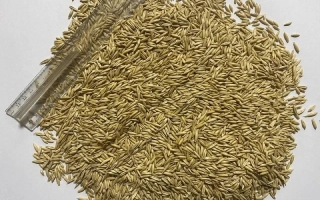
Rysk is a mid-ripening spring oat (Avena sativa L.) variety developed jointly by the Ulyanovsk Agricultural Research Institute and the Central Non-Chernozem Zone Agricultural Research Institute. It belongs to the mutica variety type and is characterized by a medium-height plant with a height of 99 to 117 cm. It has an intermediate bush, a stem of medium thickness that is strong and hollow. The leaf blade is glaucous-blue, of medium width and length, with weak pubescence on the leaf sheaths and leaf margins, as well as medium or strong pubescence on the upper stem node. The panicle is two-sided with a semi-erect branch arrangement, florets are drooping, the floret lemma is long with a strong waxy coating. The caryopsis is hulled, from medium to large size, white in color, with a 1000-grain weight of 32-40 g.
The variety is distinguished by high yield and grain quality. The vegetation period is 78-95 days, ripening 1-2 days earlier than the Allure variety and 1-3 days later than the Skakun variety. Average yield in the Lower Volga region reaches 21.9 c/ha, and in the Saratov region — 24.4 c/ha, which is 2 c/ha higher than the Skakun standard. The maximum yield was recorded at 42.4 c/ha. Hulling accounts for 24-28%, natural density is 500-580 g/l, protein content in grain varies from 13 to 14.9%. Grain shedding is weak, which contributes to harvest preservation.
Rysk has high drought resistance, exceeding the Skakun and Allure varieties by 1.0-1.5 points in drought years. Lodging resistance is slightly lower than standard varieties, however, the plant is distinguished by stem strength. The variety is moderately resistant to powdery head smut with minimal infection (0.4%) and moderately susceptible to crown rust. Due to the combination of high yield, grain quality, and resistance to adverse conditions, Rysk is recommended for cultivation in the Middle Volga, Lower Volga, and Urals regions, including the Saratov region.
The variety is distinguished by high yield and grain quality. The vegetation period is 78-95 days, ripening 1-2 days earlier than the Allure variety and 1-3 days later than the Skakun variety. Average yield in the Lower Volga region reaches 21.9 c/ha, and in the Saratov region — 24.4 c/ha, which is 2 c/ha higher than the Skakun standard. The maximum yield was recorded at 42.4 c/ha. Hulling accounts for 24-28%, natural density is 500-580 g/l, protein content in grain varies from 13 to 14.9%. Grain shedding is weak, which contributes to harvest preservation.
Rysk has high drought resistance, exceeding the Skakun and Allure varieties by 1.0-1.5 points in drought years. Lodging resistance is slightly lower than standard varieties, however, the plant is distinguished by stem strength. The variety is moderately resistant to powdery head smut with minimal infection (0.4%) and moderately susceptible to crown rust. Due to the combination of high yield, grain quality, and resistance to adverse conditions, Rysk is recommended for cultivation in the Middle Volga, Lower Volga, and Urals regions, including the Saratov region.
Crop & resistance
Crop
Disease resistance
Specifications hover over for a hint about the specification
| Ripeness Group (days) | Medium-maturing (95-110) |
|---|---|
|
Yield
Yield
Overall bulb harvest per unit area. Depends on both onion variety characteristics and agronomic practices, fertilizers, and irrigation. Under optimal growing conditions, an onion yield of 100 tons per hectare and above is not considered record-breaking. |
60+ |
| Disease Resistance | |
| Mass of 1000 seeds (g) | 32-36 |
| Protein (%) | 13+ |
| Plant Height | 90-100 |
| Grain-oriented | |
| Corn Color | |
| Usage Type | |
| Resistance to Sliding | |
| Registration year | 2009 |
| Catalog | Catalog → Oats |
| Legal data |
Show · 12
|
| Country | Russia |
Store offers
Prices are updated on loadLoading offers…
Aggregator catalog: prices are collected automatically from store websites, normalized by AI and converted at the current exchange rate. Before ordering, confirm the price and availability on the store's website. This block is not indexed by search engines — the data is loaded after the page opens.
Not yet комментариев. Be the first!




See also
Often considered together with this variety



Recently viewed
Products you’ve viewed on this site
Reviews · 0