

Description
Symptoms
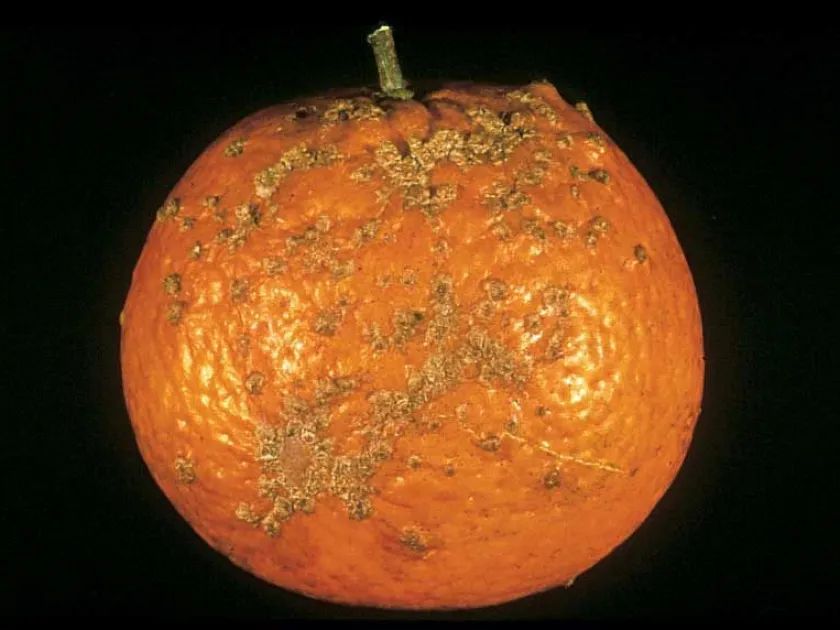
Initial signs of melanose appear as tiny, dark-brown, sunken spots on young foliage and tender green shoots, often surrounded by a yellow halo.
As the fruit matures, the symptoms develop into raised, dark-brown or black crusty lesions that feel rough to the touch, resembling sandpaper.
Severe infections may cause the lesions to coalesce, forming large, irregular, and unsightly patches that significantly downgrade fruit quality.
On leaves, the infection can cause chlorosis, distortion, and premature abscission if the pathogen pressure is sufficiently high during the flush period.
On older bark, the fungus may cause localized gumming or small cracks, indicating deep-seated tissue death caused by long-term colonization.
Pathogen
Citrus melanose is a fungal disease caused by the ascomycete Diaporthe citri, which has a widespread distribution in tropical and subtropical citrus-growing regions.
The fungus produces two types of spores: pycnidiospores, which spread during rains, and ascospores, which are dispersed by wind, allowing for efficient colonization.
It acts as a saprophyte on dead twigs and branches, meaning that any source of dry wood within the tree canopy serves as a constant reservoir of inoculum.
The pathogen is highly specialized for citrus and can remain dormant within the host tissues until climatic conditions trigger its reproductive phase.
The fungus colonizes the epidermal cells of young leaves, shoots, and fruit, leading to the characteristic necrotic lesions associated with the disease.
Conditions for development
High relative humidity and frequent rainfall are the primary environmental drivers for the germination and dispersal of Diaporthe citri spores.
The fungus thrives in temperatures between 20°C and 28°C, which perfectly aligns with the most vulnerable growth stages of the citrus trees.
Overcrowded plantations with poor canopy airflow maintain a microclimate conducive to prolonged leaf wetness, facilitating the entry of the fungus.
Overhead irrigation systems are particularly dangerous as they mimic rain, splashing spores from dead wood onto newly developing fruit and leaves.
The presence of necrotic wood, often caused by freezing damage or previous diseases, is essential for the buildup of the inoculum in the orchard.
Why it matters
The primary economic impact of melanose is the physical degradation of fruit appearance, which makes the crop unsuitable for the premium fresh fruit market.
Chronic infection reduces the overall vigor of the trees, leading to lower yields and an increased susceptibility to secondary stress factors.
Severe foliar infections significantly limit photosynthetic activity, which impairs the development of fruit size and quality over the entire season.
Continuous dieback of twigs caused by the fungus requires costly pruning and maintenance labor to prevent complete decline of the orchard.
While the fruit remains edible, the aesthetic defects necessitate sorting and grading processes, which increase post-harvest handling costs.
Protection
The most effective strategy for managing melanose is rigorous sanitation: removing dead wood and pruning out infected twigs to eliminate the inoculum source.
Copper-based fungicides are the standard preventive measure, with applications typically scheduled after petal fall and during subsequent growth flushes.
Maintaining adequate canopy spacing and performing proper pruning to improve air circulation helps dry foliage faster, reducing the infection window.
Integrated Pest Management (IPM) practices, including the use of targeted fungicides and proper fertilization, are crucial for long-term control.
- Perform pruning only in dry weather.
- Avoid overhead irrigation during susceptible growth periods.
- Monitor for disease outbreaks after heavy rain events.
Content graph
Connections · Citrus melanose
Most often together:
Marketplace
Products · 52





KOLORITNOYE 15
ФГБНУ Воронежский ФАНЦ им. В.В. Докучаева
Millet
0
0
·
35
3 offers
0.17 €per 1 kg
Buy


SARATOVSKOYE ZHELTAYE
Federal Agrarian Scientific Center of the South-East
Millet
0
0
·
34
1 offer
48.83 €per pack
Buy


Golden
Federal Agrarian Scientific Center of the South-East
Millet
0
0
·
29
2 offers
0.54 €per 1 kg
Buy




SARATOVSKOE 3
Federal Agrarian Scientific Center of the South-East
Millet
0
0
·
38
No offers
—
Details

SARATOVSKOE 15
Federal Agrarian Scientific Center of the South-East
Millet
0
0
·
37
No offers
—
Details

SARATOVSKOE 6
Federal Agrarian Scientific Center of the South-East
Millet
0
0
·
37
No offers
—
Details


Community
Discussion
No discussions yet — be the first.