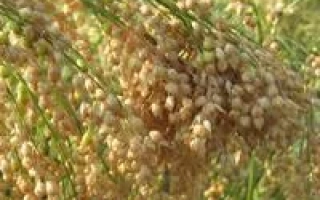
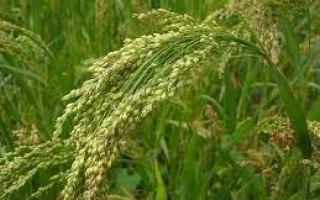
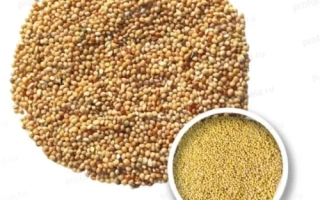
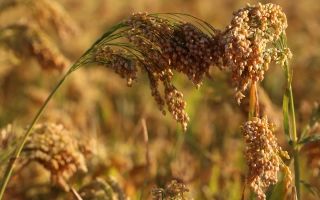
The cultivated millet variety "Golden Horde" is a mid-season crop with a growing period of 70 to 100 days, ideally suited for cultivation in various climatic zones, including the North Caucasus, Middle Volga, Lower Volga, and Ural regions. Plants reach a height of 70 to 105 cm, possess a sturdy stem of medium thickness, and have weakly or moderately hairy leaves of an elongated-lanceolate shape. The panicle is compacted and of medium length, while the grain is large, oval-shaped, with white-cream or white-yellow coloring, ensuring good technological and culinary qualities. The variety differs in high yield, which during variety testing reached up to 48 centners per hectare, while the average yield varies depending on the region: 21.4 c/ha in the North Caucasus and 33.7 c/ha in the Middle Volga. "Golden Horde" exhibits resistance to lodging, shattering, and drought, as well as high resistance to melanosis, making it a reliable choice for farmers. However, the variety is sensitive to head smut, so pre-sowing seed treatment is recommended to protect against this disease. To achieve maximum productivity, the sowing rate ranges from 2.0 to 3.5 million viable seeds per hectare, depending on soil type. Due to its characteristics and adaptability, "Golden Horde" is a high-yielding and drought-resistant millet variety suitable for cultivation in the eighth and ninth zones of Russia, providing a stable and quality harvest.