
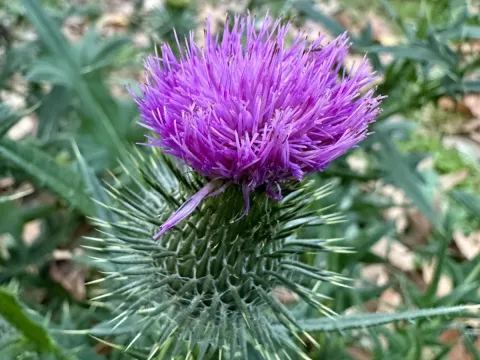
Thistle
Cirsium
Thistle, belonging to the Cirsium genus within the Asteraceae family, is a persistent perennial weed that poses significant challenges in global agriculture. It is characterized by deep taproots and spiked leaves that act as a defense mechanism against herbivores.
What the section contains
 Pannonian thistle
Cirsium pannonicum
Pannonian thistle
Cirsium pannonicum
 Purple thistle
Cirsium purpuratum
Purple thistle
Cirsium purpuratum
 Pyrenean thistle
Cirsium pyrenaicum
Pyrenean thistle
Cirsium pyrenaicum
 Rough thistle
Cirsium scabrum
Rough thistle
Cirsium scabrum
 Schantar thistle
Cirsium schantarense
Schantar thistle
Cirsium schantarense
 Sea thistle
Cirsium maritimum
Sea thistle
Cirsium maritimum
 Siebold's Thistle
Cirsium sieboldii
Siebold's Thistle
Cirsium sieboldii
 Spiny thistle
Cirsium spinosissimum
Spiny thistle
Cirsium spinosissimum
 Stemless thistle
Cirsium acaule
Stemless thistle
Cirsium acaule
 Swamp thistle
Cirsium muticum
Swamp thistle
Cirsium muticum
 Tall thistle
Cirsium altissimum
Tall thistle
Cirsium altissimum
 Tanaka thistle
Cirsium tanakae
Tanaka thistle
Cirsium tanakae
 Tatar thistle
Cirsium tataricum
Tatar thistle
Cirsium tataricum
 Tuberous thistle
Cirsium tuberosum
Tuberous thistle
Cirsium tuberosum
 Ukrainian thistle
Cirsium ukranicum
Ukrainian thistle
Cirsium ukranicum
 Utah thistle
Cirsium utahense
Utah thistle
Cirsium utahense
 Vlassov's Thistle
Cirsium vlassovianum
Vlassov's Thistle
Cirsium vlassovianum
 Waldstein's Thistle
Cirsium waldsteinii
Waldstein's Thistle
Cirsium waldsteinii
 Wavy-leaf thistle
Cirsium undulatum
Wavy-leaf thistle
Cirsium undulatum
 Western thistle
Cirsium occidentale
Western thistle
Cirsium occidentale
 Winged thistle
Cirsium alatum
Winged thistle
Cirsium alatum
 Woolly thistle
Cirsium eriophorum
Woolly thistle
Cirsium laniflorum
Woolly thistle
Cirsium eriophorum
Woolly thistle
Cirsium laniflorum
 Woolly thistle
Cirsium eriophoroides
Woolly thistle
Cirsium eriophoroides
 Yellow melancholy thistle
Cirsium erisithales
Yellow melancholy thistle
Cirsium erisithales
 Yellow thistle
Cirsium horridulum
Yellow thistle
Cirsium horridulum
 Yellow-spined thistle
Cirsium ochrocentrum
Yellow-spined thistle
Cirsium ochrocentrum
 Yezo thistle
Cirsium yezoense
Yezo thistle
Cirsium yezoense
Thistle
The origin of Cirsium species is primarily in the Northern Hemisphere. They have adapted to various environments, ranging from fertile croplands to pastures and meadows, showing a preference for nitrogen-rich soils with consistent moisture levels.
Botanically, these plants reproduce through both wind-dispersed seeds and extensive rhizome networks. Their ability to regenerate from deep underground roots makes them one of the most resilient weeds in a cropping system.
Climatic requirements are broad, as thistles thrive in temperate regions. They grow actively during the spring and summer months, often outcompeting crops for sunlight and soil nutrients, thereby reducing total crop yields.
Agronomic management requires integrated efforts. Deep primary tillage combined with the strategic application of post-emergence herbicides is the standard practice to keep infestations under economic thresholds.
Rust fungi, specifically Puccinia species, are major pathogens affecting thistles. These diseases can lead to necrosis of the foliage and significantly reduce the plant's vigor during the growing season.
The thistle gall fly is a common pest that creates galls on the stems, disrupting the plant's transport of nutrients. This biological interaction can stunt the growth and reproductive capacity of the weed.
Various aphids utilize thistles as host plants, potentially acting as vectors for plant viruses that can threaten neighboring crops like sugar beets or legumes.
Insects like the painted lady butterfly larvae can cause significant damage to the leaf tissue, though their impact is rarely enough to eradicate large thistle stands without additional intervention.
Farmers should implement scouting protocols to detect early infestations. Controlling the weed before flowering is essential to prevent the massive distribution of seeds across the field through wind currents.