
Rough thistle
Cirsium scabrum
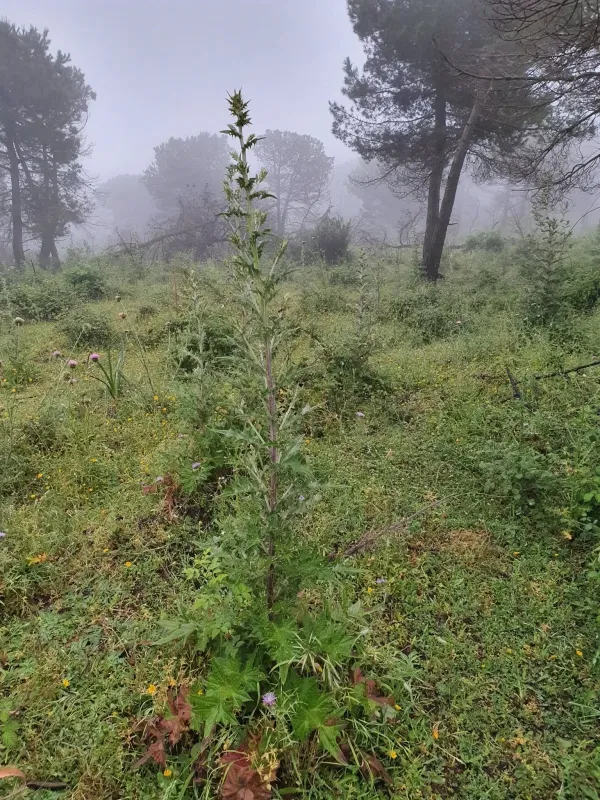
Description
Growing requirements
Rough thistle (Cirsium scabrum) is a perennial herbaceous plant belonging to the Asteraceae family. In agricultural settings, it is often identified as a persistent weed capable of competing aggressively with various field crops, making it a significant subject for agronomic management.
The plant is native to temperate regions and has a wide distribution range. It thrives in open areas, meadows, and agricultural land where it can access sufficient sunlight. It is particularly well-adapted to fertile soils but shows high plasticity, allowing it to colonize less optimal environments.
Botanically, Cirsium scabrum is characterized by its robust root system, which includes both vertical taproots and horizontal spreading roots. The stems are upright, rigid, and covered in spines, which serve as a primary defense mechanism against herbivory in wild environments.
The leaves of this thistle are deeply lobed and armed with sharp spines along the margins. This structure, combined with a dense covering of hair (pubescence), helps the plant minimize transpiration, allowing it to remain viable during periods of moderate heat and drought.
In terms of habitat, the species prefers well-drained soils with good nutrient availability. While it can withstand occasional soil compaction, its optimal growth is observed in undisturbed or poorly managed fields, where it can establish large, dense colonies that suppress surrounding vegetation.
Main diseases and pests
Diseases affecting Rough thistle are primarily fungal in nature, with various rusts and mildews being the most common. These pathogens may stress the plant during humid seasons, causing leaf spots or wilting, though they are rarely sufficient to eliminate a established population.
Pests that target this species include a range of specialized insects, particularly beetles and larvae that feed on the flower heads or stems. These pests can significantly reduce seed production, which serves as a natural biological check on the thistle's reproductive success.
The main threat that Cirsium scabrum poses to agriculture is its competition for limited resources such as soil moisture and nitrogen. Its aggressive root growth can rapidly deplete the topsoil, leading to reduced nutrient availability for neighboring crops and lower overall harvest quality.
Management is complicated by the plant's remarkable ability to regenerate from root segments left behind during tillage. Simple mechanical cutting of the foliage often triggers increased growth from the dormant buds found along the underground root network.
Integrated weed management strategies are recommended, combining mechanical removal with targeted chemical applications. Using systemic herbicides is often necessary to ensure the active ingredients reach the deep root systems, preventing the thistle from regrowing in the following season.