
Yellow-spined thistle
Cirsium ochrocentrum
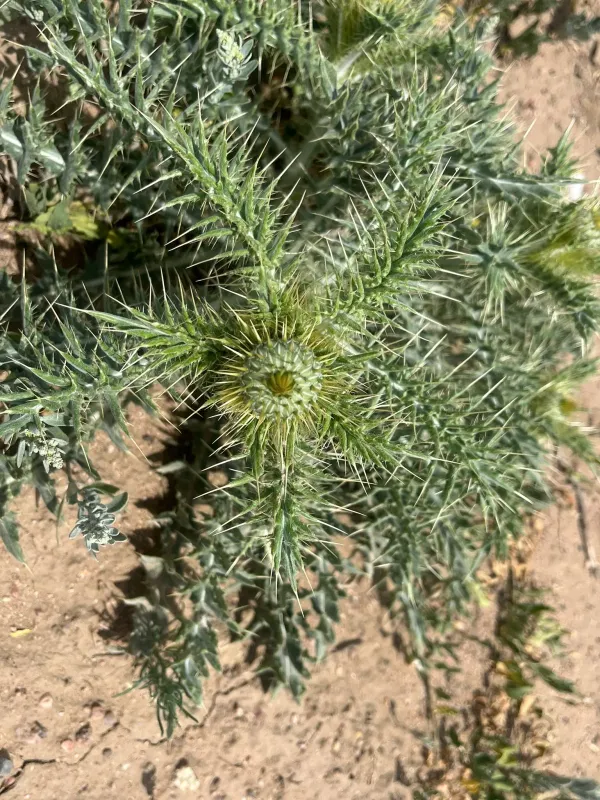
Description
Growing requirements
The yellow-spined thistle belongs to the Asteraceae family. While it is rarely grown as a crop, it is a significant plant in ecological and agricultural studies due to its role as a persistent perennial weed.
Originating from the arid regions of North America, this species has evolved to tolerate drought and extreme temperatures. It is commonly found in pastures, rangelands, and disturbed field margins.
The plant requires full sun exposure to thrive. Its ability to grow in low-nutrient soils makes it a common colonizer in areas where other agricultural crops fail to establish properly.
Soil requirements for the yellow-spined thistle are minimal. It favors well-drained soils, as waterlogged conditions can lead to root rot. Its taproot system is highly effective at extracting moisture from deep soil layers.
Agricultural management primarily focuses on suppression. Standard practices include mechanical mowing prior to seed head formation and the strategic use of systemic herbicides to target the perennial root structure.
Main diseases and pests
Like many species of the genus Cirsium, this plant is susceptible to rust fungi, specifically the Puccinia species. These fungi can cause localized leaf damage but rarely eradicate the plant population.
Several types of insects, including seed-head weevils and aphids, are known to interact with the thistle. These pests can influence the seed bank potential, which is a major factor in the plant's spread.
The yellow-spined thistle can serve as an alternative host for pests that damage economic crops. This makes its presence in the vicinity of commercial fields a potential phytosanitary risk.
Biological control agents, such as specialized beetles or flies, have been investigated to manage thistle populations. However, these methods are usually most effective in large rangelands rather than small fields.
Effective management requires a multi-year approach. Continuous monitoring for new seedlings and eradicating them before they develop a deep taproot is essential for successful field maintenance.