
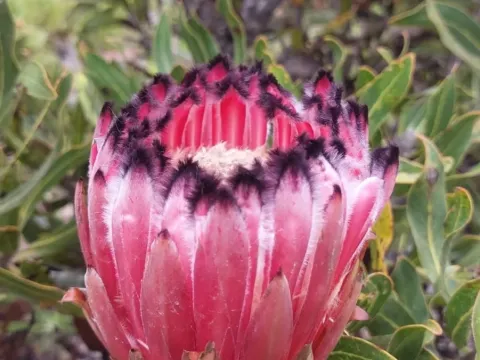
Protea
Protea L.
The propagation of Protea in commercial settings is conducted primarily through seeds or vegetative cutting methods. Sowing is typically scheduled for late summer or early autumn to emulate the natural germination cycles of these unique South African plants.
What the section contains
 King protea
Protea cynaroides L.
King protea
Protea cynaroides L.
 Long-leaved protea
Protea longifolia Andrews
Long-leaved protea
Protea longifolia Andrews
 Oleander-leaf protea
Protea neriifolia R. Br.
Oleander-leaf protea
Protea neriifolia R. Br.
 Protea amplexicaulis
 (Salisb.) R. Br.
Protea amplexicaulis
Protea amplexicaulis (Salisb.) R. Br.
 Protea aristata
 E. Phillips
Protea aristata
Protea aristata E. Phillips
 Protea aristata hybrid
Protea aristata x repens
Protea aristata hybrid
Protea aristata x repens
 Protea burchellii
 Stapf
Protea burchellii x Protea obtusifolia
Protea burchellii x Protea obtusifolia
Protea burchellii
Protea burchellii Stapf
Protea burchellii x Protea obtusifolia
Protea burchellii x Protea obtusifolia
 Protea compacta
 R. Br.
Protea hybrid
Protea neriifolia x Protea susannae
Protea compacta
Protea compacta R. Br.
Protea hybrid
Protea neriifolia x Protea susannae
 Protea magnifica
 Link
Protea magnifica
Protea magnifica Link
 Protea magnifica x compacta
Protea magnifica x longifolia
Protea magnifica x longifolia
Protea magnifica x compacta
Protea magnifica x compacta
Protea magnifica x longifolia
Protea magnifica x longifolia
 Protea obtusifolia
 H. Buek ex Meisn.
Protea obtusifolia
Protea obtusifolia H. Buek ex Meisn.
 Protea pudens
Protea pudens x longifolia
Protea pudens x longifolia
Protea pudens
Protea pudens
Protea pudens x longifolia
Protea pudens x longifolia
 Protea rouppelliae
 Meisn.
Protea rouppelliae
Protea rouppelliae Meisn.
 Protea susannae
 E. Phillips
Protea susannae
Protea susannae E. Phillips
 Sugarbush
Protea repens (L.) L.
Sugarbush
Protea repens (L.) L.
Protea
Seeds often require specific pre-treatment, such as smoke treatment or thermal stratification, to break dormancy. The growing medium must be sterile, extremely low in nutrients, and have excellent drainage to prevent seedling death.
When sowing, seeds are placed in sandy, acidic substrates. Proper ventilation and light are crucial during the germination phase, which can span from several weeks to months depending on the specific species.
Vegetative propagation via cuttings is preferred to ensure genetic uniformity and faster maturation. Semi-hardwood cuttings taken during the active growth phase are treated with rooting hormones and placed in well-aerated propagation beds.
Seedlings and young plants require delicate handling during potting. The presence of proteoid roots makes the plant highly susceptible to disturbance and nutrient toxicity, necessitating cautious management from the earliest stages.
Protea is a genus within the family Proteaceae, comprising evergreen shrubs known for their massive, complex inflorescences. They are native to the Cape Floristic Region, which dictates their specific climatic needs.
The plants require intense, full-spectrum sunlight throughout the day. In regions outside their native habitat, greenhouse cultivation with high-intensity supplemental lighting is often mandatory to achieve commercial quality.
Soil requirements are strict: the substrate must be acidic (low pH) and contain virtually no phosphorus. Protea roots are evolutionarily adapted to nutrient-poor soils, and excessive fertilizers will cause severe stress or plant death.
Watering must be meticulous. High-quality, lime-free water is essential. The root zone requires optimal aeration, and any water stagnation will trigger rapid fungal colonization, making drainage the most critical factor in their cultivation.
Temperature control is essential for successful growth, ideally maintaining between 15 and 25 degrees Celsius. Proteas are sensitive to frost, requiring protected environments in cooler climates to avoid tissue damage and developmental stagnation.
The yield of a Protea plantation depends on the species, cultivar, planting density, and the maturity of the plants. A single well-maintained bush can produce between 10 to 30 high-quality blooms per season.
Productivity reaches its peak as the plant matures, usually starting 3 to 5 years after initial planting. Proper pruning techniques significantly influence the number of flowering stems produced in subsequent years.
Profitability is driven by the longevity and ornamental value of the stems. Protea blooms are highly sought after in the floral industry due to their durability, often lasting up to a month in a vase.
Commercial producers focus on precision fertigation to manage the nutrient intake of the plants. Continuous monitoring ensures that the stems meet specific length and head-size standards required by the international export market.
The harvest cycle is extended over several weeks as buds mature at different rates. Skilled management of this cycle allows for consistent supply to markets, which is essential for maintaining commercial contracts.
Fungal pathogens, particularly Phytophthora species, represent the most significant threat to Protea crops. These pathogens thrive in poorly drained soils and can devastate entire plantations in a short time.
Pest issues include mealybugs, spider mites, and aphids. These insects exploit the sheltered environment of greenhouses, causing aesthetic damage to the leaves and developing inflorescences, which lowers the commercial value.
Biosecurity and hygiene are the primary lines of defense. All tools must be disinfected between use, and infected plants should be removed immediately to prevent the spread of soil-borne or airborne diseases.
Integrated Pest Management (IPM) is essential. Chemical control is limited because many Protea species are highly sensitive to pesticides, which can cause leaf burn or developmental issues if used improperly.
Nutritional imbalances often manifest as chlorosis or stunted growth. Regular soil and tissue testing are required to adjust the nutrient mix, ensuring that the sensitive root system remains healthy and functional.
Harvesting is performed when the flower head is fully developed and the bracts have reached their characteristic color intensity. Cutting too early often results in a failure of the bloom to fully open post-harvest.
Sterile secateurs are used to cut the stems, leaving sufficient foliage on the remaining branch to support the plant's continued health and future bud development. The cut must be clean and free of jagged edges.
Immediately after cutting, stems are placed in fresh, clean water. Transport and packaging must be handled with extreme care to prevent physical damage to the delicate bracts and petals.
Grading is strictly based on stem length and inflorescence maturity. Any specimens showing signs of pest damage or mechanical bruising are discarded to ensure the quality of the overall shipment.
Storage in refrigerated chambers at approximately 5-8 degrees Celsius is necessary to maintain the freshness of the blooms. Proper temperature control extends the market window and allows for global shipping of this high-value crop.