
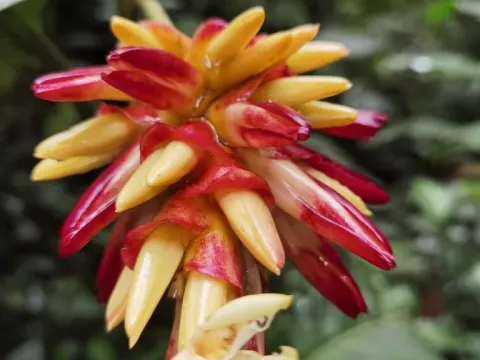
Goeppertia
Goeppertia Nees
Goeppertia is a genus of perennial herbaceous plants belonging to the Marantaceae family. Native to the tropical rainforests of Central and South America, these plants are renowned for their ornamental foliage and shade-tolerant nature.
What the section contains
 Goeppertia crocata
 (É. Morren & Joriss.) Borchs. & S. Suárez
Goeppertia crocata
Goeppertia crocata (É. Morren & Joriss.) Borchs. & S. Suárez
 Goeppertia ecuadoriana
 (H. A. Kenn.) Borchs. & S. Suárez
Goeppertia ecuadoriana
Goeppertia ecuadoriana (H. A. Kenn.) Borchs. & S. Suárez
 Goeppertia loeseneri
 (J. F. Macbr.) Borchs. & S. Suárez
Goeppertia loeseneri x Goeppertia roseopicta
Goeppertia loeseneri x Goeppertia roseopicta
Goeppertia loeseneri
Goeppertia loeseneri (J. F. Macbr.) Borchs. & S. Suárez
Goeppertia loeseneri x Goeppertia roseopicta
Goeppertia loeseneri x Goeppertia roseopicta
 Goeppertia louisae
 (Jacob-Makoy) Borchs. & S. Suárez
Goeppertia louisae
Goeppertia louisae (Jacob-Makoy) Borchs. & S. Suárez
 Goeppertia majestica
 (Linden) Borchs. & S. Suárez
Goeppertia majestica
Goeppertia majestica (Linden) Borchs. & S. Suárez
 Goeppertia makoyana
 (E. Morren) Borchs. & S. Suárez
Goeppertia makoyana
Goeppertia makoyana (E. Morren) Borchs. & S. Suárez
 Goeppertia roseopicta
 (Linden) Borchs. & S. Suárez
Goeppertia roseopicta
Goeppertia roseopicta (Linden) Borchs. & S. Suárez
 Goeppertia rufibarba
 (Fenzl) Borchs. & S. Suárez
Goeppertia rufibarba
Goeppertia rufibarba (Fenzl) Borchs. & S. Suárez
 Goeppertia warscewiczii
 (L. Mathieu ex Planch.) Borchs. & S. Suárez
Goeppertia warscewiczii
Goeppertia warscewiczii (L. Mathieu ex Planch.) Borchs. & S. Suárez
Goeppertia
The culture thrives in environments with high humidity levels, ideally above 70 percent. It requires a warm climate with temperatures consistently ranging from 20 to 25 degrees Celsius, as the plant is highly sensitive to cold drafts and temperature fluctuations.
Soil requirements involve a well-draining, loose potting mix that is rich in organic matter. A slightly acidic pH level between 5.5 and 6.5 is essential for optimal nutrient absorption and healthy root development in container settings.
Light requirements for Goeppertia are specific, as it prefers indirect, filtered light. Exposure to direct sunlight can quickly damage the leaves, causing bleaching or burning, which significantly reduces the plant's aesthetic and economic value.
Its primary use is in the horticulture industry as an indoor decorative plant. Due to its striking leaf patterns, it serves as a staple in greenhouse cultivation and interior landscaping, contributing to improved indoor air quality.
Spider mites represent a major threat, particularly in environments with low humidity. They colonize the undersides of leaves, leading to chlorosis and potential plant death if not treated with appropriate acaricides.
Root rot, typically caused by overwatering or poor drainage, is a common physiological problem. Proper irrigation management, involving drying the top layer of soil, is critical for prevention.
Scale insects can infest the stems and leaves, extracting plant sap and weakening the overall structure. Regular inspections and the application of horticultural oils or systemic insecticides are recommended.
Fungal leaf spot diseases may appear if water remains on the foliage for extended periods. It is vital to keep the leaves dry and ensure adequate air circulation around the canopy to minimize these risks.
Mealybugs can often hide in the tight leaf nodes, making them difficult to detect early. If spotted, immediate isolation of the affected plant and treatment with specific insecticidal sprays are necessary to contain the spread.