
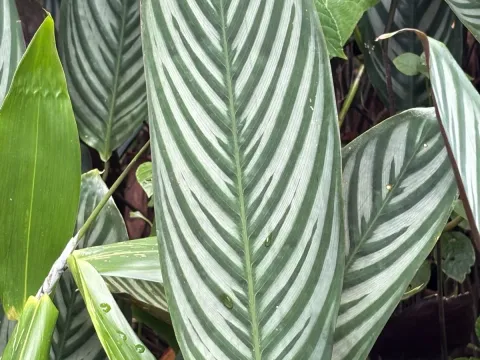
Ctenanthe
Ctenanthe Eichler
Ctenanthe is a genus of evergreen perennial herbaceous plants belonging to the family Marantaceae. Native to the tropical rainforests of Central and South America, particularly Brazil, these plants are highly valued in interior design for their striking foliage patterns. The genus is closely related to Maranta and Calathea, sharing similar physiological characteristics and growth habits.
What the section contains


Ctenanthe
Botanically, Ctenanthe develops from rhizomes and forms rosettes of leaves on long petioles. The leaf blades are often oval or lanceolate, displaying complex variegation patterns that provide high ornamental value. One of the most fascinating features of the genus is nyctinasty, where the leaves fold upwards at night, a response to changes in light intensity and circadian rhythm.
The cultural requirements for Ctenanthe include moderate, indirect light, as direct sun causes leaf scorching and fading of the variegated patterns. A stable temperature between 20°C and 25°C is ideal for active growth. High relative humidity (70–80%) is essential; in residential environments, this can be achieved through misting or using a pebble tray filled with water to ensure the plant thrives without foliage tip necrosis.
Soil structure is critical for this crop: it requires a well-draining, loose, and slightly acidic medium with a pH between 5.5 and 6.5. A mixture of peat, leaf mold, and perlite or coarse sand is standard for ensuring proper aeration and moisture retention. Proper drainage holes are mandatory to prevent waterlogging, which the plant does not tolerate well due to its shallow and delicate root system.
Ctenanthe is cultivated exclusively as an indoor ornamental crop, serving as a staple in biophilic design. It is prized for its ability to filter indoor air and adapt to lower light conditions, making it an excellent choice for homes and offices. Propagation is typically achieved through division of the rhizomes during the spring repotting season, ensuring each section has healthy roots and foliage.
The primary pests affecting Ctenanthe are spider mites, scale insects, and mealybugs, all of which thrive in low-humidity conditions. Fungal diseases such as root rot may occur if the substrate remains excessively wet or cold. Maintaining proper hygiene, including wiping the leaves with a damp cloth to remove dust and checking for pests, is the most effective preventative measure against infestations and disease outbreaks.