
Goeppertia makoyana
Goeppertia makoyana (E. Morren) Borchs. & S. Suárez
Description
Growing requirements
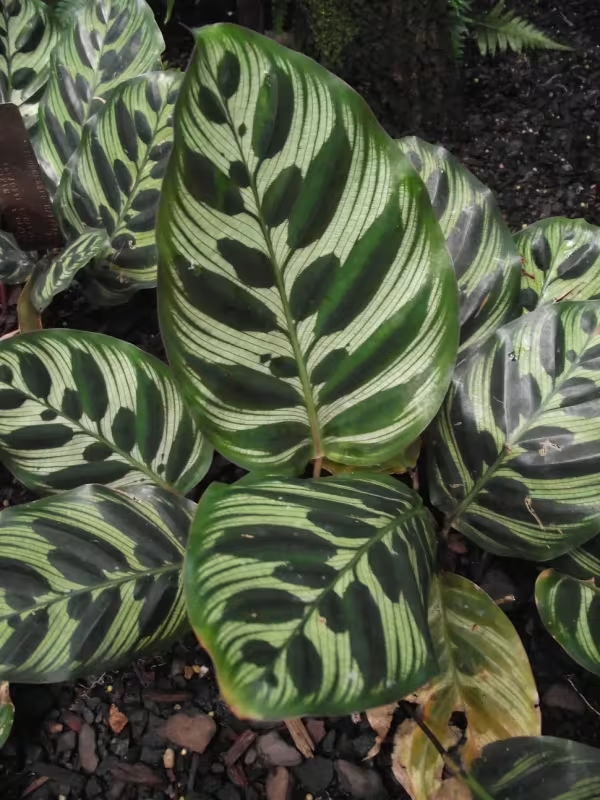
Goeppertia makoyana is a perennial herbaceous plant belonging to the Marantaceae family. Commonly known as the Peacock plant, it is widely valued in the horticultural industry for its striking ornamental foliage patterns.
The species originates from the tropical rainforests of eastern Brazil. As an agricultural commodity for the indoor plant market, it requires strict adherence to its native environmental conditions to thrive successfully in a controlled setting.
Botanically, the plant is characterized by thin, oval-shaped leaves with distinct dark green blotches and a purplish undersurface. A unique physiological feature is the daily movement of leaves, which fold upward at night in response to changes in light intensity.
Climate requirements include a high humidity level, ideally between 60% and 80%, and ambient temperatures ranging from +18 to +25 degrees Celsius. Protection from direct sunlight is essential, as high irradiance levels can lead to leaf chlorosis and burning.
The ideal growing medium is a well-aerated, peat-based substrate with high organic matter content. Ensuring proper drainage is critical to prevent the accumulation of moisture, which is necessary for maintaining a healthy rhizosphere and preventing root compaction.
Main diseases and pests
Spider mites are the most common pests associated with this culture, particularly in low-humidity environments. These mites feed on the sap of the plant, often causing the foliage to lose its vibrant coloration and leading to significant aesthetic degradation.
Scale insects and mealybugs also pose a threat to the plant's health. These pests cluster on the stems and leaf undersides, extracting nutrients and often leading to the development of secondary fungal infections caused by the honeydew they secrete.
Root rot, primarily caused by excessive irrigation and lack of soil oxygenation, is the most prevalent disease. When the roots remain submerged in water for too long, the plant cannot absorb essential nutrients, leading to rapid decay of the vascular system.
Effective management strategies include routine monitoring of the leaf underside and soil moisture levels. Utilizing systematic pest control and maintaining a clean environment are essential for preventing the spread of parasites in greenhouse operations.
To ensure optimal health, it is recommended to irrigate the plant with filtered or distilled water, as the species is highly sensitive to the mineral salts and chlorine often found in tap water. Such precision in water quality management significantly enhances the plant's longevity.