
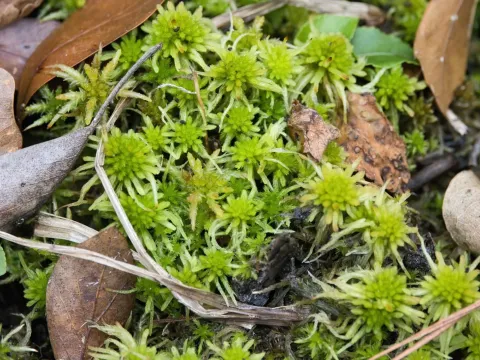
Sphagnum
Sphagnum
Sphagnum is a genus of mosses belonging to the Sphagnaceae family. These bryophytes are essential components of peatlands, growing in dense mats or carpets that can span vast areas.
What the section contains
 Baltic bog moss
Sphagnum balticum
Baltic bog moss
Sphagnum balticum
 Bog peat moss
Sphagnum palustre
Bog peat moss
Sphagnum palustre
 Five-row peat moss
Sphagnum quinquefarium
Five-row peat moss
Sphagnum quinquefarium
 Flat-leaved peat moss
Sphagnum platyphyllum
Flat-leaved peat moss
Sphagnum platyphyllum
 Fringed bogmoss
Sphagnum fimbriatum
Fringed bogmoss
Sphagnum fimbriatum
 Lindberg's peat moss
Sphagnum lindbergii
Lindberg's peat moss
Sphagnum lindbergii
 Lustrous bog-moss
Sphagnum subnitens
Lustrous bog-moss
Sphagnum subnitens
 Magellanic bog-moss
Sphagnum magellanicum
Magellanic bog-moss
Sphagnum magellanicum
 Shore bog-moss
Sphagnum riparium
Shore bog-moss
Sphagnum riparium
 Soft bog-moss
Sphagnum molle
Soft bog-moss
Sphagnum molle
 Sphagnum
 hybrids
Sphagnum
Sphagnum hybrids
 Sphagnum affine
Sphagnum affine
Sphagnum affine
 Sphagnum angustifolium
Sphagnum angustifolium
Sphagnum angustifolium
 Sphagnum auriculatum
Sphagnum auriculatum
Sphagnum auriculatum
 Sphagnum austinii
Sphagnum austinii
Sphagnum austinii
 Sphagnum capillifolium
Sphagnum capillifolium
Sphagnum capillifolium
 Sphagnum compactum
Sphagnum compactum
Sphagnum compactum
 Sphagnum contortum
Sphagnum contortum
Sphagnum contortum
 Sphagnum cuspidatum
Sphagnum cuspidatum
Sphagnum cuspidatum
 Sphagnum denticulatum
Sphagnum denticulatum
Sphagnum denticulatum
 Sphagnum fallax
Sphagnum fallax
Sphagnum fallax
 Sphagnum flexuosum
Sphagnum flexuosum
Sphagnum flexuosum
 Sphagnum fuscum
Sphagnum fuscum
Sphagnum fuscum
 Sphagnum girgensohnii
Sphagnum girgensohnii
Sphagnum girgensohnii
 Sphagnum inundatum
Sphagnum inundatum
Sphagnum inundatum
 Sphagnum majus
Sphagnum obtusum
Sphagnum obtusum
Sphagnum majus
Sphagnum majus
Sphagnum obtusum
Sphagnum obtusum
 Sphagnum papillosum
Sphagnum papillosum
Sphagnum papillosum
 Sphagnum pulchrum
Sphagnum pulchrum
Sphagnum pulchrum
 Sphagnum russowii
Sphagnum russowii
Sphagnum russowii
 Sphagnum skyense
Sphagnum skyense
Sphagnum skyense
 Sphagnum strictum
Sphagnum strictum
Sphagnum strictum
 Sphagnum subsecundum
Sphagnum subsecundum
Sphagnum subsecundum
 Sphagnum tenellum
Sphagnum tenellum
Sphagnum tenellum
 Sphagnum teres
Sphagnum teres
Sphagnum teres
 Squarrose peat moss
Sphagnum squarrosum
Squarrose peat moss
Sphagnum squarrosum
 Warnstorf's bog moss
Sphagnum warnstorfii
Warnstorf's bog moss
Sphagnum warnstorfii
Sphagnum
The primary requirement for successful cultivation is consistent moisture. Sphagnum thrives in environments with high humidity and requires a low pH range, typically between 3.0 and 4.5, to flourish properly.
The plant prefers shaded or semi-shaded locations. Direct exposure to intense sunlight can cause desiccation and inhibit growth, leading to the bleaching of the plant's terminal ends.
Sphagnum lacks true roots; instead, it absorbs water and nutrients through its stems and leaves. It features specialized hyaline cells that possess an exceptional capacity to store water, which is critical for its survival.
Cultivation protocols involve managing water levels in low-lying areas. It is vital to avoid hard water, as minerals like calcium can alter the pH and cause the moss to perish rapidly.
Sphagnum has significant agricultural and horticultural utility. Its high hygroscopicity makes it a preferred medium for potting mixes, helping to maintain soil structure and hydration levels for various ornamental plants.
In propagation, the moss is extensively used for rooting cuttings. Its inherent antiseptic properties, derived from the compound sphagnol, help prevent fungal infections and root rot in young specimens.
The floral industry utilizes dried Sphagnum for packaging plants for transport, as it acts as a moisture-retaining layer that ensures the root systems remain hydrated for extended periods.
Beyond gardening, the plant is a critical component in the production of peat. Its long-term accumulation serves as a vital resource for various industrial and horticultural applications worldwide.
Harvesting is conducted manually by skimming the top layers of the moss. This method ensures that the basal sections remain intact, allowing the moss to regenerate and continue its growth cycle.
Environmental changes pose the most significant threat to Sphagnum. Drainage and land development lead to the immediate loss of moisture and subsequent degradation of moss habitats.
Pollution from agricultural runoff, particularly nitrates and phosphates, causes eutrophication. This alters the chemistry of the water, allowing faster-growing vascular plants to outcompete and replace the moss.
While the plant is generally resistant to pests due to its acidic and antimicrobial properties, poor harvesting and storage practices can lead to the development of unwanted mold and decay.
Climate change, manifesting as prolonged droughts or extreme heat, creates conditions that are hostile to Sphagnum's physiology, forcing the colonies into dormancy or death.
Preservation of this crop requires strict monitoring of the water table and preventing any form of chemical contamination that could potentially neutralize the acidic nature of the growth medium.