

Sunn pest
Coptosoma scutellata
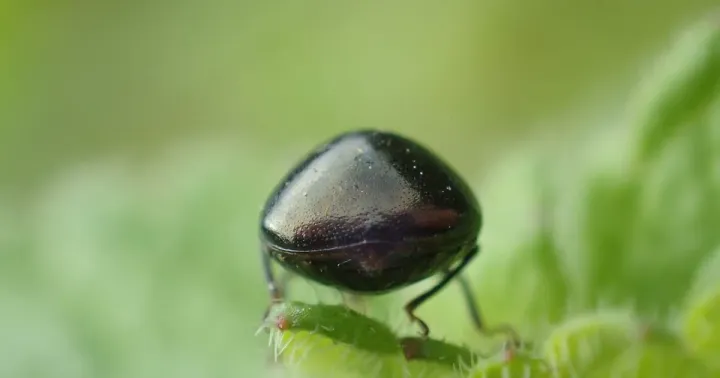
Description
How to identify
The Sunn pest, scientifically known as Eurygaster integriceps, belongs to the family Scutelleridae and the order Hemiptera. These insects are easily recognized by their broad, shield-like body shape, which measures approximately 10–13 mm in length.
Their coloration is highly variable, ranging from pale yellow to dark brown, often with intricate mottled patterns. This coloration provides excellent camouflage against the soil and cereal stalks where they reside.
The head of the insect is relatively small, featuring a specialized piercing-sucking mouthpart designed to feed on plant sap and developing grains. This morphology makes them highly efficient at damaging cereal crops.
The life cycle consists of five nymphal stages. As they develop, nymphs increasingly resemble adults but lack functional wings, which only appear after the final molt in late summer.
Adults overwinter in protected areas such as forests, windbreaks, or gardens under leaf litter, where they remain in a dormant state until spring temperatures rise significantly.
What it damages
Sunn pests primarily infest cereal crops, with winter and spring wheat being their most preferred hosts. They also feed on barley, rye, and oats, causing significant qualitative and quantitative yield losses.
When adults migrate to fields in spring, they feed on the stems of young plants. This feeding punctures the conductive tissues, causing the heads to whiten and fail to develop properly.
The most severe damage occurs when nymphs and adults feed on developing grain kernels. During feeding, they inject salivary enzymes that degrade the gluten proteins, rendering the grain useless for baking.
Flour produced from damaged grain lacks the necessary elasticity and quality, making it unsuitable for commercial bread production. Even a low percentage of damaged kernels can significantly lower the market grade of a crop.
In outbreak years, uncontrolled populations of Sunn pest can destroy a large portion of the harvest, leading to severe economic impacts for farmers and grain producers worldwide.
When it appears
The spring migration from overwintering sites typically begins in April or May, triggered by air temperatures reaching around 12–15 degrees Celsius. They fly to cereal fields to start their breeding cycle.
Females lay eggs on the underside of cereal leaves in distinct clusters of 10 to 20. The incubation period depends heavily on temperature and usually lasts for one to two weeks.
The emergence of nymphs is synchronized with the booting and heading stages of the wheat crop, providing them with immediate access to essential nutrients for their development.
By late June and July, the population is dominated by older nymphs and newly emerged adults that feed aggressively on the milk and dough stages of the maturing grain kernels.
Once the grain reaches full maturity and harvest is completed, the pests migrate away from the fields back towards their hibernation sites to prepare for the approaching cold season.
Signs of infestation
Early warning signs include the presence of adult bugs on stems during early morning inspections. They are often found resting near the base of the plant or just below the head.
Egg masses found on the underside of leaf blades are a clear indicator of a developing infestation and signal that immediate monitoring is required to track population growth.
White, empty heads appearing within the green crop canopy are symptomatic of stems punctured by adult feeding earlier in the season, which stopped the flow of nutrients to the head.
Damaged kernels show visible dark spots where the insect's stylets pierced the grain. These spots are typically surrounded by a pale, wrinkled area, making them easy to identify during inspection.
A high density of nymphs observed on the spikes during the milk-ripeness stage is a critical threshold indicator that suggests potential for significant yield and quality losses.
Control measures
Agronomic control practices include harvesting cereals as early as possible to disrupt the pest's preparation for hibernation and reduce the number of bugs returning to overwintering sites.
Deep plowing of stubble immediately after harvest helps destroy remaining weeds and creates hostile soil conditions that discourage the survival of the pest population.
Chemical control remains the primary intervention when pest densities exceed economic injury levels. Targeted insecticide applications during the peak nymph stage are usually most effective.
Biological control efforts focus on the conservation of natural parasitoids, such as the egg-parasitizing wasp Telenomus, which can significantly suppress population growth in the field.
- Regular field scouting using sweeping nets to estimate population density.
- Implementation of crop rotation to break the pest's developmental cycle.
- Planting high-vigor seed varieties to ensure faster crop maturity.
- Aerial or ground-based insecticide spraying during the most vulnerable life stages.
Content graph
Connections · Sunn pest
Most often together:
Marketplace
Products · 49


Attergauer Dinkel
Probstdorfer Saatzucht Ges.m.b.H & Co KG
Wheat
0
0
·
33
2 offers
14.28 €per 1 kg
Buy


Biology
Taxonomy
- Latin name
- Coptosoma scutellata
- Order
- Hemiptera (bugs, aphids, leafhoppers)
- Family
- Plataspidae
- EPPO code
- COPSSC
Community
Discussion
No discussions yet — be the first.