

Description
Symptoms
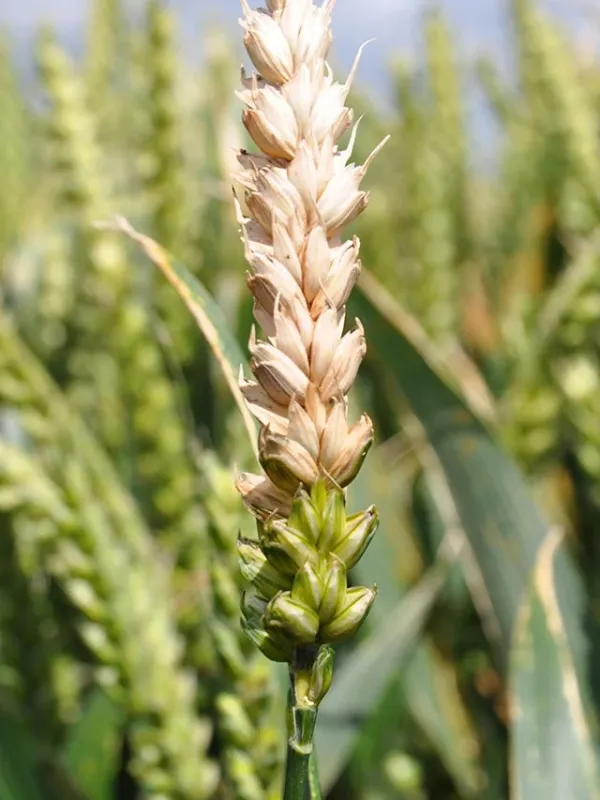
The most recognizable symptom is the premature bleaching of spikelets, which can appear as individual infected spikelets or the entire head turning prematurely white.
Under warm and humid conditions, orange or pinkish-red fungal mycelium and spore masses may become visible at the base of the infected glumes.
Infected grains often appear shriveled, discolored, or pinkish in appearance, and they are typically much lighter than healthy kernels.
The infection may spread through the rachis, causing the parts of the head above the infection site to die prematurely.
In the field, infected heads stand out clearly against the green or maturing healthy plants, a phenomenon often referred to as "blighted head."
Pathogen
The disease is caused by the fungus Fusarium culmorum, a prominent plant pathogen known for its ability to cause extensive damage to cereal crops worldwide.
This fungus survives primarily as mycelium or spores on infected crop debris, soil, and seeds, acting as the primary source of infection in the next season.
It affects various small grain cereals, with winter wheat being particularly susceptible during its flowering stage when the anthers are exposed.
The pathogen thrives by colonizing the head tissues, spreading rapidly throughout the rachis and preventing the proper development of grains.
A major concern regarding Fusarium culmorum is its capacity to produce harmful mycotoxins, such as deoxynivalenol, which pose severe health risks to humans and livestock.
Conditions for development
The development of the disease is highly dependent on environmental conditions, specifically during the flowering or anthesis stage of the wheat plant.
High relative humidity and frequent rainfall are critical for the dispersal of macroconidia and the subsequent infection of the wheat spikes.
Temperatures ranging from 20°C to 25°C are ideal for the rapid growth and sporulation of the fungus, leading to potential epidemics.
Field management practices that leave high amounts of crop residue on the surface provide a perfect niche for the fungus to persist and multiply.
Fields with tight crop rotations, especially those involving continuous wheat or corn, are at a significantly higher risk of disease outbreak.
Why it matters
The primary impact of Fusarium head blight is a substantial reduction in yield due to the production of light, shriveled, and non-viable grains.
The presence of mycotoxins in the harvest can lead to the total rejection of grain batches, causing severe economic losses for farmers.
Technological quality of the grain is severely compromised, resulting in poor flour quality and restricted use in the food and feed processing industries.
Even moderate levels of infection can cause significant losses by reducing the germination rate of seed, making it unsuitable for future sowing.
The disease is considered a major economic threat, forcing producers to invest in costly chemical applications and intensive post-harvest grain cleaning.
Protection
Preventative measures start with effective crop rotation, avoiding the sequence of wheat following corn, which is a known reservoir for the pathogen.
Incorporating crop residues into the soil via deep tillage helps speed up the decomposition process and reduces the overwintering inoculum.
Strategic application of systemic fungicides during the flowering period is the most effective approach to suppress infection during high-risk seasons.
- Selection of resistant or moderately resistant varieties.
- Use of high-quality fungicide-treated seeds.
- Timely harvesting to minimize further infection.
- Optimal drying and storage of grain post-harvest.
In brief
1
Affects crops
Biology
Pathogens and affected parts
Pathogens
Fusarium culmorum· fungus
Fusarium acuminatum· fungus
Fusarium scirpi· fungus
Gibberella acuminata· fungus
Microcera acuminata· fungus
Fusarium avenaceum· fungus
Fusisporium avenaceum· fungus
Gibberella avenacea· fungus
Fusarium cerealis· fungus
Nelson· fungus
Fusarium sambucinum· fungus
Fusisporium cerealis· fungus
Affected plant parts
ear
Content graph
Affects crops · 1
Content graph
Connections · Fusarium head blight
Most often together:
Marketplace
Products · 1019
All 1019
Wheat 580
Fungicides 312
Triticale 56
Rye 26
Tulips 11
Herbicides, Desiccants 8
Barley 8
Plant Growth Regulators 4
Corn 4
Hemp 2
Soybean 2
Fescue 2


Kolosal Pro
ЗАТ Фірма Август, Росія.,селище Вурнари,
Fungicides
1
1
·
5.2K
3 offers
20.51 €per 1 l
Buy





Unique
ТОВ «Фабрика агрохімікатів», Черкаси, Україна
Fungicides
0
0
·
1.6K
17 offers
6.75 €per 1 l
Buy


Fulgor 250
Фадер Альянс Лтд., Великобританія (Fader Alliance Ltd., England) на заводах Нідерландів, Польщі
Fungicides
0
0
·
1.2K
3 offers
7.3 €per 1 l
Buy


Impal
Три Дельта Компані Інтернешнл, Гонконг, Китай.
Fungicides
0
0
·
990
1 offer
0.39 €per pack
Buy




Carbon
«Нанджин Ессенс Файн-Кемікал Ко. Лтд» (Китай)
Fungicides
0
0
·
118
4 offers
9.27 €per 1 l
Buy


Selenivka Odeska
Pryvatne aktsionerne tovarystvo "Selena"
Wheat
0
0
·
110
1 offer
0.25 €per 1 kg
Buy


Community
Discussion
No discussions yet — be the first.