
Brachyplatys vahlii
Brachyplatys vahlii
Description
How to identify
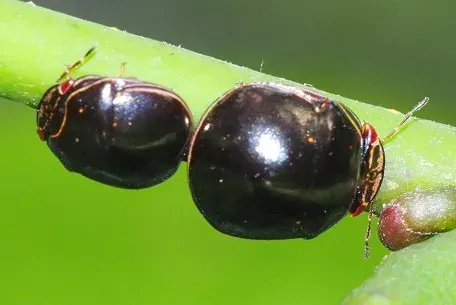
Brachyplatys vahlii belongs to the order Hemiptera and the family Plataspidae. These insects are easily recognized by their distinctively compact, globose body shape, which sets them apart from typical shield bugs.
Adults typically measure between 4 and 6 mm in length. Their coloration ranges from dark brown to glossy black with a metallic sheen, often featuring small, light-colored spots or markings along the margins of the elytra.
The head of the bug is small and closely pressed against the pronotum. A defining characteristic of the Plataspidae family is the large scutellum that extends to cover almost the entire abdomen and folded wings.
The life cycle of this pest includes the egg stage, five nymphal instars, and the adult stage. Females lay their eggs in tight, organized clusters on the underside of host plant leaves to protect the offspring.
Young nymphs are lighter in color and tend to be secretive, feeding on plant sap while progressively darkening as they molt and mature into the final adult stage.
What it damages
Brachyplatys vahlii primarily affects legume crops, including soybeans, beans, cowpeas, and various forage legumes. Within its range, it can damage both wild and agricultural plant species.
Both adults and nymphs possess piercing-sucking mouthparts. They use these to penetrate the epidermis of stems, petioles, and young pods to extract essential plant nutrients and sap.
High infestations lead to stunted plant growth. Damage to stems often causes deformation, and the loss of sap in young pods can lead to flower or pod abortion, directly reducing crop yield.
In addition to direct tissue damage, the feeding process creates entry points for secondary fungal and bacterial pathogens, which can exacerbate the decline of the plant health.
The level of damage tends to be significantly higher during drought conditions, as the plants are already under stress and the pest population can rapidly exploit the weakened crop.
Control measures
The primary control strategy involves strict crop rotation and the systematic removal of weeds, which often serve as host reservoirs for the pest population during the off-season.
Effective agrotechnical practices include deep plowing after harvest. This mechanical disruption helps eliminate the overwintering stages of the bugs that remain in soil or plant debris.
When infestation levels exceed the economic threshold, the application of systemic insecticides is recommended to effectively target sucking insects throughout their development.
Biological control plays a crucial role; promoting the presence of natural enemies, such as parasitic wasps, can help keep Brachyplatys vahlii populations below damaging levels.
- Frequent field phytosanitary monitoring
- Targeted insecticide applications on field borders
- Use of high-quality, pest-free seed
- Conservation of beneficial predatory insects
Taxonomy
- Latin name
- Brachyplatys vahlii
- Order
- Hemiptera (bugs, aphids, leafhoppers)
- Family
- Plataspidae
- EPPO code
- BRAPWA
Discussion
No discussions yet — be the first.