
Brachyplatys
Brachyplatys
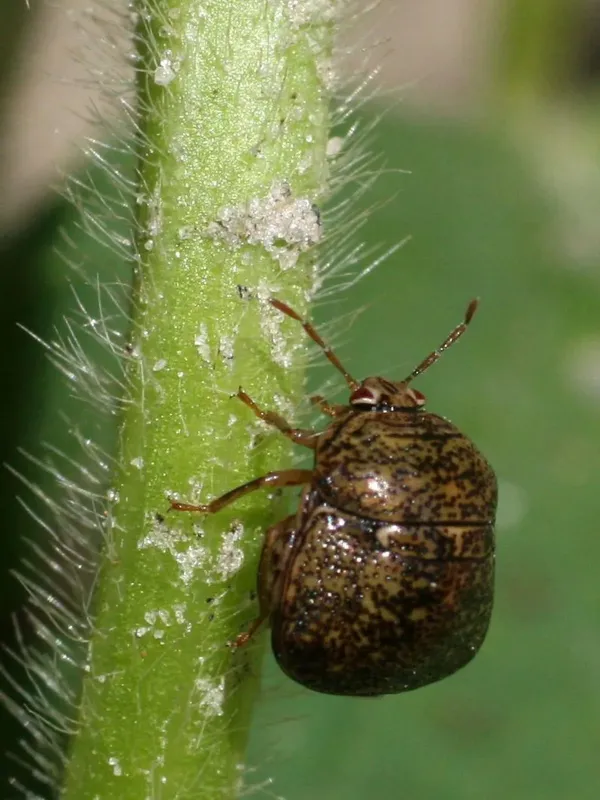
Description
How to identify
Brachyplatys is a genus of hemipteran insects belonging to the family Plataspidae. These small bugs have a distinctively broad, rounded body shape that resembles a shield, which is why they are often grouped with shield bugs.
Adult specimens typically range from 4 to 6 millimeters in length. Their coloration varies from dark brown to jet black, often featuring a metallic sheen or small light-colored spots along the edges of the shield-like body.
Systematically, these pests are classified within the superfamily Pentatomoidea. They are easily distinguished from other true bugs by their very wide scutellum, which completely covers the abdomen and hides the wings when folded.
The life cycle includes the egg stage, five nymphal instars, and the adult stage. Nymphs of early instars often stay in groups, making them easier to spot during the early stages of crop development.
These insects possess a specialized piercing-sucking mouthpart, allowing them to penetrate plant tissues and feed on cellular sap effectively throughout the growing season.
What it damages
The primary crops attacked by Brachyplatys are members of the legume family. This pest poses a significant threat to soybeans, beans, chickpeas, and various other pulse crops.
In tropical and subtropical climates, this pest can cause substantial damage by feeding on stems, leaf petioles, and developing pods, which leads to plant exhaustion and yield reduction.
Beyond direct feeding damage, these bugs are known to be vectors of phytoplasma diseases, which can cause severe plant deformation and significantly lower the quality of the harvested produce.
High population densities on a single plant weaken the host's immune system, making it more susceptible to secondary infections, fungal diseases, and environmental stress factors.
Economic damage depends on the region and the crop stage, but heavy infestations can result in yield losses ranging from 15 to 30 percent if management actions are not implemented in time.
When it appears
The activity of Brachyplatys is highly dependent on temperature and photoperiod. In most regions, the mass emergence of the pest coincides with the active growth phase of legume crops.
Overwintering adults become active as soon as stable warm weather arrives. During spring, they occupy wild host plants that serve as reservoirs before migrating to cultivated fields.
The most dangerous period occurs during the flowering and pod-setting stages. This is when the population peaks, and mass migration of bugs onto soybean and other pulse fields is observed.
Throughout the season, Brachyplatys can produce multiple generations, which complicates control measures, as nymphs of various instars and adults may be present simultaneously in the field.
Towards the end of the season, as temperatures drop and the host plants mature, the adults move to overwintering sites, hiding in crop residues or under tree bark in nearby windbreaks.
Signs of infestation
The main sign of infestation is the presence of clustered colonies of bugs on the undersides of leaves or along the internodes of stems, where they congregate to feed.
Upon close inspection, one can identify characteristic puncture marks on stems and petioles, which eventually turn brown or black due to the necrosis of the damaged plant tissues.
Affected pods are often underdeveloped, deformed, or display dark spots at the puncture sites, which can lead to shriveled seeds with reduced germination rates.
Leaves may turn yellow and drop prematurely under heavy infestation, mimicking signs of nutrient deficiency or drought stress during hot periods.
- Yellowing of leaf margins.
- Presence of dark necrotic spots on young pods.
- A specific, unpleasant odor near massive bug congregations.
- Stunted growth of side shoots and overall plant weakness.
Control measures
Effective protection against Brachyplatys requires an integrated approach that combines agricultural, biological, and chemical methods to control population numbers.
Agricultural practices include deep plowing after harvest and the removal of weed reservoirs around field edges, which significantly reduces the number of overwintering individuals.
Adhering to crop rotation schedules and optimal planting times helps crops pass through the most vulnerable growth stages before the peak activity of the pest, minimizing damage risks.
When the economic threshold is reached, chemical applications using systemic and contact insecticides are recommended, strictly following dosage and application regulations.
Biological control involves the preservation and augmentation of natural enemies, such as egg parasitoids, which are capable of naturally limiting the pest population within the agroecosystem.
Taxonomy
- Latin name
- Brachyplatys
- Order
- Hemiptera (bugs, aphids, leafhoppers)
- Family
- Plataspidae
- EPPO code
- BRAPSP
Discussion
No discussions yet — be the first.