
Kudzu bug
Coptosoma
Description
How to identify
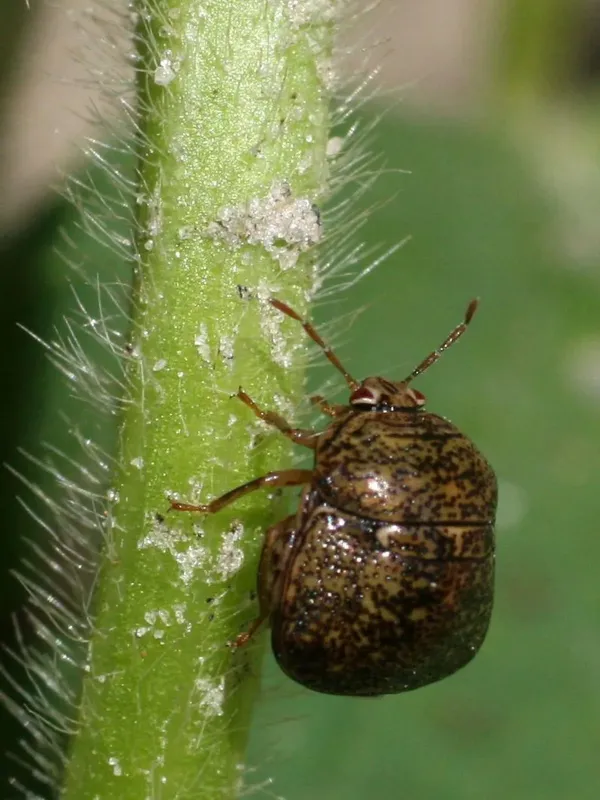
The Kudzu bug (Coptosoma) belongs to the Plataspidae family, order Hemiptera. The adult insect is easily identified by its characteristic rounded, almost hemispherical body shape and a dense scutellum that completely covers the abdomen and wings.
The coloration of adults ranges from dark brown to almost black, sometimes with a metallic sheen or fine light speckles. Adult individuals measure between 4 and 6 millimeters, making them compact and elusive pests within the crop canopy.
The nymphs of the bug go through five developmental stages (instars), gradually increasing in size and acquiring a coloration close to the adult form. They differ by having a flatter body and lacking fully developed membranous wings.
Females lay eggs in specific batches, usually on the underside of leaves or on the stems of host plants. A clutch typically consists of two parallel rows containing 15 to 20 cylindrical eggs.
The life cycle includes the egg stage, five nymphal instars, and the adult stage. In warmer climatic zones, several generations can develop per season, which significantly complicates population control efforts.
What it damages
The primary food source for the Kudzu bug is legumes. The insect causes the greatest damage to crops such as soybeans, beans, peas, and alfalfa by sucking cell sap from stems, leaves, and developing seed pods.
Damage to reproductive plant parts — ovaries and pods — leads to premature shedding or deformation. As a result, agronomists record significant yield losses and a decline in the quality of the seed material.
In areas where plant tissues are punctured, outbreaks of fungal and bacterial infections often occur. A weakened plant becomes more susceptible to secondary pathogens, which further reduces the overall phytosanitary stability of the agroecosystem.
The harm caused by these bugs is exacerbated during drought periods when plants suffer from water deficiency. Active sap-sucking during periods of water stress accelerates the wilting and death of the generative parts of legume crops.
Mass reproduction of the Kudzu bug can destroy a significant portion of the future crop during the early stages of pod formation. Therefore, monitoring population density during the flowering stage is critical for farming operations.
Signs of infestation
The first sign of infestation is the presence of specific brown or yellowish spots on leaves, which eventually merge to cause tissue chlorosis. Under severe pressure, plants slow down their growth and lag in development.
Upon inspecting the underside of leaves or stems, one can find colonies of bugs at various developmental stages. Adults often hide in leaf axils, making them difficult to detect during quick field surveys.
The presence of empty or deformed pods during the grain-filling period indicates active feeding by adults and older nymphs. Dissecting damaged pods often reveals shriveled or underdeveloped seeds.
A characteristic sign is bug excrement appearing as tiny dark dots on the surface of vegetative organs. When the pest population is high, a specific, sharp odor characteristic of many bug species may be noticeable in the field.
Damaged sections of the field look stunted, with clear signs of stem deformation in areas of intense feeding. When plants are shaken, the bugs may fall to the ground and feign death.
Control measures
Effective protection against the Kudzu bug is based on a comprehensive approach. An important agronomic practice is the timely management of weeds, which serve as reservoirs for the pest population between seasons.
Adhering to crop rotation and spatial isolation of legume fields from the previous year's planting sites reduces the likelihood of early bug migration. It is also important to perform high-quality deep soil tillage after harvesting.
Chemical control involves the use of contact-stomach insecticides during periods of active nymphal emergence. Treatments are most effective when the economic threshold of damage is reached, which is typically 5–10 individuals per meter of row.
- Application of pyrethroid and organophosphate-based insecticides.
- Conducting treatments in the early morning or evening to ensure maximum population coverage.
- Regular field monitoring using yellow sticky traps.
Biological control can involve the use of entomophages, such as the egg parasitoid Telenomus, which targets Kudzu bug clutches. Maintaining biodiversity along field edges helps attract natural enemies of the bug.
Taxonomy
- Latin name
- Coptosoma
- Order
- Hemiptera (bugs, aphids, leafhoppers)
- Family
- Plataspidae
- EPPO code
- COPSSP
Discussion
No discussions yet — be the first.