

Disease
Especially harmful
Potato cyst nematode
Globodera rostochiensis
Description
Symptoms
Visible symptoms often appear in patches within the field where plants are stunted, weak, and show signs of poor development compared to healthy ones.
Foliar symptoms include premature yellowing and wilting, starting from the lower leaves and moving upwards, often mimicking the appearance of drought stress.
The root system may exhibit excessive lateral branching, a condition known as "root proliferation" or "beardiness," as the plant attempts to compensate for damage.
Tuber production is significantly affected, resulting in a reduced number of tubers, smaller sizes, and lower overall quality of the yield.
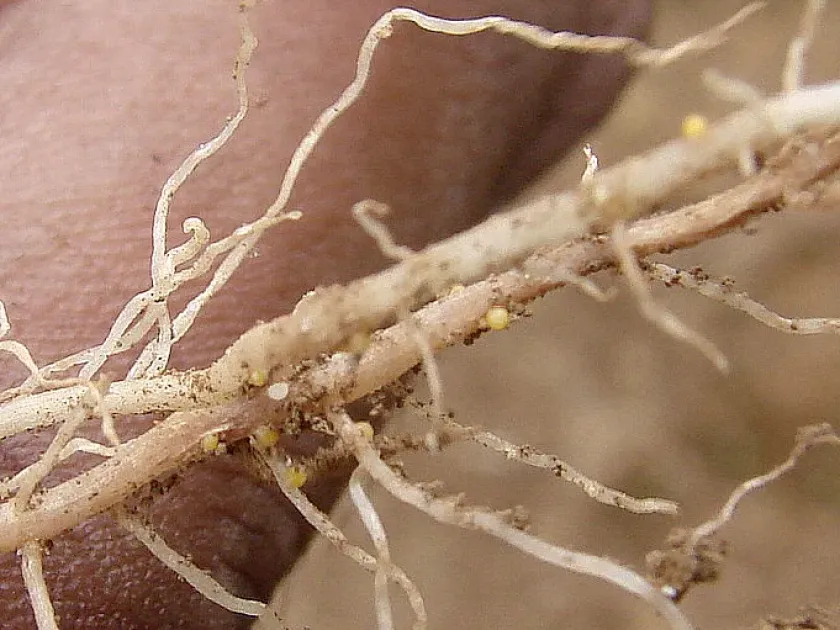
In cases of severe infestation, the golden or brown cysts can be seen attached to the roots when they are carefully dug out and cleaned of soil.
Pathogen
The causative agent of the disease is the microscopic soil-borne nematode Globodera rostochiensis, which belongs to the Heteroderidae family. It is a severe quarantine pest for solanaceous crops.
The nematode's lifecycle involves the formation of cysts, which are the hardened outer bodies of females containing eggs and larvae. These cysts can survive in the soil for up to 12 years.
As an endoparasite, the nematode larvae penetrate the potato roots, where they feed and develop, severely impacting the plant's ability to absorb water and nutrients.
Once the female reaches maturity, it breaks through the root surface, becoming visible as a small, golden-yellow spherical structure, which eventually falls into the soil.
The reproduction rate of this nematode is extremely high, allowing it to rapidly build up population densities in fields that are continuously cropped with potatoes.
Conditions for development
The development of Globodera rostochiensis is favored by temperate climates, with soil temperatures ranging from 15°C to 20°C during the growing season.
The spread of the nematode is mainly driven by human activity: contaminated machinery, farm equipment, tools, and infested seed potatoes are the primary vectors.
Light, sandy soils provide an environment that facilitates the movement of juveniles in search of new root systems, accelerating the spread within a field.
Continuous cropping of potatoes without adequate rotation periods is the leading cause of massive nematode buildup in the soil.
Cysts have a robust protective shell, making them highly resistant to environmental stressors, allowing them to persist in the field for over a decade.
Why it matters
The damage caused by the potato cyst nematode can lead to substantial yield losses, sometimes exceeding 80% in highly infested fields, making it an economic threat.
Infested tubers may lose their marketability due to reduced size and impaired appearance, rendering them unsuitable for commercial sales.
Because it is a quarantine pest, its detection leads to strict regulatory control, which may restrict the movement of produce and seeds from the infested area.
The plant's reduced nutrient uptake capacity makes it more susceptible to secondary infections, further weakening the crop and decreasing overall field vitality.
Restoring the soil to a productive state after an infestation requires long-term management strategies and can be costly for agricultural businesses.
Protection
Integrated Pest Management (IPM) is essential, with crop rotation using non-host crops being the most effective tool to decrease the nematode population in the soil.
The cultivation of resistant potato cultivars is the cornerstone of control, as these varieties prevent the nematode from successfully completing its lifecycle.
Strict hygiene practices on the farm, including the cleaning of machinery and tools between fields, are critical to prevent the cross-contamination of clean soil.
Soil testing and monitoring are vital for early detection, allowing for quick quarantine measures and targeted management actions.
- Use of resistant potato varieties.
- Implementation of 3 to 4-year crop rotation cycles.
- Use of trap crops like white mustard or oil radish.
- Rigorous decontamination of farm equipment.
- Regular soil analysis in certified laboratories.
Content graph
Connections · Potato cyst nematode
Most often together:
Marketplace
Products · 240























Community
Discussion
No discussions yet — be the first.