

Onion smut
Urocystis colchici
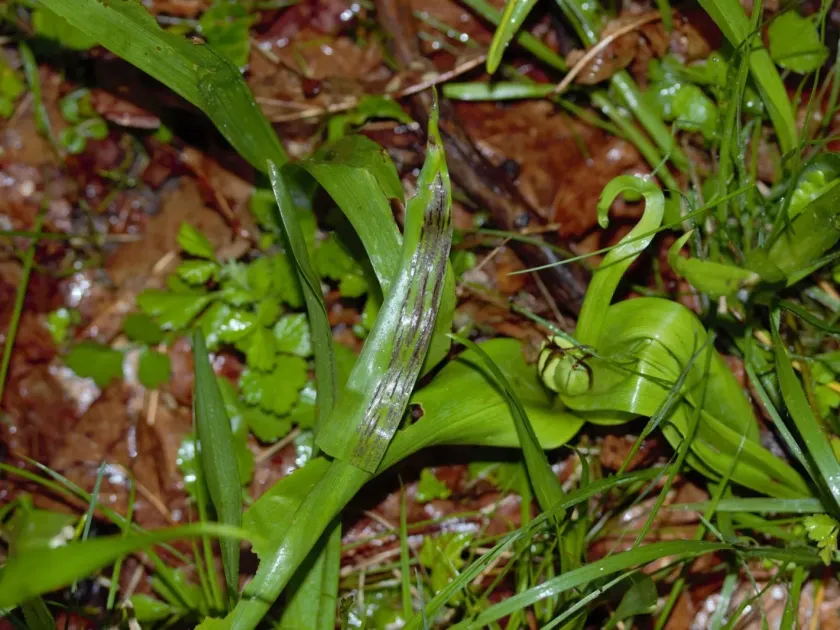
Description
Symptoms
Symptoms appear early in the development of the plant, often on the cotyledons or the first true leaves. The plants exhibit elongated, raised stripes or swellings of a greyish color.
As the fungal spores mature, the epidermis over these swellings splits open, revealing a dusty black mass of spores that can be easily spread by wind or irrigation.
Affected leaves often exhibit significant deformation, twisting, and premature browning or dying. Severely infected seedlings may wilt and die shortly after emergence.
In mature plants, the internal tissues of the bulb may turn black and become mushy due to the intense colonization by fungal spores.
Visual diagnostic signs are often confirmed by the presence of these distinctive black, sooty lesions on the foliage and within the bulb scales.
Pathogen
The causative agent of this disease is the fungus Urocystis colchici. This is an obligate parasite that specifically infects members of the Amaryllidaceae family, including bulb onions, garlic, and several ornamental species like dahlias.
The pathogen survives in the soil primarily as teliospores, which can remain viable for several years. Infection typically occurs during the germination stage, targeting the tender tissues of young seedlings.
Once inside, the fungal mycelium grows systemically, spreading through the bulb and leaves. As the fungus matures, it produces characteristic black spore masses that rupture the plant epidermis.
Dispersal primarily occurs through infected sets, bulbs, or the movement of contaminated soil particles by farm equipment or water runoff.
Due to the long-term survival capability of the spores in the soil, managing this disease requires sustained efforts and strict sanitary practices in the field.
Conditions for development
The development of onion smut is heavily dependent on soil temperature during the germination phase. The fungus thrives at moderate temperatures, typically between 10°C and 20°C.
Early-season planting in cold, damp soil significantly increases the risk of infection, as seedling growth is slow, giving the fungus a longer window to invade the host tissues.
Conversely, soil temperatures exceeding 25°C generally suppress the activity of the fungus, making late-season planting a common strategy in certain regions.
Poorly drained or waterlogged soils create a favorable microclimate for the spores to germinate and infect the root zone of the onions.
Continuous cropping of onion or garlic on the same land contributes to a high buildup of soil-borne inoculum over time.
Why it matters
Onion smut causes substantial economic losses by significantly reducing plant density during the seedling emergence stage.
The disease limits the potential for healthy bulb development, resulting in stunted, non-marketable onions that are prone to further rot.
Infected bulbs are highly susceptible to secondary infections and have very poor storage qualities, leading to further losses post-harvest.
Fields with significant smut pressure often require total abandonment for onion production for several years, causing disruption in crop rotation plans.
The spread of this pathogen poses a persistent threat to commercial operations, necessitating rigorous biosecurity measures for every new planting season.
Protection
Implementing a long-term crop rotation plan (at least 5–6 years without onion or garlic) is the most effective way to reduce soil-borne spore populations.
Sourcing and planting disease-free sets and high-quality seeds is critical to preventing the introduction of the pathogen into clean fields.
Adjusting planting dates to ensure that seedlings germinate in warmer soil can help the plants outgrow the most susceptible development stage.
Regular field scouting and the immediate roguing and destruction of symptomatic plants can help limit the spread of inoculum during the growing season.
The use of approved systemic fungicides as seed treatments or soil applications at the time of planting provides essential protection against Urocystis colchici.
In brief
3
Affects crops
Biology
Pathogens and affected parts
Affected plant parts
whole plant
Content graph
Affects crops · 3
Content graph
Connections · Onion smut
Most often together:
Marketplace
Products · 3043
All 3043
Corn 1726
Wheat 621
Barley 337
Oats 95
Fungicides 65
Millet 45
Sweet Corn 44
Sorghum 43
Triticale 40
Sunflower 8
Soybean 4
Rye 3





VOLOSHINKA
ФГБОУ ВО Омский государственный аграрный университет имени П.А. Столыпина
Wheat
0
0
·
48
1 offer
2.76 €per pack
Buy


Community
Discussion
No discussions yet — be the first.