
Disease · fungal · affects Rye, Winter barley, Winter wheat
Especially harmful
Dwarf bunt
Tilletia spp.
Description
Symptoms
The most distinctive symptom of dwarf bunt is severe stunting. Infected plants are significantly shorter than healthy ones, often reaching only half or one-third of their normal height.
Plants exhibit increased tillering, creating a stunted, brush-like appearance. Many of these tillers are malformed and fail to develop properly or emerge completely.
Spikes of infected plants are often deformed and may remain partially enclosed within the leaf sheath. They are typically wider and shorter than healthy heads, with twisted awns.
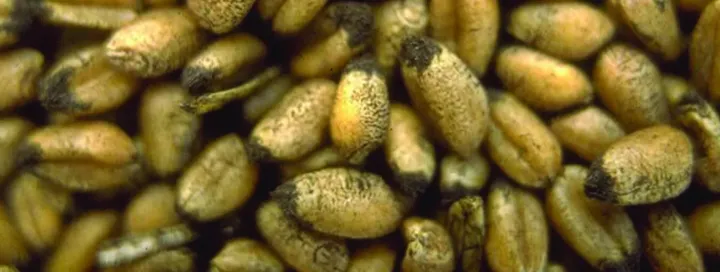
Instead of healthy kernels, the plant develops bunt balls. These are oval-shaped, hard structures filled with a dark, powdery mass of teliospores that release a fishy odor due to the presence of trimethylamine.
The disease is easily identified during the ripening stage, as the infected heads remain green longer than healthy ones and the bunt balls may rupture, releasing spores during harvest.
Pathogen
Dwarf bunt is caused by the fungus Tilletia controversa (Kühn). This highly specialized pathogen belongs to the Basidiomycota phylum and specifically targets winter cereal crops.
The fungus is soil-borne and can remain viable in the soil for several years in the form of dormant teliospores. This longevity makes it a persistent threat in agricultural fields with a history of the disease.
Unlike other bunt species, this pathogen requires specific environmental triggers, including a period of cold temperatures, to break the dormancy of the teliospores.
It is a systemic disease. Infection typically occurs at the seedling stage, when the fungus penetrates the coleoptile. The mycelium then grows internally with the plant, finally replacing the grain with spore masses.
Host crops include winter wheat, winter barley, and rye. Severe infestations can cause catastrophic yield losses and significantly downgrade grain quality for commercial use.
Conditions for development
The development of dwarf bunt is highly dependent on meteorological conditions during the autumn growing season. Optimal infection occurs at temperatures between 5 and 10 degrees Celsius.
Prolonged snow cover on unfrozen soil provides the ideal environment for teliospore germination and seedling infection. This is why the disease is prevalent in regions with long, cold winters.
High soil moisture during the seedling emergence stage is critical for the fungus to successfully colonize the host plant. Dry conditions are generally unfavorable for the pathogen.
Shallow planting or deep burial of seeds can influence infection rates. In some conditions, deep sowing keeps the seedling in the infection zone longer, increasing the risk of attack.
The presence of spore inoculum in the soil is the primary driver of infection. Continuous cropping of susceptible winter cereals leads to an accumulation of spores, creating a high-risk environment.
Why it matters
The primary damage caused by dwarf bunt is the total loss of grain production in infected tillers, as the entire kernel is replaced by fungal spores.
The disease poses a significant quality risk. Contamination of healthy grain with spores during harvest can ruin the entire batch, rendering it unfit for milling or animal feed due to the unpleasant smell and potential toxins.
Export markets have strict zero-tolerance policies for bunt spores. A single shipment testing positive can lead to significant economic losses, including rejection and loss of market access.
Infected fields suffer from reduced plant density and uneven growth, which impairs the competitive ability of the crop against weeds and reduces overall nitrogen-use efficiency.
The economic impact extends to the cost of cleaning harvesting equipment, managing contaminated soil, and the potential need for expensive long-term crop rotation changes.
Protection
The first line of defense is the use of high-quality, certified, and clean seed. Ensuring that planting material is free from bunt spores is essential for preventing the initial introduction of the fungus.
Chemical seed treatment using systemic fungicides, such as triazoles, is highly effective. These treatments protect the seedling during the vulnerable period of infection.
Implementing a sound crop rotation is vital. Avoiding winter cereals on the same field for at least 3 to 4 years helps reduce the inoculum density of teliospores in the soil.
Adjusting planting dates to avoid favorable conditions for fungus germination during the autumn can significantly reduce infection pressure, though this must be balanced with the best practices for crop development.
Breeding for genetic resistance is the most sustainable approach. Utilizing cultivars with demonstrated resistance to Tilletia controversa is the cornerstone of effective long-term disease management.
In brief
3
Affects crops
Biology
Pathogens and affected parts
Pathogens
Affected plant parts
whole plant
Content graph
Affects crops · 3
Reference
Connections · Dwarf bunt
Most often together:
Marketplace
Products · 5


Community
Discussion
No discussions yet — be the first.