
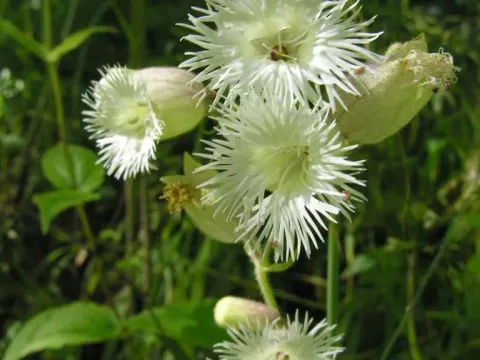
Campion
Silene L.
The genus Silene L., commonly known as campion or catchfly, belongs to the Caryophyllaceae family and contains a diverse array of species.
What the section contains
 Alpine catchfly
Silene suecica (hort. Lodd.) Greuter & Burdet
Alpine catchfly
Silene suecica (hort. Lodd.) Greuter & Burdet
 Arkwright's Campion
Silene x arkwrightii (Heydt) hort., nom. inval.
Arkwright's Campion
Silene x arkwrightii (Heydt) hort., nom. inval.
 Bladder campion
Silene vulgaris (Moench) Garcke
Bladder campion
Silene vulgaris (Moench) Garcke
 Catchfly
Silene asterias x Silene noctiflora
Catchfly
Silene asterias x Silene noctiflora
 Drooping Catchfly
Silene pendula L.
Drooping Catchfly
Silene pendula L.
 Fire pink
Silene virginica L.
Fire pink
Silene virginica L.
 Forked catchfly
Silene dichotoma Ehrh.
Forked catchfly
Silene dichotoma Ehrh.
 Jupiter's distaff
Silene flos-jovis (L.) Greuter & Burdet
Jupiter's distaff
Silene flos-jovis (L.) Greuter & Burdet
 Maltese Cross
Silene chalcedonica (L.) E. H. L. Krause
Maltese Cross
Silene chalcedonica (L.) E. H. L. Krause
 Moss campion
Silene acaulis (L.) Jacq.
Moss campion
Silene acaulis (L.) Jacq.
 Night-flowering catchfly
Silene noctiflora L.
Night-flowering catchfly
Silene noctiflora L.
 Ragged-robin
Silene flos-cuculi (L.) Greuter & Burdet
Ragged-robin
Silene flos-cuculi (L.) Greuter & Burdet
 Red campion
Silene dioica (L.) Clairv.
Red campion
Silene dioica (L.) Clairv.
 Rose campion
Silene coronaria (L.) Clairv.
Rose campion
Silene coronaria (L.) Clairv.
 Rose of Heaven
Silene coeli-rosa (L.) Godr.
Rose of Heaven
Silene coeli-rosa (L.) Godr.
 Sea campion
Silene uniflora Roth
Sea campion
Silene uniflora Roth
 Silene banksia
 (Meerb.) Mabb.
Silene cognata
Silene cognata (Maxim.) H. Ohashi & H. Nakai
Silene banksia
Silene banksia (Meerb.) Mabb.
Silene cognata
Silene cognata (Maxim.) H. Ohashi & H. Nakai
 Silene gallica
 L.
Silene gallica
Silene gallica L.
 Sleepy silene
Silene antirrhina L.
Starry catchfly
Silene asterias Griseb.
Sleepy silene
Silene antirrhina L.
Starry catchfly
Silene asterias Griseb.
 Sticky catchfly
Silene viscaria (L.) Borkh.
Sticky catchfly
Silene viscaria (L.) Borkh.
 Sticky catchfly
Silene viscaria (L.) Jess. subsp. viscaria
Sticky catchfly
Silene viscaria (L.) Jess. subsp. viscaria
 Sticky catchfly hybrid
Silene suecica x Silene viscaria
Sticky catchfly hybrid
Silene suecica x Silene viscaria
 White campion
Silene latifolia Poir.
White campion
Silene latifolia Poir. subsp. alba (Mill.) Greuter & Burdet
White campion
Silene latifolia Poir.
White campion
Silene latifolia Poir. subsp. alba (Mill.) Greuter & Burdet
Campion
Seeds are typically sown in early spring, once the soil has warmed sufficiently, allowing for consistent germination across the seedbed.
For ornamental varieties, starting plants in trays or greenhouse pots is a preferred method to ensure robust seedlings before transplanting.
The seeds are small and should be sown shallowly, ideally covered with a very light layer of soil to maintain contact while allowing light access.
Proper spacing is crucial for airflow; planting at 20–30 cm intervals helps prevent the development of foliage diseases during the growth season.
Silene species generally thrive in sunny environments, although they are adaptable and can tolerate partial shade in hotter climates.
They prefer well-drained, fertile soil, as they are susceptible to root rot if the growing medium remains persistently waterlogged.
These plants are remarkably hardy, with many species capable of enduring significant temperature fluctuations throughout the year.
Regular maintenance involves keeping the area free of weeds, as Silene can sometimes be outcompeted by more aggressive herbaceous species.
Minimal fertilization is usually sufficient; excessive nitrogen may result in overly lush vegetative growth at the expense of flower production.
Common pests affecting Silene include aphids, which cluster on tender stems and buds, and various leaf-eating beetle larvae.
Fungal issues, particularly powdery mildew, can occur if humidity levels are high and circulation around the foliage is restricted.
Integrated pest management, including the use of targeted insecticides or biological controls, is effective in managing population outbreaks.
Practicing good sanitation, such as removing infected stems immediately, is key to controlling the spread of disease within the garden.
Choosing resistant cultivars or planting in well-ventilated locations can significantly reduce the need for intensive chemical interventions.
Harvesting seeds requires timing the collection for when the seed capsules turn brown and begin to dry out naturally on the stalk.
Care must be taken to harvest before the capsules dehisce and release their seeds, which is a common occurrence in many wild species.
After collection, the capsules should be air-dried in a sheltered, dry location before being threshed to separate the seeds from debris.
Stored in cool, dry conditions, the seeds maintain their viability for multiple seasons, making them suitable for long-term propagation.
Deadheading spent flowers is a recommended practice to maintain the plant's health and encourage a potential second flush of blooms.