
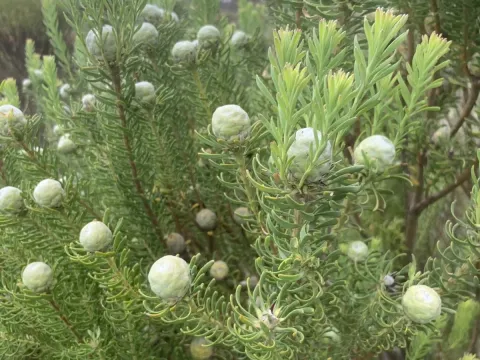
Leucadendron
Leucadendron R. Br.
Leucadendron is a genus of flowering plants in the Proteaceae family, native to South Africa. These woody shrubs are highly valued in commercial agriculture for their unique, colorful bracts which are widely used in the international floral industry.
What the section contains
 Hybrids of Leucadendron salignum and Leucadendron discolor
hybrids between Leucadendron salignum and Leucadendron discolor
Hybrids of Leucadendron salignum and Leucadendron discolor
hybrids between Leucadendron salignum and Leucadendron discolor
 Leucadendron
 discolor x Leucadendron laureolum
Leucadendron
Leucadendron discolor x Leucadendron laureolum
 Leucadendron
 spissifolium x Leucadendron discolor
Leucadendron
Leucadendron spissifolium x Leucadendron discolor
 Leucadendron
 salicifolium x Leucadendron procerum
Leucadendron
Leucadendron salicifolium x Leucadendron procerum
 Leucadendron
 uliginosum x discolor
Leucadendron
Leucadendron uliginosum x discolor
 Leucadendron conicum
 (Lam.) I. Williams
Leucadendron discolor
Leucadendron discolor E. Phillips & Hutch.
Leucadendron conicum
Leucadendron conicum (Lam.) I. Williams
Leucadendron discolor
Leucadendron discolor E. Phillips & Hutch.
 Leucadendron floridum
 R. Br.
Leucadendron floridum
Leucadendron floridum R. Br.
 Leucadendron gandogerii
Leucadendron gandogerii
Leucadendron gandogerii
 Leucadendron gandogerii x spissifolium
Leucadendron gandogerii x spissifolium
Leucadendron gandogerii x spissifolium
 Leucadendron laureolum
 (Lam.) Fourc.
Leucadendron laureolum
Leucadendron laureolum (Lam.) Fourc.
 Leucadendron Laureolum x Salignum
hybrids between Leucadendron laureolum and Leucadendron salignum
Leucadendron Laureolum x Salignum
hybrids between Leucadendron laureolum and Leucadendron salignum
 Leucadendron procerum
 (Salisb.) I. Williams
Leucadendron procerum
Leucadendron procerum (Salisb.) I. Williams
 Leucadendron salignum
 P. J. Bergius
Leucadendron spissifolium
Leucadendron spissifolium
Leucadendron salignum
Leucadendron salignum P. J. Bergius
Leucadendron spissifolium
Leucadendron spissifolium
 Leucadendron uliginosum
Willow-leaf Conebush
Leucadendron salicifolium (Salisb.) I. Williams
Leucadendron uliginosum
Leucadendron uliginosum
Willow-leaf Conebush
Leucadendron salicifolium (Salisb.) I. Williams
Leucadendron
The culture thrives in Mediterranean climates with distinct wet and dry seasons. It requires full sun exposure to maintain the vibrancy of its foliage and bracts. Protecting plants from frost is critical, as they are not hardy in freezing conditions.
Soil requirements are strict: the plants need deep, well-drained, acidic sandy soils. Good drainage is non-negotiable because the root system is extremely prone to root rot if the substrate remains saturated for extended periods.
Fertilization must be handled with extreme care. Leucadendrons have specialized root structures known as proteoid roots, which efficiently absorb nutrients. High levels of phosphorus are highly toxic to them, so specialized low-phosphorus fertilizers are mandatory.
Productivity depends on precise pruning techniques. Regular harvesting and pruning help maintain bush shape, improve air circulation, and stimulate the production of new flowering stems for the next season.
Phytophthora root rot is the most devastating disease for Leucadendron crops. It is often triggered by poor drainage or contaminated water sources, leading to sudden wilting and death of the plant.
Insect pests, including mealybugs and scale insects, frequently infest the stems. Their feeding weakens the plant and leaves honeydew deposits that promote the growth of sooty mold, damaging the aesthetic quality of the cut stems.
Integrated Pest Management (IPM) is highly recommended. This includes regular scouting for pests, using biological control agents in greenhouses, and applying selective insecticides only when necessary.
Fungal leaf spots can also be an issue, especially in high-humidity areas. Maintaining good airflow by spacing plants appropriately and removing infected debris helps to suppress the spread of fungal spores.
Strict hygiene protocols, such as disinfecting tools between plants and monitoring soil moisture sensors, are essential practices for any professional farmer to minimize biological risks and ensure a high-quality harvest.