
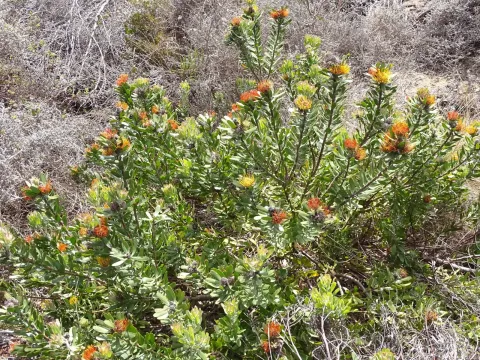
Leucospermum
Leucospermum
Leucospermum, belonging to the Proteaceae family, is a highly sought-after ornamental crop. Propagation is typically achieved through seeds requiring stratification or via semi-hardwood cuttings under controlled greenhouse conditions.
What the section contains
 Eucalyptus-leaf pincushion
Leucospermum eucalyptifolium
Eucalyptus-leaf pincushion
Leucospermum eucalyptifolium
 Leucospermum bolusii
Leucospermum bolusii
Leucospermum bolusii
 Leucospermum conocarpodendron
Leucospermum conocarpodendron
Leucospermum conocarpodendron
 Leucospermum fulgens
Leucospermum fulgens
Leucospermum fulgens
 Leucospermum grandiflorum
Leucospermum grandiflorum
Leucospermum grandiflorum
 Leucospermum hybrid
s
Leucospermum hybrid
Leucospermum hybrids
 Leucospermum saxosum
Leucospermum saxosum
Leucospermum saxosum
 Leucospermum truncatulum
Leucospermum truncatulum
Leucospermum truncatulum
 Leucospermum vestitum
Leucospermum vestitum
Leucospermum vestitum
 Rocket pincushion
Leucospermum reflexum
Rocket pincushion
Leucospermum reflexum
Leucospermum
Seeds are sown in a lightweight, well-draining substrate with low phosphorus levels. Success depends on maintaining a stable temperature range, as seedlings are particularly sensitive to environmental fluctuations during the early stages of development.
Cuttings are the preferred method for commercial nurseries to ensure genetic uniformity. Stems are treated with rooting hormones and maintained in high-humidity environments with moderate bottom heat to encourage vigorous root development.
When grown from seeds, germination can be irregular, necessitating careful moisture management. Once seedlings reach a height of 10-15 cm, they are transplanted into individual containers or prepared field plots.
Commercial plantations often employ drip irrigation systems to deliver precise water amounts to the root zone. This targeted approach is essential to prevent waterlogging and root rot, which are common issues in Proteaceae cultivation.
Leucospermum is a heat-loving plant native to South Africa, thriving only in Mediterranean or subtropical climates. It is highly intolerant to frost, making open-field cultivation viable only in frost-free regions.
Soil requirements are strict: the plants demand acidic, sandy, or rocky soil with exceptional drainage. Organic matter should be kept to a minimum, as Proteaceae have evolved to thrive in nutrient-poor conditions.
Full, direct sunlight is vital throughout the year. Insufficient light levels will lead to poor flower production, spindly stem growth, and a significant decrease in the plant's overall aesthetic and commercial quality.
Moderate humidity levels are necessary, combined with excellent airflow. Stagnant air and excessive moisture often lead to fungal pathogens, making greenhouse ventilation a key aspect of farm management.
Maintenance includes regular pruning immediately after the flowering season. This practice not only shapes the bush but also stimulates the growth of new stems that will bear next year's flower buds.
Yield depends on plant maturity and adherence to specific horticultural practices. Productive flowering typically begins at 3-4 years of age, with maximum yields achieved between the 6th and 8th year.
A healthy, mature bush can produce between 20 and 50 flower stems per season. Standard commercial planting densities usually range from 2,500 to 3,000 plants per hectare, depending on the cultivar and soil conditions.
Market quality is dictated by stem length and inflorescence size. High-grade flowers must have sturdy, upright stems capable of supporting the weight of the dense, decorative flower heads.
Yield decreases rapidly if incorrect fertilizers are used. Specialized fertilizers with very low phosphorus content are mandatory, as the root systems of Proteaceae are easily damaged by high nutrient concentrations.
Harvested products require immediate cooling to +2...+4°C. Proper cold-chain management is critical for maintaining quality during export and extending the shelf life of the flowers.
Phytophthora root rot is the most devastating threat to Leucospermum plantations, usually triggered by poor soil drainage and waterlogging. Once infected, plants are often impossible to save.
Common pests include mealybugs and spider mites. These insects feed on young succulent shoots, causing tissue deformity and reducing the commercial value of the flower stems.
- Phytophthora — causes fatal root and crown rot.
- Botrytis (Grey Mold) — infects inflorescences in high humidity.
- Spider Mites — damage leaves during hot, dry periods.
- Mealybugs — congregate in leaf axils, stunting overall growth.
Integrated Pest Management (IPM) is recommended, utilizing systematic insecticide applications while rotating active ingredients to prevent pest resistance. Preventive monitoring is key to success.
Farm hygiene is crucial. Removing dead leaves and debris helps prevent the spread of pathogens. Ensuring proper spacing between plants also assists in maintaining the health of the entire plantation.
Harvesting is performed when the inflorescence is approximately 30-50% open. Timing is precise: early cutting results in flowers that never fully bloom, while late harvesting leads to rapid deterioration.
Stems are cut with sharp, sterilized tools. It is essential to leave at least 2-3 layers of foliage on the bush to ensure the plant has enough energy reserves to recover and produce in the next season.
Harvesting is best conducted during the early morning hours to ensure maximum turgor pressure in the stems. This enhances the vase life and durability of the flowers during subsequent packing and transport.
Freshly cut stems are placed in water treated with anti-bacterial agents. Because Proteaceae stems are prone to vascular blockage, water quality and hygiene are absolute necessities for post-harvest longevity.
After sorting and grading, flowers are packaged carefully to avoid mechanical bruising of the intricate floral structures. Consistent temperature control is maintained until the final sale point.