
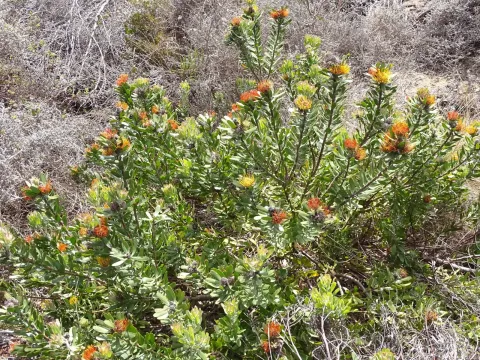
Leucospermum
Leucospermum R. Br.
Leucospermum, a member of the Proteaceae family, is a genus of evergreen shrubs native to the southern regions of Africa. These plants are widely recognized in floriculture for their distinctive pin-cushion-shaped flower heads, which possess exceptional vase life and aesthetic appeal.
What the section contains
 Leucospermum
 cordifolium x Leucospermum glabrum
Leucospermum
Leucospermum cordifolium (Salisb. ex Knight) Fourc. x L. tottum (L.) R. Br.
Leucospermum cordifolium
Leucospermum cordifolium (Salisb. ex Knight) Fourc.
Leucospermum
Leucospermum cordifolium x Leucospermum glabrum
Leucospermum
Leucospermum cordifolium (Salisb. ex Knight) Fourc. x L. tottum (L.) R. Br.
Leucospermum cordifolium
Leucospermum cordifolium (Salisb. ex Knight) Fourc.
 Leucospermum erubescens
Leucospermum erubescens
Leucospermum erubescens
 Leucospermum glabrum
Leucospermum glabrum x tottum
Leucospermum glabrum x Leucospermum tottum
Leucospermum glabrum
Leucospermum glabrum
Leucospermum glabrum x tottum
Leucospermum glabrum x Leucospermum tottum
 Leucospermum hybrid
Leucospermum erubescens x Leucospermum cuniforme
Leucospermum hybrid
Leucospermum erubescens x Leucospermum cuniforme
 Leucospermum lineare
 R. Br.
Leucospermum lineare
Leucospermum lineare R. Br.
 Leucospermum lineare x L. tottum
Leucospermum lineare R. Br. x L. tottum (L.) R. Br.
Leucospermum lineare x L. tottum
Leucospermum lineare R. Br. x L. tottum (L.) R. Br.
 Leucospermum patersonii
Leucospermum patersonii
Leucospermum patersonii
 Leucospermum tottum
 (L.) R. Br.
Pincushion protea
Leucospermum cordifolium x Leucospermum patersonii
Leucospermum tottum
Leucospermum tottum (L.) R. Br.
Pincushion protea
Leucospermum cordifolium x Leucospermum patersonii
 Wedge-leaf pincushion
Leucospermum cuneiforme (Burm. f.) Rourke
Wedge-leaf pincushion
Leucospermum cuneiforme (Burm. f.) Rourke
Leucospermum
The cultivation of this crop requires a Mediterranean-like climate, characterized by abundant sunlight and mild temperatures. In regions with harsh winters, Leucospermum must be grown in specialized glasshouses where thermal conditions can be strictly regulated to prevent frost damage.
Soil management is perhaps the most critical aspect of agrotechnology for this species. It requires well-drained, acidic to neutral soils with extremely low phosphorus content. Over-fertilization, especially with phosphorus-based nutrients, can be toxic to the plant, leading to root system failure and necrosis.
Irrigation practices must be precise to avoid waterlogging, which is the primary cause of plant death. A robust drainage system is mandatory, and growers often use raised beds or porous substrates to ensure that the roots receive adequate aeration while maintaining the required moisture balance.
Propagation is typically carried out through semi-hardwood cuttings. Unlike species that grow from seed, cuttings ensure the consistency of commercial traits, such as flower color, stem length, and resistance to environmental stress, providing a standardized product for the floral market.
The yield of Leucospermum is determined by the age of the shrubs and the specific pruning regimen applied during the growing season. A mature, well-maintained plant can produce between 15 and 50 premium stems per season, depending on the cultivar and the environmental control system implemented.
The most significant disease threats are root rot pathogens, specifically Phytophthora, which thrive in poorly drained and waterlogged soils. Disease prevention centers on strict hygiene in the nursery and the use of fungicide-treated growth media for young plants.
Pest management focuses on controlling sap-sucking insects like mealybugs and aphids, which frequently infest flower buds and new growth. Integrated Pest Management (IPM) strategies, including the introduction of natural predators, are standard practice to minimize the need for chemical interventions.