
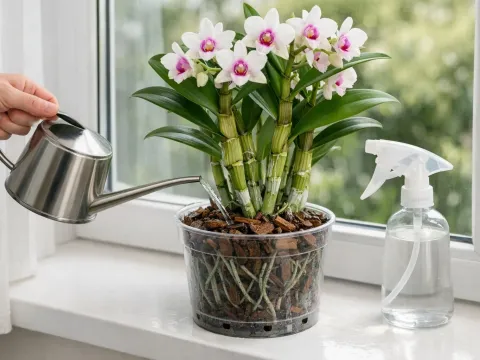
Dendrobium
Dendrobium
Dendrobium is a genus of diverse epiphytic plants belonging to the Orchidaceae family. Native to the tropical regions of Asia, Australia, and the Pacific Islands, these plants have adapted to thrive in a wide range of habitats, from humid tropical forests to cooler high-altitude mountain zones.
What the section contains
 Dendrobium pulchellum
Dendrobium pulchellum
Dendrobium pulchellum
 Dendrobium purpureum
Dendrobium purpureum
Dendrobium purpureum
 Dendrobium regale
Dendrobium regale
Dendrobium regale
 Dendrobium rupestre
Dendrobium rupestre
Dendrobium rupestre
 Dendrobium salaccense
Dendrobium salaccense
Dendrobium salaccense
 Dendrobium samoense
Dendrobium samoense
Dendrobium samoense
 Dendrobium scopa
Dendrobium scopa
Dendrobium scopa
 Dendrobium secundum
Dendrobium secundum
Dendrobium secundum
 Dendrobium senile
Dendrobium senile
Dendrobium senile
 Dendrobium sladei
Dendrobium sladei
Dendrobium sladei
 Dendrobium smillieae
Dendrobium smillieae
Dendrobium smillieae
 Dendrobium speciosum
Dendrobium speciosum
Dendrobium speciosum
 Dendrobium subuliferum
Dendrobium superans
Dendrobium superans
Dendrobium subuliferum
Dendrobium subuliferum
Dendrobium superans
Dendrobium superans
 Dendrobium thyrsiflorum
Dendrobium thyrsiflorum
Dendrobium thyrsiflorum
 Dendrobium transparens
Dendrobium transparens
Dendrobium transparens
 Dendrobium unicum
Dendrobium unicum
Dendrobium unicum
 Dendrobium uniflorum
Dendrobium uniflorum
Dendrobium uniflorum
 Golden Dendrobium
Dendrobium chrysotoxum
Golden Dendrobium
Dendrobium chrysotoxum
 Thumbnail Orchid
Dendrobium linguiforme
Thumbnail Orchid
Dendrobium linguiforme
Dendrobium
The plant is characterized by its sympodial growth habit, producing specialized stem structures known as pseudobulbs. These organs are vital for water storage, allowing the plant to sustain itself during dry seasons, which is a key adaptation for survival in epiphytic conditions.
Successful cultivation requires specific light conditions, usually bright but filtered sunlight. Agronomists emphasize that a stable thermal regime with a distinct day-to-night temperature drop is essential for inducing flowering in most commercial Dendrobium varieties.
The choice of substrate is critical; it must facilitate high gas exchange and drainage. Orchid growers typically use mixtures of pine bark, charcoal, and perlite to ensure the roots remain healthy and free from stagnant moisture, which is the primary cause of root failure.
Economically, Dendrobiums are significant in the floriculture industry, being widely cultivated for the cut-flower market and as premium ornamental potted plants. Ongoing hybridization programs continue to produce resilient varieties suited for both controlled greenhouse environments and home interiors.
Pest management is a fundamental aspect of Dendrobium cultivation, as spider mites can quickly thrive in the low-humidity environments often found in indoor or improperly ventilated greenhouse settings.
Mealybugs are another common threat that feeds on the plant's sap, often hiding in the crevices between leaf axils and stems, which makes manual cleaning and systemic insecticide application necessary for control.
Fungal pathogens such as Pythium and Phytophthora pose a significant risk, causing root and crown rot if the substrate remains saturated for too long, leading to rapid decay of the vascular tissues.
Bacterial soft rot can spread rapidly in high-humidity and high-temperature conditions, necessitating immediate quarantine of affected plants and the removal of infected pseudobulbs to prevent further spread.
Integrated pest management strategies should include rigorous sanitation of tools, careful monitoring of humidity levels, and the application of fungicides to maintain the vigor and health of the Dendrobium collection.