

Description
Sowing dates
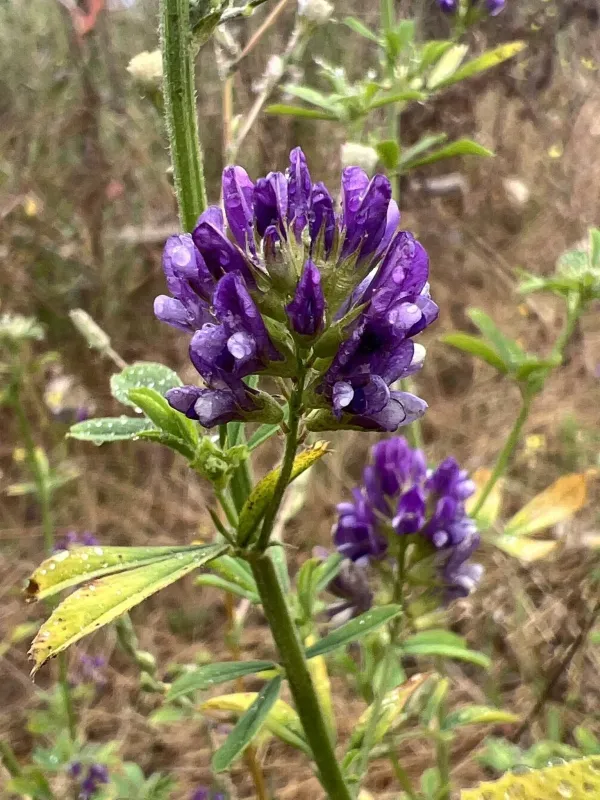
Alfalfa (Medicago sativa L.), a member of the Fabaceae family, is globally recognized as the premier forage legume due to its high protein content and digestibility.
Sowing should take place in early spring or late summer, ensuring the soil temperature is sufficient for germination and that soil moisture is readily available.
The ideal planting depth is shallow, usually around 1 to 2 centimeters, requiring a firm and fine-textured seedbed to ensure excellent soil-to-seed contact.
Standard seeding rates range from 15 to 20 kg per hectare, depending on the method of sowing and the specific environmental conditions of the region.
Successful establishment relies on the presence of beneficial Rhizobium bacteria, which are necessary for atmospheric nitrogen fixation within the root nodules.
Growing requirements
Alfalfa thrives in deep, well-drained loamy soils with a neutral pH, as it is highly sensitive to acidic environments and waterlogged, poorly aerated conditions.
It is renowned for its deep taproot system, which allows the plant to tap into deep soil moisture, making it remarkably resilient during periods of drought.
While the plant is hardy, it requires ample sunlight for optimal photosynthesis and is highly productive when cultivated in regions with clear seasonal transitions.
Nutrient management is critical; alfalfa requires significant amounts of potassium and phosphorus to maintain structural integrity and vigor throughout its life cycle.
The crop is not suitable for soils with high water tables, as root rot can quickly develop, leading to the rapid decline of the stand over several seasons.
Yield
Yield potential is exceptional, often allowing for 3 to 5 harvests per growing season, depending on the climatic conditions and irrigation availability.
Total dry matter production can reach significant levels, making it one of the most profitable perennial forage options for livestock-focused agricultural operations.
High yields are contingent upon selecting high-performing, disease-resistant cultivars that are specifically bred for the intended agro-climatic zone.
Proper harvest intervals are essential to maximize yield; cutting too early or too late can negatively affect the overall productivity of the subsequent regrowth cycle.
Over time, yield may naturally decrease, so implementing rotation practices every 4 to 6 years is standard procedure to maintain optimal agricultural efficiency.
Main diseases and pests
Alfalfa stands are susceptible to various fungal pathogens, including anthracnose, verticillium wilt, rhizoctonia, and sclerotinia, which can devastate entire crops.
Other significant threats include gray mold and downy mildew, which compromise the quality of the foliage and reduce the nutritional value of the harvested hay.
Pest populations such as the meadow moth, aphids, various leaf beetles, and gall midges can cause substantial defoliation and reduction in overall yield quality.
Nematodes, particularly root-knot nematodes, represent a hidden but serious threat that can debilitate plants by damaging their critical root infrastructure.
Integrated Pest Management (IPM) strategies, including crop rotation and the use of resistant varieties, are vital to mitigating these biological threats effectively.
Harvesting
The timing of the harvest is the most critical factor for quality, with the early flowering stage being the optimal window to balance protein and fiber content.
Utilizing modern swathers and conditioners allows for uniform drying of the forage, which helps preserve nutrients and reduces losses during the curing process.
Maintaining a proper stubble height of at least 5 centimeters is essential to protect the crown and ensure rapid regrowth after the mowing process.
Hay should be baled at the correct moisture level to prevent spoilage and potential spontaneous combustion while ensuring long-term storage stability.
Careful handling of the harvested forage is necessary to maintain leaf retention, as the leaves contain the highest concentration of the plant's essential proteins.
In brief
56
Crop diseases
44
Crop pests
Content graph
Crop diseases · 56
Acrocalymma root rot of alfalfaAlfalfa enationAlfalfa leaf spotAlfalfa mosaicAlfalfa phytonodermosisAlfalfa witches' broomAnthracnoseAphanomyces root rotBacterial canker of tomatoBacterial leaf spotBean leafroll virusBlossom blightCercospora leaf spotCharcoal rotChrysanthemum nematodeColumbia root-knot nematodeCorky root rotCrown gallCylindrocarpon root rotCylindrocladium root rotDickeyaFusarium wiltFusarium wiltGray moldLance nematodeLate blightLeptosphaerulina leaf spotLucerne transient streakMerliniusMycoleptodiscus root and crown rotNeedle nematodeParatrichodorus minorParatylenchus diseasePea streakPeronosporosisPhoma leaf spotPhymatotrichum root rotPlant RustPowdery mildewPythium root rotRed clover vein mosaicRhizoctonia root rotRhizoctonia root rotRing nematodeRoot-knot nematodeRoot-lesion nematodeSclerotinia rotSnow rot of the crownSouthern blightSpiral nematodeStagonospora leaf spot of alfalfaStemphylium leaf spotVerticillium wiltViolet root rotXiphinemaYellow leaf spot of alfalfa
Content graph
Crop pests · 44
Alfalfa seed chalcidAlfalfa weevilAphidApple blossom weevilAustrian beetleBean aphidBeet midgeBeet webwormBeet weevilCabbage mothCereal leaf beetleChloropid fliesCotton bollwormCrucifer flea beetleDiamondback mothDiamondback mothDock weevilEuropean cherry fruit flyEuropean corn borerGall midgesGeometridaeGrape phylloxeraGreenhouse whiteflyGrey beet weevilGround beetle (Zabrus tenebrioides)Hemp flea beetleLarge whiteLeaf beetlesLeafhoppersLeaf miner mothLeaf minersOriental fruit mothPea aphidPea mothPea weevilPollen beetlePotato tuber mothPyralid mothsSawfliesSoft scalesSunn pestTwo-spotted spider miteWeevilYellow cereal fly
Content graph
Connections · Alfalfa
Most often together:
Marketplace
Products · 140
All 140
Herbicides, Desiccants 81
Insecticides, Acaricides 39
Plant Growth Regulators 14
Fertilizers 5
Biological Products 1


Superclin 480 RK
Ф.Сімоніс Б.В. Барневелд, Нідерланди.
Herbicides
0
0
·
48
2 offers
6.36 €per 1 l
Buy


RIZOFIX LUCERNE
ЛАГЕ І СІА. С.A. (LAGE y Cia. S.A.), Монтевідео, Уругвай
Plant Growth Regulators
0
0
·
48
2 offers
53.63 €per 1 l
Buy


Glyphosate 480 SL
F.A.GAN Chemical Manufacturers Ltd. Israel, member
Herbicides
0
0
·
46
3 offers
5.59 €per 1 l
Buy


Concur, KS (metribuzin, 600 g/l)
Белоцерковский завод препаративных форм
Herbicides
0
0
·
45
3 offers
25.96 €per 1 l
Buy


Napalm, RK (Glyphosate isopropylamine salt, 480 g/l)
Hangzhou Ruijiang Chemical Co., Ltd.
Herbicides
0
0
·
40
3 offers
5.92 €per 1 l
Buy


Argument Forte 500 SL
Zhejiang Zhongshan Chemical Industry Group Co., Ltd.
Herbicides
0
0
·
30
8 offers
4.41 €per 1 l
Buy

Ekstraklin607RK
Шанхай Міо Кемікалз Ко., Лтд., Шанхай, Китай
Herbicides
0
0
·
30
1 offer
9.36 €per 1 l
Buy


Trifluralin 480 g/L, herbicide
F.A.GAN Chemical Manufacturers Ltd. Israel, member
Herbicides
0
0
·
27
2 offers
8.72 €per 1 l
Buy


Bentagran AS
Nanjing No.1 Pesticide Factory of Red Sun Group Co., Ltd.
Herbicides
0
0
·
999
No offers
—
Details


Triflurex 240 g.e., (Trifluralin, 240 g/l)
F.A.GAN Chemical Manufacturers Ltd. Israel, member
Herbicides
0
0
·
65
No offers
—
Details


Dimilin
Кемарк КФТ, Угорщи (на замовлення Кемтура Корпорейшн, США)на
Insecticides
0
0
·
56
No offers
—
Details


Dursaban 480
Доу АгроСайенсіс, Кінг’з-Лінн, Великобританія
Insecticides
0
0
·
51
No offers
—
Details