

Reference · Crops
Alfalfa
Medicago L.
The optimal sowing time for alfalfa depends on regional climatic conditions, but early spring is generally preferred. This timing ensures that the soil has sufficient moisture levels, which are critical for seed germination and initial root development.
22
items
What the section contains
 Alfalfa
Medicago sativa L.
138 products
Alfalfa
Medicago sativa L.
138 products
 Barrel medic
Medicago truncatula Gaertn.
Barrel medic
Medicago truncatula Gaertn.
 Black medic
Medicago lupulina L.
Black medic
Medicago lupulina L.
 Button Medick
Medicago tornata (L.) Mill.
Button Medick
Medicago tornata (L.) Mill.
 Button medick
Medicago orbicularis (L.) Bartal.
Button medick
Medicago orbicularis (L.) Bartal.
 Intertexta medic
Medicago intertexta (L.) Mill.
Intertexta medic
Medicago intertexta (L.) Mill.
 Italian medic
Medicago italica (Mill.) Fiori
Italian medic
Medicago italica (Mill.) Fiori
 Medicago doliata
 Carmign.
Medicago doliata
Medicago doliata Carmign.
 Medicago littoralis
 Rohde ex Loisel.
Medicago littoralis
Medicago littoralis Rohde ex Loisel.
 Medicago sphaerocarpos
 Bertol.
Medicago truncatula
Medicago truncatula x Medicago littoralis
Medicago sphaerocarpos
Medicago sphaerocarpos Bertol.
Medicago truncatula
Medicago truncatula x Medicago littoralis
 Moon trefoil
Medicago arborea L.
Moon trefoil
Medicago arborea L.
 Murex medic
Medicago murex Willd.
Murex medic
Medicago murex Willd.
 Sickle alfalfa
Medicago sativa L. subsp. sativa
Sickle alfalfa
Medicago sativa L. subsp. sativa
 Snail medic
Medicago scutellata (L.) Mill.
Snail medic
Medicago scutellata (L.) Mill.
 Spotted medic
Medicago arabica (L.) Huds.
Spotted medic
Medicago arabica (L.) Huds.
 Toothed bur clover
Medicago polymorpha L.
Toothed medick
Medicago hispida Gaertn.
Tuberculate medic
Medicago polymorpha L. var. brevispina (Benth.) Heyn
Variegated alfalfa
Medicago sativa L. nothosubsp. varia (Martyn) Arcang.
Toothed bur clover
Medicago polymorpha L.
Toothed medick
Medicago hispida Gaertn.
Tuberculate medic
Medicago polymorpha L. var. brevispina (Benth.) Heyn
Variegated alfalfa
Medicago sativa L. nothosubsp. varia (Martyn) Arcang.
 Wrinkled medic
Medicago rugosa Desr.
Wrinkled medic
Medicago rugosa Desr.
 Yellow alfalfa
Medicago sativa L. subsp. falcata (L.) Arcang.
Yellow alfalfa
Medicago sativa L. subsp. falcata (L.) Arcang.
Marketplace
Products in this section · 12


Alfalfa
In regions with milder winters, fall sowing is sometimes practiced; however, this requires precise timing to avoid germination before severe frost hits. Summer sowing is only viable when irrigation is available to prevent seedling desiccation.
The seeding rate varies based on the planting method and soil quality. Drilling or row planting is standard, as it ensures uniform seed distribution and reduces competition for light and nutrients among seedlings.
Before planting, seed scarification is highly recommended to improve germination rates, as alfalfa seeds have a hard seed coat. Inoculating seeds with specific nitrogen-fixing bacteria is also a standard practice for establishing healthy stands.
Sowing depth should be strictly controlled, typically 2 to 3 cm in sandy soils and 1 to 2 cm in heavier soils. Planting too deep can exhaust the seed's energy reserves before it emerges, leading to poor stand establishment.
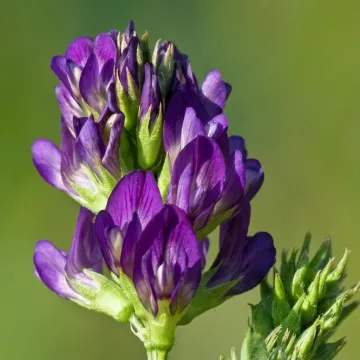
Alfalfa (Medicago L.) is a perennial legume known for its deep taproot system, which can reach depths of up to 10 meters, making it highly drought-tolerant compared to other forage crops.
This crop requires well-drained, aerated soils to flourish and is intolerant of waterlogged conditions or high water tables. The ideal soil pH ranges between 6.5 and 7.5, which is crucial for optimal nutrient availability.
Alfalfa thrives in open, sunny locations and is highly sensitive to shading from weeds or taller crops. Adequate sunlight is necessary for the plant to maintain its metabolic processes and high protein production.
Fertility management is key, with specific needs for phosphorus, potassium, and calcium. Soils that are deficient in these minerals will require regular fertilization to maintain vigor and ensure the longevity of the alfalfa field.
The crop is highly cold-hardy once established, provided it has had sufficient time to accumulate nutrients in the crown area before winter dormancy. However, ice sheets in winter can sometimes cause plant death.
Alfalfa is recognized for its high production potential, often providing multiple cuts per year. Depending on irrigation and management, producers can expect 3 to 5 cuts per growing season.
Under optimal conditions and well-maintained stands, dry matter yields can reach 10 to 15 tons per hectare annually. Its high protein content makes it one of the most valuable feed sources for dairy and livestock sectors.
Beyond direct feed production, alfalfa serves as a superior crop in rotation due to its ability to fix atmospheric nitrogen, which enhances soil health and boosts yields for subsequent cereal crops.
Field longevity is a significant economic advantage; a healthy alfalfa stand can produce high-quality forage for 4 to 6 years before requiring rotation, reducing costs associated with annual soil preparation.
Maximum nutritional quality is obtained by harvesting at the late bud stage, ensuring a balance between vegetative growth and nutrient concentration, specifically in terms of essential amino acids.
Common diseases affecting alfalfa include Fusarium wilt, Anthracnose, and leaf spots. These pathogens are most prevalent during prolonged wet spells and can significantly decrease stand density.
Pests such as the alfalfa weevil, aphids, and lygus bugs are major threats. Regular field scouting is necessary to identify outbreaks before they reach economic injury levels that require intervention.
Integrated Pest Management (IPM) strategies, including timely cutting and the use of resistant varieties, are essential for long-term control. Chemical insecticides should be used as a last resort.
Maintaining a balanced fertility program and avoiding over-grazing or excessive cutting are critical management practices that help the plants resist infection and pest pressure.
Crop rotation remains the most effective prophylactic measure to reduce soil-borne pathogen populations and interrupt the life cycles of specific insect pests that inhabit the field.
The timing of the harvest is the most critical factor for quality control. Cutting at the late-bud stage or very early bloom maximizes the protein-to-fiber ratio, which is vital for high-quality livestock feed.
Delayed harvesting leads to increased stem lignification and leaf loss, which drastically lowers the overall nutritional value, resulting in forage with high fiber but poor digestibility.
Efficient harvesting involves using a mower-conditioner to speed up drying times, allowing the forage to reach moisture targets quickly while minimizing exposure to weather-related risks in the field.
The cutting height must be maintained at 5 to 7 cm. Cutting too low can damage the plant crown, which slows regrowth and shortens the overall lifespan of the alfalfa field.
Following the final cut of the season, it is essential to allow the plants a sufficient recovery period before the first hard frost to ensure root carbohydrates are replenished for winter survival.