
Phymatotrichum root rot
Phymatotrichopsis omnivora
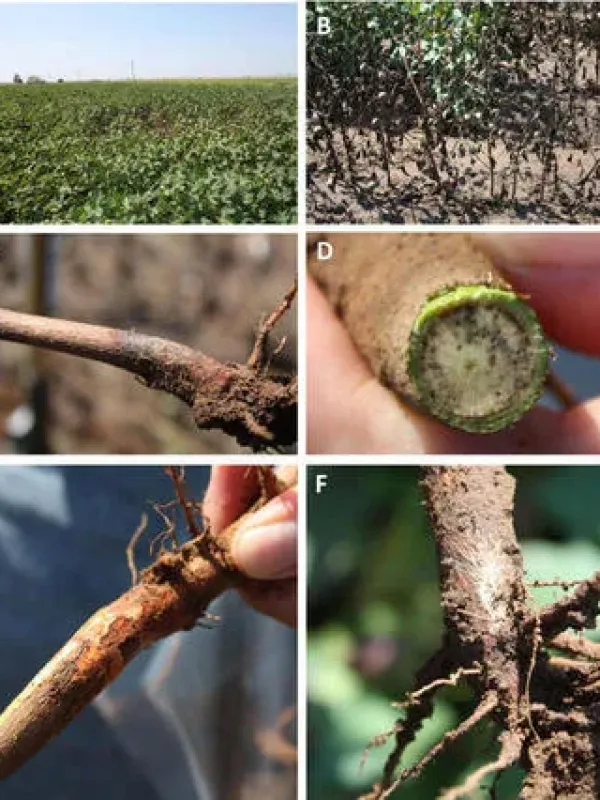
Description
Symptoms
The first symptom is usually a sudden wilting of the foliage, which often occurs during the hottest part of the day.
Upon inspection of the root system, one will observe necrotic brown lesions and the presence of fine, tan-colored mycelial strands on the root surface.
Under moist soil conditions, a yellowish or whitish mat of the fungus may appear at the soil line around the base of the plant stem.
Infection typically occurs in circular patterns or patches within a field, which gradually expand as the fungus spreads from plant to plant through the soil.
In perennials such as peach trees or vines, the decline may be progressive, showing yellowing of leaves before the plant ultimately dies.
Pathogen
The causal agent of this disease is the soil-borne fungus Phymatotrichopsis omnivora, a highly persistent pathogen in the Ascomycota phylum.
It is infamous for producing resilient sclerotia that survive in the soil for decades, making complete eradication almost impossible.
The fungus attacks the vascular tissues of the roots, effectively cutting off the plant's supply of water and nutrients from the soil.
This pathogen exhibits an exceptionally broad host range, infecting over 2,000 species of broad-leaved plants including trees, shrubs, and herbs.
Key crops susceptible to this disease include fodder beet, sunflower, Jerusalem artichoke, alfalfa, peach, rhododendron, and grapevine.
Conditions for development
The development of the disease is strictly dependent on soil temperature, with 25 to 30 degrees Celsius being the most favorable range.
The fungus thrives in alkaline to neutral soils that have poor drainage and low aeration, often found in hot, arid regions.
Fluctuations in soil moisture, particularly following periods of drought, trigger the rapid growth of the fungal mycelium.
Inoculum can be transported between fields via contaminated machinery, irrigation water, or the movement of infected root debris.
Continuous planting of susceptible broad-leaved species promotes the accumulation of the fungus in the soil, leading to severe outbreaks.
Why it matters
This root rot is considered one of the most destructive diseases, capable of killing large swaths of mature trees and profitable field crops.
The economic impact is profound because infected land becomes unsuitable for the cultivation of susceptible hosts for many years.
The rapid death of plants causes total crop failure, which is especially devastating for high-value orchard and vineyard operations.
Because the disease affects the vascular system, affected plants cannot be saved once the wilting symptoms have reached an advanced stage.
The persistence of the fungus makes long-term site management extremely challenging and often forces a change in the type of crops grown.
Protection
Cultural management through crop rotation with resistant monocot species, such as grains or grasses, is the most recommended preventative strategy.
Deep cultivation or plowing can help disrupt the fungal mycelium by improving soil aeration and drying out the pathogen.
Amending the soil with organic matter can increase the population of beneficial microbes that compete with Phymatotrichopsis omnivora.
Chemical fumigation is sometimes used in nurseries or high-value landscapes, though it is costly and provides only localized control.
Strategies to slightly lower soil pH are occasionally employed, as the fungus performs best in alkaline environments.
Pathogens and affected parts
Affects crops · 7
Discussion
No discussions yet — be the first.