
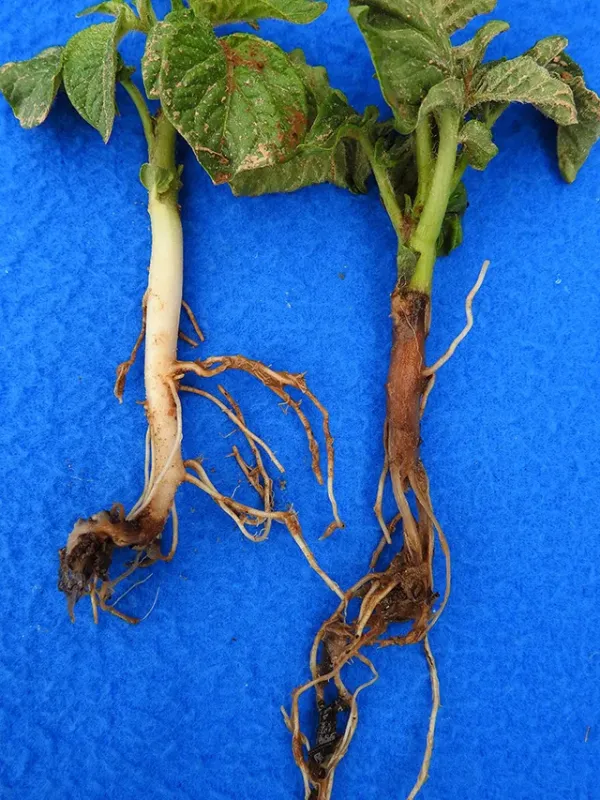
Description
Symptoms
The most characteristic symptom of Dickeya infection is the rapid development of soft rot, where infected plant tissues become translucent, soft, and watery. In advanced stages, the tissue disintegrates into a foul-smelling mass.
On stems and stalks, the infection often manifests as water-soaked lesions that quickly expand. This leads to wilting of the upper foliage, even if the root system appears partially intact initially.
In crops like alfalfa, Dickeya can cause stunting, chlorosis, and general systemic wilting. When the stem is sectioned, internal tissues often show extensive browning and cellular breakdown due to pectin degradation.
Under high humidity, a bacterial ooze may be visible on the surface of infected lesions. This ooze contains millions of bacterial cells, serving as a primary inoculum for spread through rain splash or contact.
Because symptoms can mimic other bacterial or fungal wilts, early detection often requires molecular methods, such as PCR, to confirm the presence of Dickeya and distinguish it from other pectinolytic bacteria.
Pathogen
Dickeya is a genus of Gram-negative, rod-shaped, facultatively anaerobic bacteria belonging to the Pectobacteriaceae family. These pathogens are renowned for causing devastating soft rot diseases in a wide array of high-value crops worldwide.
The primary mechanism of pathogenicity involves the secretion of powerful plant cell wall-degrading enzymes, such as pectinases and cellulases. These enzymes rapidly break down the plant tissue structure, leading to liquefaction.
This genus has a broad host range, infecting various vegetables, ornamental plants, and forage crops like alfalfa (Medicago sativa). The bacteria are highly efficient at colonization and can easily exploit physiological weaknesses in plants.
These pathogens are often disseminated through contaminated vegetative propagation material, such as tubers or cuttings, allowing them to travel across continents via agricultural trade. Once established, they can persist in the environment and soil.
Genetic diversity within the Dickeya genus is significant, with various species showing different environmental preferences, making it a persistent and evolving challenge for plant pathologists and farmers.
Conditions for development
The development of Dickeya is heavily dependent on moisture. High soil moisture and relative humidity are essential for the survival and movement of the bacteria from plant to plant.
Optimal temperatures for the growth and enzymatic activity of these bacteria generally range between 25°C and 30°C. However, certain strains are highly active even in cooler temperate climates.
Mechanical damage is the most common entry point for the pathogen. Injuries caused by harvesting, pruning, insect feeding, or environmental factors like hail provide direct access to the vascular and parenchymal tissues.
Nutritional status of the host also plays a role; high nitrogen levels promote lush, succulent growth that is more susceptible to enzymatic degradation by Dickeya.
Poor field management, including insufficient drainage and over-irrigation, creates an aquatic environment that promotes the rapid spread of the pathogen, often resulting in sudden disease outbreaks.
Why it matters
Dickeya causes significant economic losses by reducing both the yield and the marketable quality of produce. Infected crops often become unsalable due to severe tissue decay.
For tuber crops, the disease is particularly devastating during storage, where a small number of infected units can spoil entire batches, leading to catastrophic losses in post-harvest processing.
In fodder crops like alfalfa, the infestation reduces biomass yield and makes the forage less suitable or unsafe for animal consumption, impacting the entire agricultural value chain.
The pathogen's ability to survive in water, soil, and symptomless hosts complicates eradication efforts, often forcing farmers to implement strict and costly quarantine measures.
The unpredictability and rapid progression of the disease leave growers with very little time to intervene, making it one of the most feared bacterial threats in modern agriculture.
Protection
The most effective strategy for managing Dickeya is the use of pathogen-free, certified seed material. Strict inspection and diagnostic testing of propagating material are the first lines of defense.
Implementing long crop rotations with non-host species is essential to reduce the bacterial population in the soil. Avoiding continuous cropping of susceptible plants breaks the disease cycle.
Sanitation practices, such as disinfecting equipment between fields and removing infected plant debris, are critical to prevent the mechanical transfer of bacteria.
Integrated Pest Management (IPM) to control insect vectors that cause tissue injury can significantly decrease the incidence of infection in the field.
- Prompt removal and destruction of infected plants to limit the inoculum source.
- Optimizing irrigation and improving soil drainage to minimize standing water.
- Application of copper-based bactericides for temporary protection during high-risk periods.
- Breeding and planting resistant cultivars where available to ensure long-term stability.
Pathogens and affected parts
Affects crops · 1
Discussion
No discussions yet — be the first.