
Description
Symptoms
The first observable symptom is a sudden and rapid wilting of the leaves, starting from the lower parts of the plant. Unlike other wilts that develop slowly, Southern blight can collapse a plant in a matter of days.
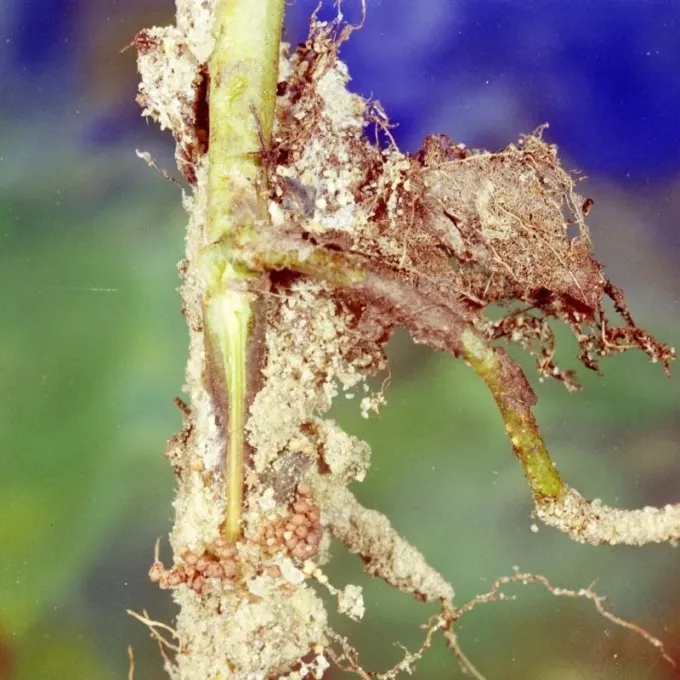
A dense, white, thread-like mycelium often becomes visible around the base of the stem at the soil line. This "white rot" appearance is diagnostic of Athelia rolfsii infection in high-humidity conditions.
Brown, water-soaked necrotic lesions appear on the stem near the crown. As the disease progresses, these lesions girdle the plant, cutting off water and nutrient transport, leading to irreversible wilting and death.
Small, round sclerotia (1–2 mm) begin to form on the surface of the infected tissue or the soil around it. These start as white, immature structures and gradually darken to a tan or deep brown color, resembling mustard seeds.
In alfalfa crops, the infection frequently focuses on the crown area, causing total plant mortality. In field settings, the disease typically spreads in circular patches, with new plants becoming infected as the fungus grows outward.
Pathogen
Southern blight is caused by the soil-borne fungal pathogen Athelia rolfsii (formerly Sclerotium rolfsii). It is a highly aggressive parasite capable of infecting over 500 plant species, including legumes like alfalfa, various vegetables, and ornamentals.
The fungus survives in the soil primarily as sclerotia, which are hard, dark, spherical structures that serve as long-term survival units. These sclerotia can remain viable in the soil for several years, even in the absence of a host crop.
The pathogen initiates infection through the production of mycelium that spreads across the soil surface. This white, fan-like mycelial growth is a hallmark of the pathogen's search for vulnerable host tissue.
Once it contacts a host, the fungus secretes enzymes, specifically cellulases and pectinases, which rapidly degrade plant cell walls. This enzymatic breakdown facilitates the colonization of stems, crowns, and roots.
The biological activity of the fungus is strictly temperature-dependent, showing maximum growth and infectivity between 25°C and 35°C (77°F to 95°F). Consequently, disease outbreaks are most frequent during the hot, humid summer months.
Conditions for development
The development of Southern blight is heavily favored by warm temperatures and high soil moisture. These environmental factors promote the rapid growth of the fungal mycelium across the soil surface.
Poor drainage and high relative humidity contribute to higher disease incidence. Areas where water tends to puddle at the base of plants provide the exact moisture levels required for the fungus to thrive and invade.
The presence of organic debris, such as un-decomposed plant residues, acts as a primary food source for the fungus. Pathogen populations tend to be higher in fields with abundant surface organic matter.
Soil pH plays a role, with the pathogen typically thriving in acidic to neutral soils. Additionally, planting density is a critical factor; overly dense crops impede airflow, keeping the microclimate near the soil surface humid and still.
The pathogen is easily disseminated by contaminated tools, machinery, and runoff water. Once introduced, the buildup of sclerotia in the soil profile creates an increasing threat for subsequent seasons.
Why it matters
Southern blight causes severe economic losses by killing susceptible crops in the field. When an outbreak occurs, it can result in near-total destruction of the crop stand in the affected areas.
The persistence of sclerotia in the soil makes long-term management challenging. Once a field is heavily infested, it may become economically unviable to grow susceptible cash crops for many years.
In alfalfa, the destruction of the crown effectively ends the productive life of the plant. This leads to reduced stand longevity, necessitating expensive reseeding and potential loss of valuable forage revenue.
Beyond crop loss, the pathogen can infect harvested plant materials if they are stored under poor conditions. This introduces the risk of the fungus spreading to healthy, dried forage or seeds in storage.
The cumulative damage includes not just the loss of immediate harvest, but the increased costs associated with cleaning equipment, implementing intensive crop rotations, and soil treatment programs.
Protection
A robust crop rotation strategy is the most effective management tool. Rotating away from host species to non-host crops like corn or small grains for 3–4 years can significantly reduce the soil sclerotia population.
Deep plowing that incorporates plant residues and buries surface sclerotia to a depth of several inches can disrupt the pathogen's lifecycle, as the fungi generally require surface moisture to become active.
Improved field drainage and management of irrigation are crucial to prevent saturated soil conditions at the crown of the plant. Removing weeds that may serve as alternative hosts is also highly recommended.
Biological control agents, particularly species of Trichoderma, have shown efficacy in suppressing Athelia rolfsii. Applying these biocontrol products to the soil can help manage fungal activity naturally.
Strict sanitation practices must be observed when moving equipment between infested and clean fields to prevent the transfer of soil containing sclerotia. If the disease is detected, early removal of infected plant material can help slow the spread.
Pathogens and affected parts
Affects crops · 1
Discussion
No discussions yet — be the first.