

Soft scales
Coccidae
Description
How to identify
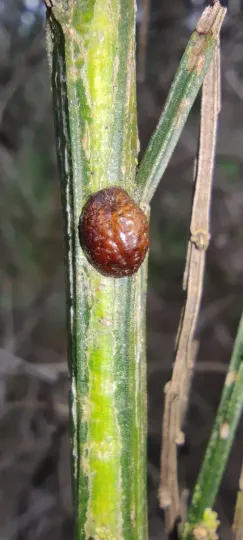
Soft scales (family Coccidae, order Hemiptera) are specialized sucking pests. Unlike armored scales, they do not possess a separate shell; instead, their protective covering is formed by the hardened cuticle of the insect itself.
Adult females are typically convex, often hemispherical, and range from brown to yellow or reddish in color. They are sessile, attaching themselves firmly to stems or leaves. Their bodies are frequently covered with a waxy secretion or coating.
Males are rarely seen; they are winged and capable of flight, though their life cycle is very short. First-instar nymphs, known as crawlers, are mobile and move across the plant in search of suitable feeding sites.
The biology of soft scales is closely linked to plant phenology. They typically overwinter as second-instar nymphs or fertilized females within bark crevices or near buds. Activity resumes with the onset of rising sap in spring.
These pests are highly fecund. A single female can lay thousands of eggs beneath her body, which often shrivels after egg-laying to form a protective chamber for the developing offspring.
What it damages
Soft scales are polyphagous insects that affect a wide variety of crops. In agriculture, they can cause significant damage to fruit trees such as apple and plum, as well as various field and forage crops.
Commonly affected plants include fodder beet, winter barley, common hop, alfalfa, tobacco, and peas. In these crops, infestation can lead to reduced plant vigor and lower commercial quality of the harvested yield.
Damage is caused by the continuous extraction of plant sap. This depletion of nutrients leads to stunted growth, distorted shoots, and general weakening of the plant organism.
Mass outbreaks often result in premature leaf drop, fruit abortion, and reduced yield. Heavily infested trees may experience branch dieback and decreased cold hardiness during winter months.
A secondary consequence is the excretion of honeydew. This sticky substance promotes the growth of sooty mold, which covers leaves in a black layer, obstructing photosynthesis and gas exchange.
Signs of infestation
The primary sign of infestation is the presence of immobile, convex bumps on branches or the underside of leaves. Removing these structures often reveals light-colored spots on the bark, marking the feeding site.
A sticky residue on leaves and branches is one of the most noticeable symptoms. This substance attracts ants, which may protect the scale colonies from natural predators.
The appearance of black sooty mold on foliage is an indicator of a heavy infestation. This mold significantly degrades the plant's health and appearance.
Slowed growth, chlorosis, and premature yellowing of leaves that cannot be attributed to nutrient deficiencies or root diseases may indicate the hidden presence of scale insects.
Inspecting branches during the winter season may reveal overwintering individuals, which appear as small bumps on the bark that blend in with the texture and color of the wood.
Control measures
Control strategies include cultural methods such as pruning to improve aeration and light penetration, and removing heavily infested branches. Cleaning tree trunks of dead bark can also reduce overwintering sites.
Biological control relies on preserving natural enemies such as parasitic wasps and predatory lady beetles. Using biological agents based on entomopathogenic fungi can be effective under high humidity conditions.
Chemical control is most effective during the crawler stage. At this point, the insects are not yet protected by a waxy coating, making them highly susceptible to contact and systemic insecticides.
In commercial orchards, insecticides from groups such as organophosphates, neonicotinoids, and insect growth regulators are commonly used. Rotating products with different modes of action is essential to prevent resistance.
Applying horticultural mineral oils in early spring, before bud break, can effectively smother overwintering scales by cutting off their oxygen supply, thereby reducing the population early in the season.
In brief
14
Damages crops
Content graph
Damages crops · 14
Reference
Connections · Soft scales
Most often together:
Marketplace
Products · 78


Actara 25 WG granules, Insecticide (thiamethoxam 250 g
Kemark
Insecticides
0
0
5 offers
2.29 €за кг
Buy


Dime 58 c.e., in
Jiangsu SevenContinent Green Chemical Co., Ltd.
Insecticides
0
0
2 offers
5.67 €per pack
Buy

SULFURIC SMOKE WICK "CLIMATE", DS, (Sulfur - 750 g/kg)
LIMITED LIABILITY COMPANY
Herbicides
0
0
4 offers
1.63 €за кг
Buy




Biology
Taxonomy
- Latin name
- Coccidae
- Order
- Hemiptera (bugs, aphids, leafhoppers)
- Family
- Coccidae
- EPPO code
- 1COCCF
Community
Discussion
No discussions yet — be the first.