
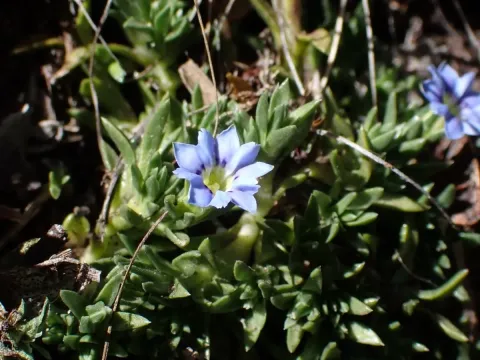
Gentian
Gentiana L.
Gentian seeds are notoriously difficult to germinate and generally require a period of cold stratification, mimicking the conditions of their native alpine environment.
What the section contains
 Chinese gentian
Gentiana sino-ornata Balf. f.
Chinese gentian
Gentiana sino-ornata Balf. f.
 Crested gentian
Gentiana septemfida Pall.
Crested gentian
Gentiana septemfida Pall.
 Cross gentian
Gentiana cruciata L.
Cross gentian
Gentiana cruciata L.
 Dahurian gentian
Gentiana dahurica Fisch.
Dahurian gentian
Gentiana dahurica Fisch.
 Gentian hybrid
Gentiana makinoi Kuzen. x Gentiana scabra Bunge
Gentian hybrid
Gentiana makinoi Kuzen. x Gentiana scabra Bunge
 Gentiana axillariflora
 Levier & Vaniot
Gentiana axillariflora var. coreana
Gentiana axillariflora var. coreana (Nak.) Kudo
Gentiana makinoi
Gentiana makinoi Kuzen.
Gentiana axillariflora
Gentiana axillariflora Levier & Vaniot
Gentiana axillariflora var. coreana
Gentiana axillariflora var. coreana (Nak.) Kudo
Gentiana makinoi
Gentiana makinoi Kuzen.
 Gentiana scabra
 Bunge
Gentiana scabra
Gentiana scabra Bunge
 Gentiana triflora
 Pall.
Gentiana triflora
Gentiana triflora Pall.
 Hybrid Gentian
Gentiana pneumonanthe x Gentiana triflora
Hybrid Gentian
Gentiana pneumonanthe x Gentiana triflora
 Hybrid Gentiana triflora and Gentiana scabra
Hybrids between Gentiana triflora and Gentiana scabra
Hybrid Gentiana triflora and Gentiana scabra
Hybrids between Gentiana triflora and Gentiana scabra
 Japanese gentian
Gentiana scabra Bunge var. buergeri (Miq.) Maxim. ex Franch. & Sav.
Marsh gentian
Gentiana pneumonanthe L.
Marsh gentian
Gentiana pneumonanthe x Gentiana scabra
Rough gentian
Gentiana scabra x Gentiana septemfida
Japanese gentian
Gentiana scabra Bunge var. buergeri (Miq.) Maxim. ex Franch. & Sav.
Marsh gentian
Gentiana pneumonanthe L.
Marsh gentian
Gentiana pneumonanthe x Gentiana scabra
Rough gentian
Gentiana scabra x Gentiana septemfida
 Stemless gentian
Gentiana acaulis L.
Stemless gentian
Gentiana acaulis L.
 Willow gentian
Gentiana asclepiadea L.
Willow gentian
Gentiana asclepiadea L.
 Yellow gentian
Gentiana lutea L.
Yellow gentian
Gentiana lutea L.
Gentian
For commercial cultivation, seeds are sown in late autumn to allow natural winter frost to break dormancy, or kept in moist conditions at low temperatures artificially.
The seeds are extremely small and light-sensitive, meaning they should be sown on the surface of the soil with minimal covering, often just a dusting of sand.
Young seedlings grow very slowly during their first year, so they must be kept in a controlled nursery environment or sheltered from aggressive weed competition.
Success in sowing depends heavily on maintaining consistent soil moisture, as the tiny sprouts can desiccate rapidly if the surface layer dries out even for a short time.
Gentians belong to the Gentianaceae family and are diverse perennials, many of which are adapted to nutrient-poor but well-drained alpine meadows.
The plant requires a soil structure that is loose and aerated; heavy clays that hold stagnant water are fatal to the root system and must be amended with grit.
Most species prefer acidic to neutral soil conditions and struggle in highly alkaline environments, which can lead to iron chlorosis and overall stunted growth.
Temperature management is critical; Gentians thrive in cooler, high-altitude climates and often require protection from the intense heat of lowland summers.
Regular mulching with organic material helps maintain cool root temperatures, mimicking the natural insulating effects of snow or alpine rock cover.
In agricultural settings, the main economic product is the root, which is harvested for its bitter glycosides, such as gentiopicroside, used in digestive bitters.
The yield potential of a Gentian plantation is realized over a long cycle, with the first harvest typically taking place 4 to 6 years after the initial planting.
Root size and active ingredient concentration are closely linked to the maturity of the plant, necessitating a multi-year investment before reaching profitable output.
Yield stability is ensured by choosing specific high-yield cultivars and maintaining optimal spacing to prevent competition for essential nutrients in the root zone.
Harvesting strategies often involve rotation cycles to ensure that different age classes of plants are always reaching maturity for consistent annual supply.
Gastropods, particularly slugs and snails, represent the most significant pest pressure, as they can devastate young Gentian foliage during moist spring and autumn conditions.
Root rot, primarily caused by waterlogged conditions or poor soil drainage, is the most common pathology leading to total plant loss in large plantations.
Fungal leaf spot diseases may appear if there is poor air circulation around the plants, which is common in high-density plantings or greenhouses with low ventilation.
Aphids and thrips can occasionally cause damage by feeding on the sap of growing shoots, potentially serving as vectors for various mosaic viruses.
- Implementing systematic soil drainage improvements.
- Physical barriers or traps for slug management.
- Routine pruning to remove diseased tissue and improve airflow.
Harvesting of the roots occurs in late autumn when the plant is dormant and all metabolic energy has been sequestered into the underground storage organs.
Manual harvesting is common due to the precision required, though mechanical digging can be used if the soil is light and free of stones to prevent root damage.
Once extracted, the roots are thoroughly cleaned of all soil particles and fibrous root hairs to meet high standards for medicinal and extract production.
Drying must be conducted in temperature-controlled environments, as excessive heat will degrade the sensitive chemical compounds that define the plant's medicinal value.
After reaching the appropriate moisture content, the dried roots are stored in airtight, light-protected containers to preserve potency and prevent moisture absorption.