

Reference · Crops
Sedge
Carex L.
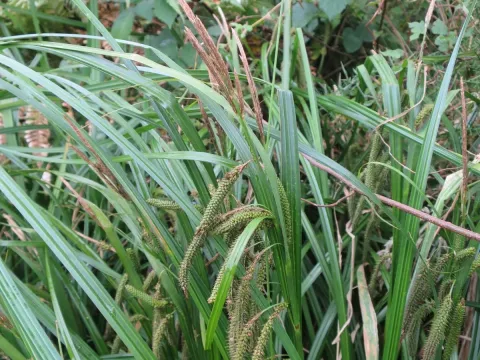
Sedge (Carex L.) is a large genus of perennial herbaceous plants belonging to the Cyperaceae family. In agricultural practices, sedge is cultivated primarily for land reclamation, hay production on waterlogged soils, and as a raw material for specific industries.
24
items
What the section contains
 Carex bostrychostigma
 Maxim.
Carex bostrychostigma
Carex bostrychostigma Maxim.
 Carex brunnea
 Thunb.
Carex brunnea
Carex brunnea Thunb.
 Carex edura
 K. A. Ford
Carex edura
Carex edura K. A. Ford
 Carex morrowii, Carex oshimensis and Carex trifida hybrids
Hybrids between Carex morrowii, Carex oshimensis and Carex trifida
Carex morrowii, Carex oshimensis and Carex trifida hybrids
Hybrids between Carex morrowii, Carex oshimensis and Carex trifida
 Carex oshimensis
 Nakai
Carex oshimensis
Carex oshimensis Nakai
 Carex phyllocephala
 T. Koyama
Carex phyllocephala
Carex phyllocephala T. Koyama
 Carex punicea
 K. A. Ford
Carex punicea
Carex punicea K. A. Ford
 Carex siderosticta
 Hance
Carex siderosticta
Carex siderosticta Hance
 Carex trifida
 Cav.
Carex trifida
Carex trifida Cav.
 Conical sedge
Carex conica Boott
Conical sedge
Carex conica Boott
 Egmont sedge
Carex egmontiana (Hamlin) K. A. Ford
Egmont sedge
Carex egmontiana (Hamlin) K. A. Ford
 Glaucous sedge
Carex flacca Schreb.
Glaucous sedge
Carex flacca Schreb.
 Hair sedge
Carex comans Berggr.
Hair sedge
Carex comans Berggr.
 Hooked sedge
Carex uncinata L. f.
Hooked sedge
Carex uncinata L. f.
 Morrow's sedge
Carex morrowii Boott
Morrow's sedge
Carex morrowii Boott
 Mountain sedge
Carex montana L.
Mountain sedge
Carex montana L.
 Mouse-tail sedge
Carex myosurus Nees
Mouse-tail sedge
Carex myosurus Nees
 Okamoto sedge
Carex okamotoi Ohwi
Okamoto sedge
Carex okamotoi Ohwi
 Palm sedge
Carex muskingumensis Schweinitz
Palm sedge
Carex muskingumensis Schweinitz
 Pennsylvania sedge
Carex pensylvanica Lam.
Pennsylvania sedge
Carex pensylvanica Lam.
 Spreading sedge
Carex laxiculmis Schwein.
Spreading sedge
Carex laxiculmis Schwein.
 Tufted sedge
Carex elata All.
Tufted sedge
Carex elata All.
 Wahu sedge
Carex wahuensis C. A. Mey. subsp. Wahuensis
Wahu sedge
Carex wahuensis C. A. Mey. subsp. Wahuensis
 Wahuensis sedge
Carex wahuensis C. A. Mey.
Wahuensis sedge
Carex wahuensis C. A. Mey.
Marketplace
Products in this section · 9


Sedge
The optimal sowing time is early spring, immediately after the ground thaws and temperatures reach approximately 5 to 10 degrees Celsius. This ensures the seeds have sufficient soil moisture to initiate germination.
Autumn sowing is also feasible, providing the seeds with a natural stratification period over the winter months, which often leads to more uniform germination during the following spring.
The seeding rate typically ranges from 15 to 25 kilograms per hectare, depending on the specific species and the intended use of the crop. Seeds should be sown shallowly, ideally at a depth of no more than 2 centimeters, to facilitate rapid emergence.
In addition to seed propagation, establishing stands via rhizome division is common, especially when the goal is to stabilize banks or remediate marshy areas quickly within a single growing season.
Sedge is highly adapted to environments with excess moisture, making it an ideal candidate for boggy, peat, and floodplain soils where traditional cereal crops often struggle to establish or produce significant biomass.
The crop is known for its high tolerance to acidic soil conditions and can withstand seasonal flooding, which is a major advantage for farming in low-lying agricultural zones.
Regarding climate, the genus is incredibly diverse and resilient, with many species thriving in temperate regions with moderate to high rainfall. It requires consistent water availability during the peak vegetative stage.
Soil management should focus on maintaining adequate nutrient levels; while sedge is hardy, applications of nitrogen and phosphorus fertilizers can significantly increase the total yield of dry matter per hectare.
Full sun to partial shade is generally required for optimal growth. Excessive shading from dense forests or shrubbery can suppress the development of the stand, reducing the potential yield for agricultural harvesting.
Yield capacity varies considerably based on species selection, soil fertility, and water management. On average, natural meadow stands can produce between 20 and 50 centners of green matter per hectare per cut.
Through intensive agricultural management, including controlled irrigation and appropriate fertilization, yields can be increased significantly, ensuring a reliable source of biomass even on marginal lands.
The quality of the yield is heavily dependent on the stage of development at harvest; early harvesting captures the highest protein content, whereas later harvesting yields more fibrous biomass suitable for bedding or industrial use.
Sedge plants exhibit excellent regrowth capabilities, allowing for multiple cuts in a single season under favorable conditions, which enhances the economic viability of the stand for forage purposes.
Beyond animal fodder, the harvest is utilized in various industrial sectors, including the manufacturing of cellulose-based products and fiber-reinforced materials, demonstrating the crop's versatile utility.
The primary threats to sedge stands include fungal infections such as rust and smut, which are exacerbated by high humidity, poor air circulation, and exceptionally wet growing seasons.
Insect pests, particularly wireworms, can damage the underground rhizomes, leading to localized thinning of the stand and reduced plant vigor over subsequent years.
Nematodes also pose a silent threat, often damaging the vascular tissues of the leaves and stems, which can impede growth and decrease the overall palatability and nutritional value of the forage.
- Rust (Puccinia spp.) — creates discoloration and inhibits photosynthesis.
- Smut (Ustilago spp.) — affects flower structures and reduces seed viability.
- Wireworms — target roots and can kill younger, weaker plants.
Preventive measures include crop rotation where applicable, maintaining appropriate plant density to ensure adequate airflow, and monitoring soil moisture levels to avoid creating overly damp conditions conducive to fungal pathogens.
The harvest should be conducted during the early flowering phase, as this timing balances the total biomass production with the nutritional density of the plant tissues.
Modern mowing equipment, such as rotary mowers, should be adjusted to leave a stubble height of 5 to 7 centimeters to protect the base of the plant and ensure rapid recovery for the next growth cycle.
Once mowed, the material should be allowed to wilt in the field to reduce moisture content, ensuring it is stable for storage as hay or silage and preventing the development of mold and mycotoxins.
Storage facilities for sedge hay must be well-ventilated to avoid spontaneous heating and degradation, which can occur if the moisture content remains too high during the storage process.
Timely harvest is critical to prevent lignification, as older sedge stems become tough and less digestible for livestock, thereby significantly reducing the crop's value as high-quality forage.