
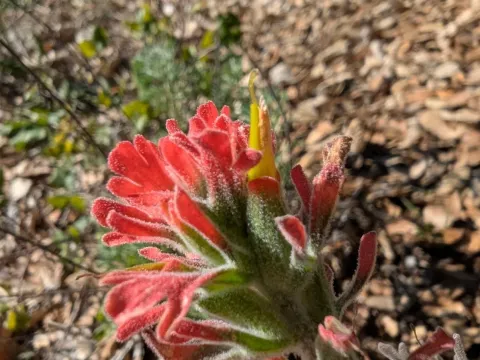
Castilleja
Castilleja
Sowing Castilleja seeds requires a cold stratification period because the species is adapted to cooler climates and seasonal dormancy. Seeds should be sown in late autumn to allow for natural chilling or stratified in a refrigerator for 6-8 weeks before spring planting.
What the section contains
 Castilleja exserta
Castilleja exserta
Castilleja exserta
 Castilleja fissifolia
Castilleja fissifolia
Castilleja fissifolia
 Castilleja indivisa
Castilleja indivisa
Castilleja indivisa
 Castilleja integrifolia
Castilleja integrifolia
Castilleja integrifolia
 Castilleja minor
Castilleja minor
Castilleja minor
 Castilleja nubigena
Castilleja nubigena
Castilleja nubigena
 Castilleja patriotica
Castilleja patriotica
Castilleja patriotica
 Castilleja tenuiflora
Castilleja tenuiflora
Castilleja tenuiflora
 Coast Indian paintbrush
Castilleja latifolia
Coast Indian paintbrush
Castilleja latifolia
 Desert Indian Paintbrush
Castilleja angustifolia
Desert Indian Paintbrush
Castilleja angustifolia
 Downy painted-cup
Castilleja sessiliflora
Downy painted-cup
Castilleja sessiliflora
 Field Indian Paintbrush
Castilleja arvensis
Field Indian Paintbrush
Castilleja arvensis
 Indian paintbrush
Castilleja coccinea
Indian paintbrush
Castilleja coccinea
 Martin's Paintbrush
Castilleja martini
Martin's Paintbrush
Castilleja martini
 Raup's Indian paintbrush
Castilleja raupii
Raup's Indian paintbrush
Castilleja raupii
 Scarlet paintbrush
Castilleja miniata
Scarlet paintbrush
Castilleja miniata
 Splitleaf Indian Paintbrush
Castilleja rhexifolia
Splitleaf Indian Paintbrush
Castilleja rhexifolia
 Suksdorf's Indian paintbrush
Castilleja suksdorfii
Suksdorf's Indian paintbrush
Castilleja suksdorfii
 Western Indian Paintbrush
Castilleja occidentalis
Western Indian Paintbrush
Castilleja occidentalis
 Wight's paintbrush
Castilleja wightii
Wight's paintbrush
Castilleja wightii
 Woolly Indian paintbrush
Castilleja foliolosa
Woolly Indian paintbrush
Castilleja foliolosa
 Wyoming Indian paintbrush
Castilleja linariifolia
Wyoming Indian paintbrush
Castilleja linariifolia
Castilleja
The crucial aspect of cultivation is the presence of a host plant. Since Castilleja is a root hemiparasite, its seeds must germinate near the roots of suitable grasses or wildflowers to establish the necessary parasitic connection for nutrient uptake.
Seeds are tiny and light-sensitive, meaning they should be sown on the surface of the soil. A light dusting of fine sand or vermiculite is sufficient to keep them in place while allowing enough light exposure for successful germination.
For container gardening, planting the host plant alongside the Castilleja in the same pot is recommended. This ensures that the root systems grow together, facilitating a more stable connection during the crucial early development stages.
Spring sowing should be performed as soon as the soil is workable. Timing is essential to ensure that the seedling has enough time to establish its parasitic link with the host plant before the onset of the summer heat.
Castilleja thrives in well-drained, nutrient-poor soils, mirroring the conditions of its native meadows and mountain slopes. Excessive fertilization should be avoided, as it can inhibit the parasitic relationship and reduce the plant's natural hardiness.
Full sun is a non-negotiable requirement for this species. In shaded conditions, the plant will become leggy, and the vibrant bracts—which serve as the main aesthetic feature—will lose their characteristic intensity.
The moisture regime should be moderate. While Castilleja can tolerate short dry spells once established, waterlogging must be avoided at all costs, as the roots are prone to decay in stagnant, oxygen-deprived soil.
Selection of an appropriate host plant is fundamental. Many species from the Asteraceae and Poaceae families are effective hosts. The health of the Castilleja is directly dependent on the vigor of the plant it is parasitizing.
Temperature tolerance is generally high, as most species are native to temperate zones. However, providing organic mulch around the root zone helps maintain stable ground temperatures and prevents excessive soil drying during winter months.
Fungal diseases are the primary threat to Castilleja, particularly those triggered by high soil moisture levels. Root rot is a significant danger if the site does not have optimal drainage characteristics.
Pests such as aphids may infest the succulent bracts during the growth phase. Integrated pest management using biological controls is preferred to maintain the delicate balance of the environment in which the plant is growing.
Poor host selection often leads to stunted growth. If the host plant is weak or poorly adapted to the local environment, the Castilleja will lack the necessary resources to develop its colorful bracts and may fail to bloom.
Weeds are strong competitors for nutrients and light. Careful weeding around the base of the Castilleja is necessary, but it must be performed gently to ensure the parasitic root connections to the host plant remain undisturbed.
Small mammals and rodents may cause damage by gnawing on the roots or basal foliage, especially in late winter. Using physical barriers or protective cages can significantly improve the survival rate of the population.
Harvesting seeds requires vigilance as the seed capsules mature and split open at the end of the season. Seeds should be collected just as the capsules begin to dry and turn brown to prevent premature loss.
Cut the stalks and place them in paper bags to allow the remaining seeds to drop naturally. This method prevents the tiny seeds from being scattered by wind before they can be collected.
For floral use, the stalks should be harvested when the bracts are at their most vibrant stage. They make excellent additions to dried arrangements, as they hold their shape and color well for an extended period.
Storage of the seed material must be done in cool, dry, and dark conditions. Using airtight containers ensures the seeds remain viable for several years, which is useful for long-term meadow restoration or garden planning.
After the seeds have been collected, the dead foliage can be cleared away. However, it is beneficial to leave the root systems of the host plant intact to support the perennial growth cycle of the Castilleja for the following season.