
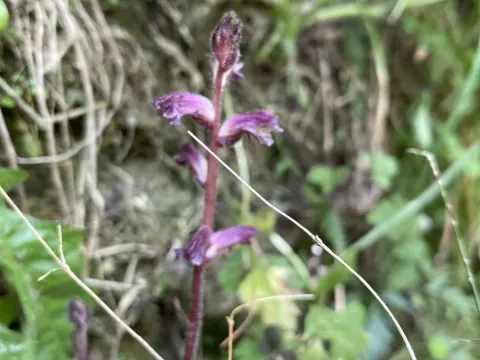
Broomrape
Orobanche
Broomrape (Orobanche) is a genus of parasitic plants belonging to the Orobanchaceae family. These plants are obligate root parasites that lack chlorophyll and do not perform photosynthesis, relying entirely on the vascular system of their hosts for nutrients, water, and carbohydrates.
What the section contains
 Amethyst broomrape
Orobanche amethystea Thuill.
Amethyst broomrape
Orobanche amethystea Thuill.
 Common broomrape
Orobanche minor Sm.
Common broomrape
Orobanche minor Sm.
 Crenate broomrape
Orobanche crenata Forssk.
Crenate broomrape
Orobanche crenata Forssk.
 Hemp broomrape
Orobanche ramosa L.
Hemp broomrape
Orobanche ramosa L.
 Lavender Broomrape
Orobanche lavandulacea Rchb.
Lavender Broomrape
Orobanche lavandulacea Rchb.
 Mutel's broomrape
Orobanche mutelii F. W. Schultz
Mutel's broomrape
Orobanche mutelii F. W. Schultz
 Nodding broomrape
Orobanche cernua Loefl.
Nodding broomrape
Orobanche cernua Loefl.
 Variegated broomrape
Orobanche variegata Wallr.
Variegated broomrape
Orobanche variegata Wallr.
Broomrape
Originating from the Mediterranean and temperate regions, broomrape has spread globally to areas with high cultivation of sunflowers, legumes, and solanaceous crops. It thrives in regions with warm, sunny climates where the soil temperature is sufficient to trigger the germination of its seeds.
Botanically, the plant consists of an underground part with specialized roots known as haustoria. These structures penetrate the roots of the host plant, creating a physiological connection that allows the parasite to hijack the flow of essential sap and suppress the development of the host.
The survival strategy of broomrape relies on the production of thousands of tiny, dust-like seeds. These seeds remain dormant in the soil for over a decade, waiting for the chemical cues (strigolactones) released by host plant roots to initiate germination, making soil management critical.
Agricultural use for this plant does not exist; instead, it is classified as a severe agricultural weed. It is a major limiting factor in crop production, particularly for sunflowers, as it can rapidly evolve into more aggressive races that overcome standard genetic resistance in crops.
The primary threat posed by Orobanche is the significant reduction in crop yield. By diverting energy from the host to its own flower spikes, the parasite causes severe stunting, reduced seed filling, and even plant death in heavily infested fields, leading to economic losses for farmers.
Control strategies for broomrape center on integrated pest management. The primary defense involves using resistant hybrids that possess specific genes to block the attachment of haustoria, effectively starving the parasite before it can emerge from the ground.
Crop rotation is another vital strategy to manage the parasite's seed bank. By alternating susceptible crops with non-host or "trap" crops, farmers can encourage the suicidal germination of broomrape seeds, reducing the soil infestation level over several growing cycles.
Chemical control involving herbicides, particularly imidazolinones, provides effective suppression when applied to crops engineered to tolerate these chemicals. This method has been widely adopted in modern agriculture to manage resistant races of the parasite.
Biological control, such as the use of the fly Phytomyza orobanchia, has been researched extensively. The larvae of this fly feed on the capsules of the broomrape, destroying the seeds and limiting the parasite's reproductive success, which serves as a sustainable management practice.