

Reference · Crops
Viburnum
Viburnum L.
Viburnum is typically planted during the spring or autumn, depending on the climatic zone and the specific plant dormancy phase of the chosen variety.
26
items
What the section contains
 Awabuki Sweet Viburnum
Viburnum odoratissimum Ker Gawl. var. awabuki (K. Koch) Zabel x Viburnum sieboldii Miq.
Awabuki Sweet Viburnum
Viburnum odoratissimum Ker Gawl. var. awabuki (K. Koch) Zabel x Viburnum sieboldii Miq.
 Bodnant Viburnum
Viburnum x bodnantense Aberc. x V. suspensum Lindl.
Bodnant Viburnum
Viburnum x bodnantense Aberc. x V. suspensum Lindl.
 Bracted viburnum
Viburnum bracteatum Rehder
Bracted viburnum
Viburnum bracteatum Rehder
 Burkwood viburnum
Viburnum x burkwoodii Burkwood & Skipwith
Burkwood viburnum
Viburnum x burkwoodii Burkwood & Skipwith
 David viburnum
Viburnum davidii Franch.
David viburnum
Viburnum davidii Franch.
 Guelder rose
Viburnum opulus L.
Guelder rose
Viburnum opulus L.
 Japanese snowball
Viburnum plicatum Thunb.
Japanese snowball
Viburnum plicatum Thunb.
 Koreanspice viburnum
Viburnum carlesii Hemsl.
Koreanspice viburnum
Viburnum carlesii Hemsl.
 Lantanaphyllum viburnum
Viburnum x rhytidophylloides J. V. Suringar
Lantanaphyllum viburnum
Viburnum x rhytidophylloides J. V. Suringar
 Laurustinus
Viburnum tinus L.
Laurustinus
Viburnum tinus L.
 Linden viburnum
Viburnum dilatatum Thunb.
Linden viburnum
Viburnum dilatatum Thunb.
 Luzon viburnum
Viburnum luzonicum Rolfe
Luzon viburnum
Viburnum luzonicum Rolfe
 Sandankwa viburnum
Viburnum suspensum Lindl.
Sargent viburnum
Viburnum opulus L. var. sargentii (Koehne) Takeda
Sandankwa viburnum
Viburnum suspensum Lindl.
Sargent viburnum
Viburnum opulus L. var. sargentii (Koehne) Takeda
 Siebold viburnum
Viburnum sieboldii Miq.
Siebold viburnum
Viburnum sieboldii Miq.
 Smooth witherod
Viburnum nudum L.
Smooth witherod
Viburnum nudum L.
 Southern arrowwood
Viburnum dentatum L.
Sweet viburnum
Viburnum odoratissimum Ker Gawl.
Sweet viburnum
Viburnum odoratissimum Ker Gawl. var. awabuki (K. Koch) Zabel
Viburnum bodnantense Aberconway
Viburnum x bodnantense Aberc.
Viburnum davidii x Viburnum propinquum
Viburnum davidii Franch. x Viburnum propinquum Hemsl.
Southern arrowwood
Viburnum dentatum L.
Sweet viburnum
Viburnum odoratissimum Ker Gawl.
Sweet viburnum
Viburnum odoratissimum Ker Gawl. var. awabuki (K. Koch) Zabel
Viburnum bodnantense Aberconway
Viburnum x bodnantense Aberc.
Viburnum davidii x Viburnum propinquum
Viburnum davidii Franch. x Viburnum propinquum Hemsl.
 Viburnum phlebotrichum
 Siebold & Zucc.
Viburnum phlebotrichum
Viburnum phlebotrichum Siebold & Zucc.
 Viburnum propinquum
 Hemsl.
Viburnum propinquum
Viburnum propinquum Hemsl.
 Wayfaring tree
Viburnum lantana L.
Wayfaring tree
Viburnum lantana L.
 Withe-rod
Viburnum cassinoides L.
Withe-rod
Viburnum cassinoides L.
 Wrinkle-leaved viburnum
Viburnum rhytidophyllum Hemsl.
Wrinkle-leaved viburnum
Viburnum rhytidophyllum Hemsl.
Marketplace
Products in this section · 12


Viburnum
Propagation is mostly achieved through vegetative methods such as hardwood cuttings, layering, or division of mature root systems to maintain genetic stability.
When using container-grown nursery stock, planting can occur throughout the growing season, provided that moisture levels are strictly monitored and maintained.
Commercial plantations require careful spatial arrangement, usually spacing plants 3 to 4 meters apart to ensure sufficient canopy ventilation and mechanical access.
Selection of the planting site should prioritize well-drained but moisture-retentive soils, although the plant demonstrates high adaptability to various light conditions.
Viburnum belongs to the Adoxaceae family and encompasses a wide range of deciduous shrubs widely distributed across the temperate Northern Hemisphere.
The crop thrives best in fertile, loamy soils that maintain consistent moisture levels and have a neutral to slightly acidic pH balance.
It is renowned for its excellent cold hardiness, allowing it to withstand harsh winters without the need for extensive additional protection.
Regular irrigation is essential, especially during dry spells, as water stress significantly reduces both the fruit set and the overall vegetative growth of the bush.
Annual maintenance involves structural pruning to remove dead or overlapping branches, which helps prevent the congestion of the crown and improves fruit quality.
Fruit production is heavily dependent on plant maturity, soil nutrient availability, and the proper application of balanced nitrogen-phosphorus fertilizers.
Economically viable yields generally begin around the fourth or fifth year of growth, with peak production occurring between the age of 10 and 15 years.
An average mature shrub can yield between 5 and 10 kilograms of fruit, though intensive management techniques can significantly enhance these numbers.
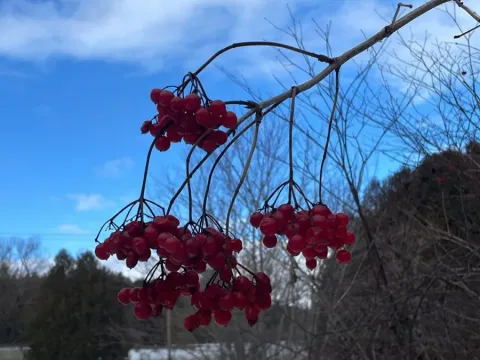
Viburnum berries are highly valued in the pharmaceutical and food industries for their high antioxidant content and use in juices, preserves, and traditional medicines.
The timing of harvest is critical; picking berries after the first frost is recommended to reduce bitterness and improve the sugar-to-acid ratio.
Common agricultural pests affecting the crop include the viburnum leaf beetle, aphids, and various sawfly species that can defoliate the shrub quickly.
Fungal diseases, most notably powdery mildew and various leaf spot pathogens, are prevalent in areas with high humidity and poor airflow.
Integrated Pest Management (IPM) practices, including the removal of infested debris and timely application of insecticides, are vital for crop protection.
Cultural control methods such as proper pruning and maintaining good soil sanitation are fundamental in preventing the spread of spores and pests.
Choosing resistant cultivars is the most effective long-term strategy for minimizing chemical input in commercial viburnum production systems.
Harvesting is performed manually by cutting whole fruit clusters, which prevents mechanical damage and juice leakage from the delicate berries.
Storage of the harvested fruit requires well-ventilated containers to prevent mold development and spoilage caused by the high moisture content of the berries.
Blast freezing is a common post-harvest processing method that preserves the vitamin profile and overall nutritional value of the fruit for long-term supply.
Dehydration is another viable processing route, allowing the berries to be used as a stable ingredient in herbal tea blends and dietary supplements.
Efficiency in harvesting relies on careful handling and immediate cooling of the produce to extend shelf life and maintain high market standards.