
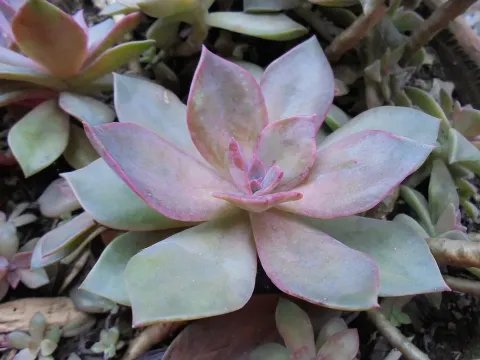
Echeveria
Echeveria
Echeveria is a genus of perennial succulent plants belonging to the Crassulaceae family. Native primarily to Mexico and Central America, these plants are highly adapted to arid, rocky environments through specialized water-storage tissues in their leaves.
What the section contains
 Echeveria amoena
Echeveria amoena
Echeveria amoena
 Echeveria cante
Echeveria cante
Echeveria cante
 Echeveria compressicaulis
Echeveria compressicaulis
Echeveria compressicaulis
 Echeveria cuencaensis
Echeveria cuencaensis
Echeveria cuencaensis
 Echeveria cuspidata
Echeveria cuspidata
Echeveria cuspidata
 Echeveria fulgens
Echeveria fulgens
Echeveria fulgens
 Echeveria globulosa
Echeveria globulosa
Echeveria globulosa
 Echeveria guerrerensis
Echeveria guerrerensis
Echeveria guerrerensis
 Echeveria harmsii
Echeveria harmsii
Echeveria harmsii
 Echeveria hyalina
Echeveria hyalina
Echeveria hyalina
 Echeveria hybrids
Echeveria hybrids
Echeveria hybrids
 Echeveria moranii
Echeveria moranii
Echeveria moranii
 Echeveria nuda
Echeveria nuda
Echeveria nuda
 Echeveria penduliflora
Echeveria procera
Echeveria procera
Echeveria penduliflora
Echeveria penduliflora
Echeveria procera
Echeveria procera
 Echeveria racemosa
Echeveria racemosa
Echeveria racemosa
 Echeveria sonianevadensis
Echeveria sonianevadensis
Echeveria sonianevadensis
 Echeveria subrigida
Echeveria triquiana
Echeveria triquiana
Echeveria subrigida
Echeveria subrigida
Echeveria triquiana
Echeveria triquiana
 Echeveria turgida
Echeveria turgida
Echeveria turgida
 Echeveria violescens
Orange Echeveria
Echeveria aurantiaca
Echeveria violescens
Echeveria violescens
Orange Echeveria
Echeveria aurantiaca
 Painted Lady
Echeveria derenbergii
Painted Lady
Echeveria derenbergii
Echeveria
The core agronomic requirement for Echeveria is high light intensity. Without sufficient exposure to full or bright indirect sunlight, the plants become etiolated, losing their characteristic rosette structure and becoming susceptible to various physiological imbalances.
Soil composition must be highly inorganic and free-draining to prevent root rot, which is the primary cause of crop loss. A mixture of pumice, coarse sand, and a small portion of peat or perlite creates the ideal environment for the root system to breathe.
Temperature control is essential for the plant's dormancy phase. During winter, keeping temperatures between 10 and 12 degrees Celsius encourages healthier growth patterns and improves the success rate of blooming during the subsequent growing season.
Watering techniques must adhere to the soak-and-dry method. It is imperative to avoid getting water into the center of the rosette, as moisture trapped between the leaves can lead to crown rot or fungal colonization of the delicate tissues.
Fungal pathogens such as Rhizoctonia and Pythium are the most dangerous threats to Echeveria. These fungi flourish in overly humid soil conditions and can destroy the plant's root system in a very short period if not addressed.
Mealybugs are the most persistent insect pests affecting Echeveria. They tend to congregate in the tight crevices between leaves, where they extract plant sap and weaken the overall structure of the rosette while secreting honeydew.
To effectively manage mealybug infestations, systemic insecticides or horticultural oils applied directly to the affected areas are recommended. Regular inspection of the plant's center is necessary to detect early stages of colonization before they spread.
Root rot, caused by poor soil drainage or excessive irrigation, manifests as soft, discolored tissue at the base of the stem. Once rot is identified, surgical removal of infected parts followed by propagation of healthy rosettes is the only viable solution.
Providing adequate air circulation around the plants acts as a significant preventive measure against both fungal infections and pest outbreaks. By maintaining low humidity levels, the risk of developing leaf spot diseases and spider mite populations is minimized.