
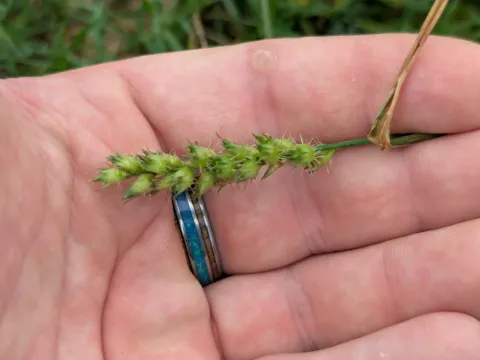
Cenchrus
Cenchrus L.
Cenchrus is a warm-season grass, so planting should occur only after soil temperatures consistently reach at least 15-18 degrees Celsius.
What the section contains
 Buffelgrass
Cenchrus ciliaris L.
Buffelgrass
Cenchrus ciliaris L.
 Cenchrus biflorus
 Roxb.
Cenchrus biflorus
Cenchrus biflorus Roxb.
 Cenchrus caudatus
 (Schrad.) Kuntze
Cenchrus caudatus
Cenchrus caudatus (Schrad.) Kuntze
 Cenchrus elegans
 (Hassk.) Veldkamp
Cenchrus elegans
Cenchrus elegans (Hassk.) Veldkamp
 Cenchrus gracillimus
 Nash
Cenchrus gracillimus
Cenchrus gracillimus Nash
 Cenchrus incertus
 M. A. Curtis
Cenchrus incertus
Cenchrus incertus M. A. Curtis
 Cenchrus longisetus
 M. C. Johnst.
Cenchrus longisetus
Cenchrus longisetus M. C. Johnst.
 Cenchrus pedicellatus
 (Trin.) Morrone
Cenchrus pedicellatus
Cenchrus pedicellatus (Trin.) Morrone
 Cenchrus pennisetiformis
 Hochst. & Steud.
Cenchrus pennisetiformis
Cenchrus pennisetiformis Hochst. & Steud.
 Cenchrus polystachios
 (L.) Morrone subsp. polystachios
Cenchrus polystachios
Cenchrus polystachios (L.) Morrone subsp. polystachios
 Cenchrus purpureus
 x Cenchrus squamulatus
Cenchrus purpureus
Cenchrus purpureus (Schumach.) Morrone
Cenchrus purpureus
Cenchrus purpureus x Cenchrus squamulatus
Cenchrus purpureus
Cenchrus purpureus (Schumach.) Morrone
 Cenchrus setaceus
 (Forssk.) Morrone
Cenchrus setaceus
Cenchrus setaceus (Forssk.) Morrone
 Cenchrus setigerus
 Vahl
Cenchrus setigerus
Cenchrus setigerus Vahl
 Cenchrus setosus
 Sw.
Cenchrus sieberianus
Cenchrus sieberianus (Schltdl.) Verloove
Cenchrus squamulatus
Cenchrus squamulatus (Fresen.) Morrone
Cenchrus setosus
Cenchrus setosus Sw.
Cenchrus sieberianus
Cenchrus sieberianus (Schltdl.) Verloove
Cenchrus squamulatus
Cenchrus squamulatus (Fresen.) Morrone
 Crimson fountaingrass
Cenchrus advena (Wipff & Veldkamp) Morrone
Crimson fountaingrass
Cenchrus advena (Wipff & Veldkamp) Morrone
 Dune sandbur
Cenchrus tribuloides L.
Dune sandbur
Cenchrus tribuloides L.
 Kikuyu grass
Cenchrus clandestinus (Hochst. ex Chiov.) Morrone
Kikuyu grass
Cenchrus clandestinus (Hochst. ex Chiov.) Morrone
 Long-spine sandbur
Cenchrus longispinus (Hack.) Fernald
Long-spine sandbur
Cenchrus longispinus (Hack.) Fernald
 Napier grass
Cenchrus purpurascens Thunb.
Napier grass
Cenchrus purpurascens Thunb.
 Oriental fountain grass
Cenchrus orientalis (Rich.) Morrone
Oriental fountain grass
Cenchrus orientalis (Rich.) Morrone
 Pearl millet
Cenchrus americanus (L.) Morrone
Pearl millet
Cenchrus americanus (L.) Morrone
 Pennisetum flaccidum
Cenchrus flaccidus (Griseb.) Morrone
Pennisetum hybrid
Cenchrus advena (Wipff & Veldkamp) Morrone x C. elegans (Hassk.) Veldkamp
Pennisetum flaccidum
Cenchrus flaccidus (Griseb.) Morrone
Pennisetum hybrid
Cenchrus advena (Wipff & Veldkamp) Morrone x C. elegans (Hassk.) Veldkamp
 Purple Napier grass
Cenchrus purpureus x Cenchrus americanus
Purple Napier grass
Cenchrus purpureus x Cenchrus americanus
 Southern sandbur
Cenchrus echinatus L.
Southern sandbur
Cenchrus echinatus L.
Cenchrus
Proper timing is essential, as early planting into cold soil will cause seed dormancy or rotting, leading to poor and uneven stand establishment.
Seeds are very small and must be placed shallowly in the soil to ensure that emerging shoots have enough energy to reach the surface.
Using specialized seed drills or broadcast sowing followed by light soil compaction provides the necessary seed-to-soil contact for germination.
Depending on the region, planting can be spread out if soil moisture is managed, but it should generally avoid the threat of late-season frosts.
As a member of the Poaceae family, Cenchrus is highly valued for its extreme drought tolerance and ability to thrive in harsh, arid climates.
The plant performs best in sandy or gravelly soils that offer excellent drainage, as it is highly susceptible to root diseases in waterlogged areas.
Full sun is required for optimal photosynthesis and growth; shaded areas significantly reduce biomass production and overall crop vitality.
While hardy, Cenchrus benefits from basic fertilization programs that focus on nitrogen availability during the peak stages of tillering.
It does not tolerate high salinity or extremely acidic conditions, so soil testing prior to planting is recommended to ensure suitable pH levels.
Yield potential is directly linked to climatic conditions, specifically the total amount of sunlight and heat units accumulated during the season.
Frequent harvesting or grazing helps to stimulate new tiller production, which maintains a high supply of fresh forage for grazing livestock.
The nutritive quality is highest in the vegetative stage; delaying harvest beyond the boot stage leads to a drop in protein and fiber digestibility.
Under optimal irrigation regimes, yield levels can increase dramatically, turning Cenchrus into one of the most productive warm-season forage options.
Monitoring the growth rate allows farmers to schedule harvesting at the precise moment when dry matter accumulation peaks for maximum profit.
Cenchrus generally shows high natural resistance to most common cereal diseases, though rust fungi can occasionally appear in humid conditions.
Soil-dwelling insects, such as grubs, can sometimes damage roots, though established stands are usually resilient enough to recover on their own.
Some species of Cenchrus are known as invasive weeds due to their prickly burrs, which require careful management to keep them in cultivated fields.
Integrated pest management strategies should be employed to monitor for any localized outbreaks that could impact the density of the forage stand.
Avoiding overgrazing or over-harvesting protects the root system from stress, which in turn reduces the plant's vulnerability to pathogens.
The most efficient harvest window begins just before the plant enters the reproductive phase, when stems are still tender and nutrient-dense.
Using forage harvesters or swathers, farmers should maintain an appropriate stubble height to ensure the plant can regrow rapidly after cutting.
Rapid dehydration is vital for hay quality, while ensiling is a practical alternative for large-scale operations to preserve the grass's nutritional value.
Storage facilities must be dry and well-ventilated to prevent the growth of molds that could decrease the palatability of the harvested forage.
Consistent harvest management schedules allow for a continuous supply of feed throughout the growing season, maximizing the value of the crop.