
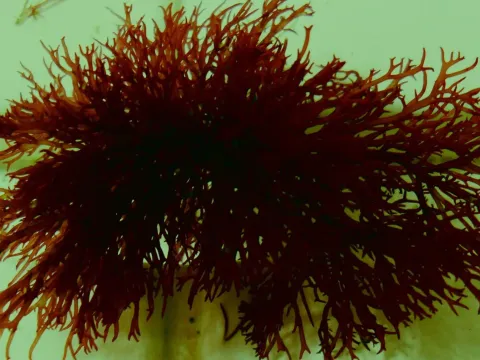
Gracilaria
Gracilaria
Gracilaria is a genus of red marine algae belonging to the Gracilariaceae family. It is typically propagated through vegetative fragmentation, where small pieces of the thallus are secured to artificial substrates.
What the section contains

Gracilaria
The farming cycle begins by attaching these vegetative fragments to ropes, nets, or monofilament lines submerged in coastal waters, ensuring optimal distribution for growth.
Timing the planting phase is essential, as the water temperature must be within a range that supports rapid cell division and expansion of the seaweed biomass.
Initial stocks are often raised in nursery tanks to ensure high health standards before the fragments are moved into open-water farming sites.
Planting density must be carefully managed to avoid overcrowding, which can inhibit light penetration and restrict the flow of essential nutrients around the individual stalks.
Gracilaria requires high-quality water with steady circulation to provide a constant supply of dissolved nutrients and to prevent the accumulation of waste products.
The ideal temperature range for most commercial species is between 20 and 28 degrees Celsius, though many varieties are adaptable to seasonal changes in climate.
Ample sunlight is vital for photosynthesis, meaning that farming sites are generally chosen in shallow, clear coastal zones where light attenuation is minimal.
Nitrogen and phosphorus levels in the water are critical drivers of biomass production, often leading farmers to select nutrient-rich areas or practice integrated multi-trophic aquaculture.
Sheltered locations that are protected from severe wave action and high-energy storms are preferred to maintain the integrity of the farm's underwater structures.
Yield efficiency is determined by the farmer's ability to maintain the farm environment, including regular cleaning of nets and monitoring water chemical levels.
In optimal tropical environments, Gracilaria can have a very rapid growth rate, allowing for multiple harvest cycles per year and consistent economic returns.
Total biomass output per square meter depends on the initial stocking density and the duration of the growing cycle before the harvest is initiated.
Seasonal environmental changes affect the productivity of the crop, with peak growth typically occurring during periods of maximum solar radiation and stable water temperatures.
Advanced farm management, using periodic water sampling and growth measurement, ensures that the yield remains within profitable limits throughout the production season.
The accumulation of epiphytes, which are unwanted smaller algae that grow on the Gracilaria stalks, is a primary threat that competes for sunlight and space.
Marine herbivores, including various species of fish and sea urchins, can cause significant damage to the crop if not properly managed or excluded by protective nets.
Bacterial pathogens can spread rapidly through a farm if water circulation becomes stagnant or if the temperature exceeds the physiological tolerance of the species.
Environmental stressors like extreme salinity changes due to heavy rainfall or water pollution can cause mass mortality events across an entire farming site.
Sedimentation and siltation can smother the seaweed, preventing it from obtaining light and nutrients, ultimately leading to decay and loss of biomass quality.
Harvesting is typically conducted by hauling the growth substrates to the surface and manually or mechanically cutting away the mature portions of the algae.
Sustainable harvesting practices involve leaving behind a portion of the healthy thallus on the lines to allow for natural regeneration and future growth cycles.
Immediately after harvest, the biomass is thoroughly cleaned to remove salt, sand, and small marine organisms trapped within the leafy structure.
Drying is an essential post-harvest process where the seaweed is laid out to dehydrate in the sun, lowering the moisture content to prevent spoilage during transport.
The dried product is then baled and shipped to processing plants, where it undergoes chemical extraction to obtain high-quality agar-agar for the food and science industries.