
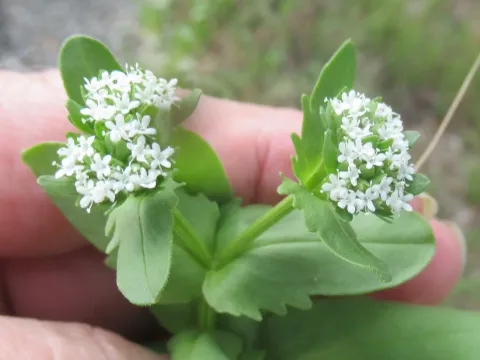
Corn salad
Valerianella
Corn salad, botanically known as Valerianella locusta, is a cold-hardy leafy green that thrives in cooler temperatures, making it ideal for spring and autumn harvests.
What the section contains
 Crown corn salad
Valerianella coronata
Crown corn salad
Valerianella coronata
 Dactyl-leaved corn salad
Valerianella dactylophylla
Dactyl-leaved corn salad
Valerianella dactylophylla
 Eastern corn salad
Valerianella orientalis
Eastern corn salad
Valerianella orientalis
 Narrow-fruited corn salad
Valerianella sclerocarpa
Narrow-fruited corn salad
Valerianella sclerocarpa
 Narrow-fruited corn-salad
Valerianella rimosa
Narrow-fruited corn-salad
Valerianella rimosa
 Ribbed corn salad
Valerianella costata
Ribbed corn salad
Valerianella costata
 Turgid cornsalad
Valerianella turgida
Valerianella boissieri
Valerianella boissieri
Turgid cornsalad
Valerianella turgida
Valerianella boissieri
Valerianella boissieri
 Valerianella carinata
Valerianella carinata
Valerianella carinata
 Valerianella dentata
Valerianella dentata
Valerianella dentata
 Valerianella discoidea
Valerianella discoidea
Valerianella discoidea
 Valerianella echinata
Valerianella echinata
Valerianella echinata
 Valerianella fusiformis
Valerianella fusiformis
Valerianella fusiformis
 Valerianella kotschyi
Valerianella kotschyi
Valerianella kotschyi
 Valerianella lasiocarpa
Valerianella lasiocarpa
Valerianella lasiocarpa
 Valerianella leiocarpa
Valerianella leiocarpa
Valerianella leiocarpa
 Valerianella microcarpa
Valerianella microcarpa
Valerianella microcarpa
 Valerianella muricata
Valerianella muricata
Valerianella muricata
 Valerianella obtusiloba
Valerianella oxyrrhyncha
Valerianella oxyrrhyncha
Valerianella pontica
Valerianella pontica
Valerianella obtusiloba
Valerianella obtusiloba
Valerianella oxyrrhyncha
Valerianella oxyrrhyncha
Valerianella pontica
Valerianella pontica
 Valerianella pumila
Valerianella pumila
Valerianella pumila
 Valerianella radiata
Valerianella radiata
Valerianella radiata
 Valerianella szovitsiana
Valerianella szovitsiana
Valerianella szovitsiana
 Valerianella tuberculata
Valerianella tuberculata
Valerianella tuberculata
 Valerianella uncinata
Valerianella uncinata
Valerianella uncinata
 Valerianella vesicaria
Valerianella vesicaria
Valerianella vesicaria
 Woods' corn salad
Valerianella woodsiana
Woods' corn salad
Valerianella woodsiana
Corn salad
For early spring crops, sow seeds as soon as the soil can be worked, as they germinate well in cool conditions starting from 5–8 degrees Celsius.
Autumn sowings are typically done in late summer to allow the plants to develop strong rosettes before the onset of winter frost.
The seeds should be sown in rows spaced 15–20 cm apart, covered with a thin layer of soil, no deeper than 1 cm to ensure proper emergence.
Succession planting every three weeks is highly recommended to maintain a steady supply of fresh, tender greens throughout the growing season.
This crop belongs to the Caprifoliaceae family and prefers sunny locations, though it can tolerate partial shade, especially in warmer regions.
It performs best in well-drained, fertile soils with a neutral pH, enriched with organic matter to support the rapid development of leafy foliage.
Consistent soil moisture is critical; if the soil dries out, the plants may become bitter or prematurely bolt, leading to a loss in quality.
Regular weeding is essential for corn salad, as its shallow root system struggles to compete with faster-growing weeds for nutrients and moisture.
The plant is remarkably frost-tolerant, often surviving winter temperatures, which allows for early harvest when other crops are just beginning to grow.
Depending on soil fertility and planting density, growers can expect an average yield of 1 to 2 kg of high-quality salad leaves per square meter.
Using row covers or cold frames during late autumn or winter can significantly boost productivity by protecting the rosettes from extreme wind and cold.
A single mature rosette typically weighs between 20 and 50 grams, with premium varieties producing larger, more uniform foliage for easier processing.
Proper plant spacing is vital for yield; crowding the plants reduces air circulation and leads to smaller, less vigorous rosettes that are prone to rot.
With correct management, corn salad provides a reliable and profitable harvest, especially for those targeting local gourmet markets and restaurants.
Powdery mildew is the most common disease affecting corn salad, particularly in humid or poorly ventilated environments where air movement is restricted.
Root rot caused by excess water in the soil can be detrimental, leading to the sudden wilting and collapse of otherwise healthy plant rosettes.
Pests such as slugs and snails are highly attracted to the tender foliage and can destroy significant portions of the crop if not managed timely.
Flea beetles may occasionally cause damage to the leaves during dry spells, leaving small shot-like holes that affect the visual appeal of the harvest.
To minimize threats, implement crop rotation, ensure proper drainage, and avoid overhead watering that keeps the foliage wet for extended periods.
Harvesting is performed by cutting the entire rosette just above the soil surface using a sharp knife, keeping the leaves bunched together for storage.
The best time to harvest is during the early morning hours when the leaves are turgid and fully hydrated, ensuring maximum freshness and shelf life.
Corn salad leaves are delicate and prone to wilting, so it is important to process and cool the harvested product immediately to maintain its quality.
When harvesting, take care to remove any damaged or yellowing leaves to ensure the final product meets market standards for cleanliness and presentation.
Properly handled corn salad can be stored in refrigerated conditions for several days, making it an excellent crop for fresh-market distribution.