

Reference · Crops
Honeysuckle
Lonicera L.
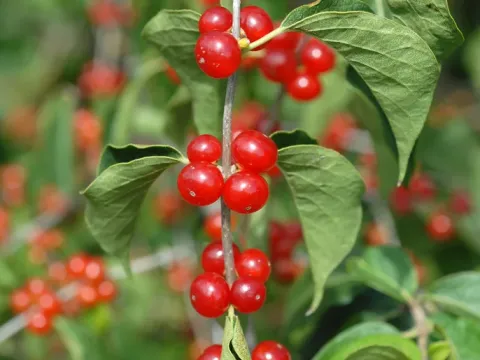
Honeysuckle (lat. Lonicera L.) belongs to the Caprifoliaceae family. While many species are ornamental, edible honeysuckle has become an important agricultural crop known for its early ripening season.
21
items
What the section contains
 Amur honeysuckle
Lonicera maackii (Rupr.) Maxim.
Amur honeysuckle
Lonicera maackii (Rupr.) Maxim.
 Bearberry honeysuckle
Lonicera involucrata (Richardson) Banks ex Spreng.
Bearberry honeysuckle
Lonicera involucrata (Richardson) Banks ex Spreng.
 Blue honeysuckle
Lonicera caerulea L.
Blue honeysuckle
Lonicera caerulea L.
 Box-leaved honeysuckle
Lonicera pileata Oliv.
Box-leaved honeysuckle
Lonicera pileata Oliv.
 Brown's honeysuckle
Lonicera x brownii (Regel) Carrière x Lonicera periclymenum
Brown's honeysuckle
Lonicera x brownii (Regel) Carrière
Brown's honeysuckle
Lonicera x brownii (Regel) Carrière x Lonicera periclymenum
Brown's honeysuckle
Lonicera x brownii (Regel) Carrière
 Chinese honeysuckle
Lonicera tragophylla Hemsl.
Chinese honeysuckle
Lonicera tragophylla Hemsl.
 Etruscan honeysuckle
Lonicera etrusca Santi
Etruscan honeysuckle
Lonicera etrusca Santi
 Henry's Honeysuckle
Lonicera acuminata Wall.
Henry's Honeysuckle
Lonicera acuminata Wall.
 Honeysuckle
Lonicera periclymenum L.
Italian honeysuckle
Lonicera x italica Tausch
Honeysuckle
Lonicera periclymenum L.
Italian honeysuckle
Lonicera x italica Tausch
 Japanese honeysuckle
Lonicera japonica Thunb.
Japanese honeysuckle
Lonicera japonica Thunb.
 Lonicera caprifolium
 L.
Notha honeysuckle
Lonicera x notha Zab
Pallas honeysuckle
Lonicera caerulea L. var. edulis Turcz. ex Herder
Pallas honeysuckle
Lonicera caerulea L. var. emphyllocalyx (Maxim.) Nakai
Pallas honeysuckle
Lonicera caerulea L. var. kamtschatica Sevast.
Purpus Honeysuckle
Lonicera x purpusii Rehder
Lonicera caprifolium
Lonicera caprifolium L.
Notha honeysuckle
Lonicera x notha Zab
Pallas honeysuckle
Lonicera caerulea L. var. edulis Turcz. ex Herder
Pallas honeysuckle
Lonicera caerulea L. var. emphyllocalyx (Maxim.) Nakai
Pallas honeysuckle
Lonicera caerulea L. var. kamtschatica Sevast.
Purpus Honeysuckle
Lonicera x purpusii Rehder
 Tartarian honeysuckle
Lonicera tatarica L.
Tartarian honeysuckle
Lonicera tatarica L.
 Trumpet honeysuckle
Lonicera sempervirens L.
Trumpet honeysuckle
Lonicera sempervirens L.
 Wilson's honeysuckle
Lonicera nitida Wils.
Wilson's honeysuckle
Lonicera nitida Wils.
Marketplace
Products in this section · 12


Honeysuckle
The plant thrives in well-drained, fertile soil with a slightly acidic to neutral pH. It prefers sunny locations; however, it can tolerate partial shade, though fruit yield is significantly lower in shaded areas.
One of the most notable traits of Lonicera L. is its exceptional hardiness. It can withstand extreme winter temperatures, often down to -45°C, making it a perfect crop for high-latitude regions.
Adequate soil moisture is critical, especially during the fruit development stage. While the plant likes water, it will not thrive in waterlogged soil, which can lead to root rot and poor plant health.
Cross-pollination is a strict requirement for fertilization. Growers must plant at least two or three different cultivars together to ensure a successful harvest, as the crop is self-sterile.
Yield varies by variety and plant maturity. A mature bush in full production typically yields 2 to 4 kilograms of berries, depending on local climate conditions and soil fertility management.
In commercial orchards, growers aim for consistent spacing and optimized pruning cycles to maintain high fruit density. Modern varieties are now being bred specifically for improved uniformity in ripening.
Common issues include powdery mildew and various leaf spot diseases caused by high humidity. Maintaining proper air circulation through regular pruning is the most effective preventative measure.
Pests like aphids and spider mites can infest the foliage during the growing season. Integrated pest management (IPM) strategies, including biological control, are recommended for maintaining healthy plant stands.
Harvesting usually occurs in early summer. The berries ripen unevenly, which often requires multiple picking passes throughout the season to gather all fruit at the peak of maturity.
Because the berries are highly perishable, post-harvest cooling is essential. The fruit is best handled with care to prevent bruising and is often processed into jams, juices, or frozen immediately after picking.