
Trumpet honeysuckle
Lonicera sempervirens L.
Description
Growing requirements
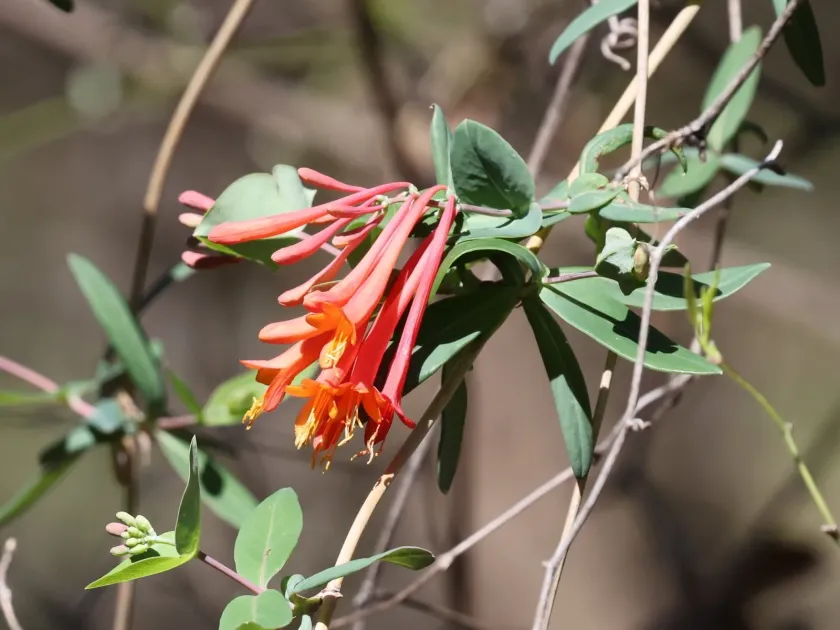
Trumpet honeysuckle (Lonicera sempervirens) is a vigorous climbing vine belonging to the Caprifoliaceae family. Native to the eastern United States, it is widely appreciated for its beautiful trumpet-shaped, coral-red flowers and semi-evergreen foliage.
This plant thrives in full sun, which is essential for maximizing flower production. While it can tolerate partial shade, insufficient light will lead to spindly growth and reduced blooming, significantly impacting its ornamental value.
The ideal soil conditions include fertile, well-draining loam that remains consistently moist. It is adaptable to various soil pH levels, but performs best in slightly acidic to neutral environments. Proper drainage is crucial to prevent root rot.
Cultivation requires regular irrigation during the growing season, particularly during prolonged dry spells. Applying a layer of organic mulch around the base of the plant helps retain soil moisture and suppresses weed growth.
In landscaping, it is used for covering trellises, arbors, and fences. Because of its tubular flowers, it is a primary nectar source for hummingbirds in its native range and attracts numerous pollinators in garden settings.
Main diseases and pests
Aphids are the most common pests affecting Lonicera sempervirens, particularly during the spring when new growth is succulent. These insects can distort leaves and stunt plant development if not treated with suitable insecticides.
Powdery mildew is a prevalent fungal disease that appears as a white, dusty coating on the leaves. It usually develops when humidity is high and airflow is poor, necessitating improved spacing and pruning for better circulation.
Leaf spot diseases can also occur, causing brown or black lesions on the foliage. These are best managed by cleaning up fallen infected leaves and applying fungicides if the infection becomes widespread or severe.
Scale insects may colonize the stems, feeding on the plant's sap and weakening the vine. Early detection is vital for control, and horticultural oils or systemic treatments are typically effective for management.
Root rot, caused by various pathogens like Phytophthora, is a significant risk in waterlogged soils. Ensuring excellent drainage at the time of planting is the most effective preventative measure against these lethal diseases.