
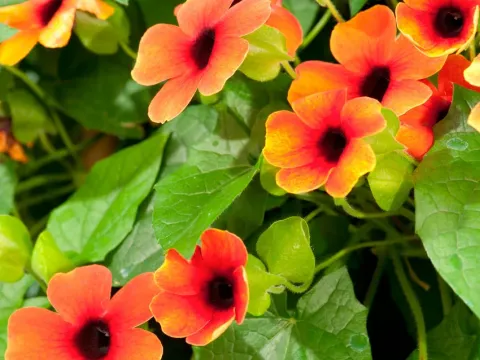
Thunbergia
Thunbergia
Thunbergia belongs to the Acanthaceae family and encompasses a variety of fast-growing herbaceous vines and shrubs. It is widely cultivated for its ornamental value, characterized by its trumpet-shaped flowers and dense foliage.
What the section contains
 Annual thunbergia
Thunbergia annua
Annual thunbergia
Thunbergia annua
 Mysore trumpet vine
Thunbergia mysorensis
Mysore trumpet vine
Thunbergia mysorensis
 Natal clockvine
Thunbergia natalensis
Natal clockvine
Thunbergia natalensis
 Scarlet Clockvine
Thunbergia coccinea
Scarlet Clockvine
Thunbergia coccinea
 Thunbergia atriplicifolia
Thunbergia atriplicifolia
Thunbergia atriplicifolia
 Thunbergia battiscombei
Thunbergia battiscombei
Thunbergia battiscombei
 Thunbergia gregorii
Thunbergia gregorii
Thunbergia gregorii
 Thunbergia hybrid
s
Thunbergia hybrid
Thunbergia hybrids
 Thunbergia kirkii
Thunbergia kirkii
Thunbergia kirkii
 Thunbergia laevis
Thunbergia laevis
Thunbergia laevis
 Thunbergia laurifolia
Thunbergia togoensis
Thunbergia togoensis
Thunbergia laurifolia
Thunbergia laurifolia
Thunbergia togoensis
Thunbergia togoensis
 Thunbergia vogeliana
Thunbergia vogeliana
Thunbergia vogeliana
Thunbergia
Seeds should be sown indoors in late winter or early spring to ensure the plants have sufficient time to develop before being transplanted outdoors. A light, well-draining seed-starting mix is essential for optimal germination rates.
Maintain a constant temperature between 20°C and 22°C to encourage sprout development. Once the seedlings have reached a manageable size and developed true leaves, they should be transplanted into individual pots to avoid root crowding.
Pinching the growing tips of the young plants is a vital practice. This technique encourages lateral branching, leading to a bushier, more vigorous plant that will produce a larger number of blooms throughout the season.
Acclimatization of the plants to outdoor conditions is necessary before final planting. This process, known as hardening off, should be done gradually over a week to prevent transplant shock in the young vines.
This crop thrives in sunny locations but requires protection from harsh midday sun in extremely hot climates. The vines need a sturdy trellis, wire, or fence to support their rapid upward growth and reach their full potential.
Soil quality is paramount; Thunbergia prefers fertile, well-drained loamy soil. If the soil is too heavy or waterlogged, it can lead to root diseases, which will significantly impede the plant's growth and flowering capacity.
Consistent moisture is required throughout the growing season. While the soil should be kept damp, it is important to avoid water stagnation, as the roots are sensitive to anaerobic conditions caused by overwatering.
Fertilizing with a balanced liquid fertilizer every two weeks during the active blooming period will provide the necessary nutrients for sustained growth. High-potassium formulas are particularly effective for encouraging flower production.
In cooler climates, Thunbergia is often grown in containers on patios or balconies. This allows for easier movement of the plant if the weather becomes unsuitable or if it needs to be sheltered from strong winds.
The primary pests affecting Thunbergia are spider mites, whiteflies, and aphids. These insects thrive in warm, dry environments and can quickly infest the undersides of the leaves if conditions are not monitored.
Management of pest populations requires integrated pest management (IPM) strategies, including the use of neem oil or insecticidal soaps. Consistent monitoring and early intervention are key to preventing a widespread infestation.
Fungal issues, such as powdery mildew, may occur if there is insufficient air circulation around the vines. Ensuring that the plants are not overcrowded helps significantly in reducing the incidence of these diseases.
Root rot is a common threat caused by poor drainage. To prevent this, ensure that containers have adequate drainage holes and that the soil mix is amended with perlite or coarse sand for improved aeration.
Sanitation practices, such as removing dead leaves and debris from the base of the plant, reduce the habitat for pathogens and pests, thereby maintaining a healthier environment for the growth of the vine.